
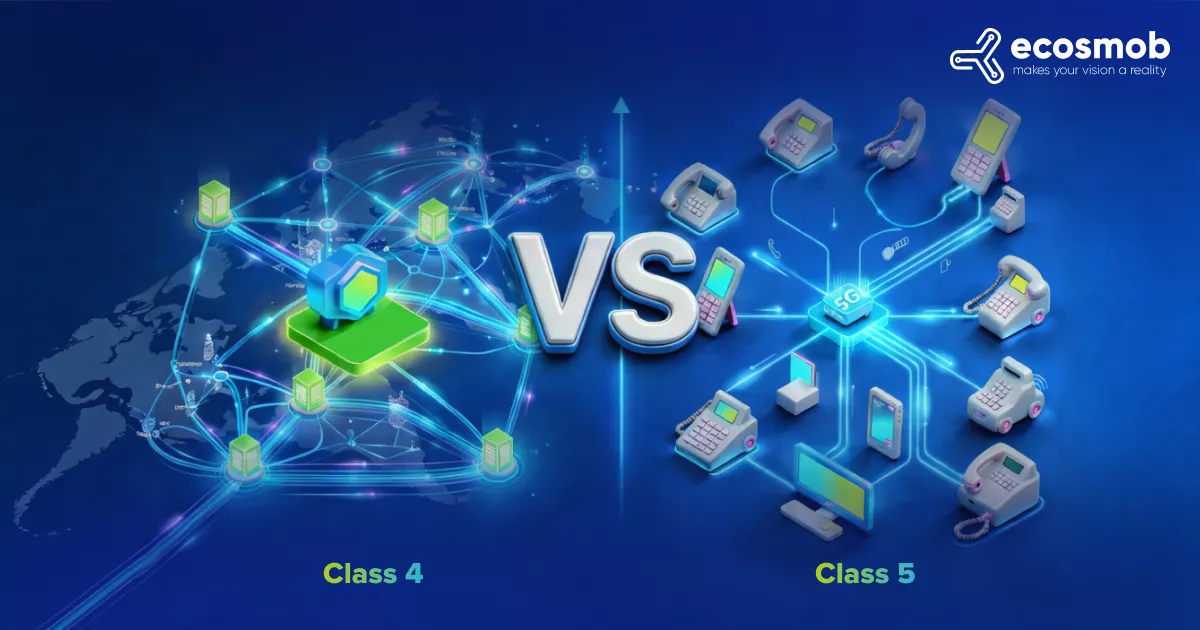
In the global telecommunications infrastructure, the distinction between class 4 and class 5 Softswitches is the difference between high-volume transit and high-value service delivery.
For service providers, selecting the right class 4 and class 5 softswitch solution goes far beyond a simple technical consideration; it dictates network scalability, operational costs, and the ability to protect profit margins.
The Class 4 switch represents the high-velocity core, a specialized engine designed for the lean, rapid movement of traffic across global carrier boundaries. Its priority is not the individual user, but the optimization of the route itself. In contrast, the Class 5 softswitch functions as the intelligence at the edge. It is the primary interface for the end user, managing the complex logic for subscriber profiles, authentication, and localized features.
With a clear picture of softswitch types in place, it’s time to go beyond the basics and examine what truly sets Class 4 and Class 5 softswitch apart from one another. A clear understanding of the fundamental differences between these two softswitch and their key points helps you pick the right softswitch solutions for your business.
Market Insight:
The softswitch market is witnessing significant momentum, with its valuation projected to rise from $7.17 billion in 2025 to $7.81 billion in 2026. This trajectory represents a healthy compound annual growth rate (CAGR) of 8.9%..
What Is Softswitch?
A softswitch, short for software switch, is a call-control solution that manages voice traffic over IP-based networks entirely in software, rather than relying on traditional physical hardware such as circuit-switched exchanges.
In conventional telephony, call routing required bulky, expensive hardware installed in central offices. A softswitch replaces that physical infrastructure with intelligent software running on standard servers, giving telecom operators the flexibility to handle, route, and manage large volumes of calls without being tied to proprietary hardware.
At its core, a softswitch acts as the brain of a VoIP network. It handles signaling, deciding where a call goes, how it connects, and when it ends, while keeping the actual voice data flowing separately through media gateways. This separation of signaling and media transmission is what makes softswitch architecture both efficient and highly scalable.
Drawing from the foundational structure of Public Switched Telephone Networks (PSTN), VoIP softswitches are divided into two distinct categories:
- Class 4 Softswitches
- Class 5 Softswitches
Each category is built to address a specific side of the telecommunications industry. Class 4 operates at the wholesale level, managing bulk call traffic between carriers, while Class 5 functions on the retail side, delivering direct services to end users, including businesses and enterprises. Despite being among the most frequently referenced terms in VoIP-based communication solutions, the distinction between Class 4 Softswitches and Class 5 Softswitches remains a source of confusion for many in the industry.
What Is Class 4 Softswitch?
A Class 4 softswitch is a carrier-grade call routing engine designed to handle massive volumes of VoIP traffic between networks, quickly, reliably, and at the lowest possible cost per call.
Unlike systems built for end users, Class 4 operates entirely at the wholesale/transit level. It sits between originating and terminating carriers, acting as the central hub that decides how and where each call is routed across interconnected telecom networks. End users never interact with it directly, but every long-distance or international call they make likely passes through one.
What Does a Class 4 Softswitch Actually Do?
At its most fundamental level, a Class 4 softswitch performs three critical jobs:
- Receives large volumes of incoming calls from originating carriers or gateways.
- Evaluates each call based on routing rules, cost tables, and quality parameters.
- Forwards the call to the most optimal termination point, instantly.
This process happens in milliseconds, across thousands of simultaneous calls, without any drop in quality or reliability.
For those looking to understand how Class 4 Softswitches enhance long-distance call management, routing efficiency, and network scalability, this comprehensive guide is worth exploring. It explains how VoIP service providers can leverage Class 4 capabilities to streamline operations and reduce overall costs, making it an essential read for anyone looking to scale their telecom infrastructure.
Core Capabilities of a Class 4 Softswitch
A class 4 softswitch is the backbone of wholesale VoIP, designed to sit at the intersection of global networks. Unlike a Class 5 softswitch, which manages individual end-user features, the Class 4 softswitch is a high-speed transit engine.
Modern class 4 softswitch development focuses on four critical pillars that turn a simple connection into a profitable network:
1. High-Velocity Traffic Management
- Scalable Concurrent Calls: Engineered to handle massive volumes of simultaneous sessions with near-zero latency, making it ideal for international carriers.
- Intelligent & Least Cost Routing (LCR): Automatically analyzes termination rates in real-time to pick the most cost-effective path for every call, maximizing profitability.
- Call Detail Records (CDR): Generates real-time logs for auditing and dispute resolution, ensuring transparency in high-volume wholesale environments.
2. Global Interoperability & Transcoding
- Protocol Transcoding & Conversion: Seamlessly bridges the gap between signaling standards such as SIP, H.323, and MGCP, ensuring calls traverse different network types.
- Universal Interconnects: Support various transport protocols, enabling seamless interconnection between global ISPs and international telecom hubs.
3. Security & Automated Billing
- Secure VoIP Traffic Management: Utilizes robust firewalls and encryption to secure VoIP traffic against DDoS attacks, unauthorized access, and costly toll fraud.
- Carrier-Grade Billing: Offers multi-currency billing and automated rate plan management, specifically tailored to the complexities of the wholesale market.
- Proactive Protection: Monitors traffic patterns to detect anomalies, ensuring the network remains a secure environment for VoIP traffic at all times.
4. Operational Efficiency
- Flexible & Simple UI: Provides a customizable dashboard that offers a bird’s-eye view of network health and traffic performance.
- Streamlined Management: Enables “on-the-fly” adjustments to routing rules and real-time monitoring without requiring deep programming expertise.
What Is Class 5 Softswitch?
A class 5 softswitch routes calls between end users or consumers within relatively small areas, such as cities or towns. For international call routing, the Class 5 softswitch forwards traffic to a Class 4 softswitch.
End users can dial into a local class 5 softswitch via calling card services or local IP devices, rather than the traditional PSTN. Usually, the central office of a local telephone company serves end-users through this layer.
Through pinless and calling card functionality, end users can dial into a Class 5 Softswitch locally and take advantage of VoIP services rather than the public switched telephone network. Usually, the local telephone company’s central office directly serves end users. Beyond standard call handling, a Class 5 Softswitch can also direct calls to an end user’s IP address, SIP address, or assigned DID (Direct Inward Dialing) number.
Maximizing ROI with Class 5 Softswitch Capabilities
While a Class 4 softswitch manages the wholesale “pipes,” the Class 5 softswitch is where the service provider interacts with the paying customer.
To move beyond a basic feature list, we must look at how these attributes function within a professional class 4 and class 5 softswitch solution:
1. Intelligent Traffic Orchestration
Instead of static call routing, a modern Class 5 softswitch uses dynamic logic to handle high-pressure environments.
- The Capability: ACD (automatic call distribution) and IVR.
- The Business Impact: By utilizing ACD (automatic call distribution), the system automatically identifies the best available agent for an incoming query. This reduces “dead air” and ensures that residential and business customers receive immediate assistance without the need for a manual operator.
2. Revenue Assurance & Financial Management
A softswitch is only as good as its ability to monetize the traffic it carries.
- The Capability: Integrated VoIP billing systems and real-time CDRs.
- The Business Impact: Modern VoIP billing systems enable providers to transition seamlessly between prepaid, postpaid, and hybrid models. When paired with detailed Call Detail Records (CDRs), businesses can automate invoicing and instantly resolve billing disputes, ensuring steady, transparent cash flow.
3. Network Integrity & Secure VoIP Traffic
In the class 4 vs. class 5 landscape, the Class 5 softswitch is the most frequently targeted by hackers because it stores user account data.
- The Capability: Call Authentication and Encryption.
- The Business Impact: To protect your margins, the softswitch must effectively verify user identities before any session begins. This proactive security layer is the primary defense against toll fraud and unauthorized account access, keeping the network’s reputation intact.
4. Legacy Integration & Quality of Service (quality of service)
For enterprises transitioning to the cloud, the Class 5 softswitch acts as a bridge between the old world and the new.
- The Capability: Analog-to-Digital Conversion and Media Transcoding.
- The Business Impact: This allows businesses to retain their existing hardware while benefiting from modern IP features. By prioritizing voice packets through quality of service, the softswitch ensures that even when the network is congested, the audio remains at a “carrier-grade” standard.
Successful class 4 softswitch development and Class 5 deployment shouldn’t exist in silos. By combining the high-volume transit of the Class 4 with the feature-rich environment of the Class 5, including robust ACD (automatic call distribution) and automated VoIP billing systems, service providers create a scalable, protected, and highly profitable ecosystem.
Class 4 vs Class 5 Softswitch Integration Explained
Think of the Class 5 softswitch as the “Retail Storefront” and the Class 4 softswitch as the “Wholesale Warehouse.” They communicate through a seamless hand-off process:
-
Step 1: The Service Layer (Class 5)
The call starts here. The softswitch handles subscriber authentication, checks credit through VoIP billing systems, and applies features such as ACD (automatic call distribution) for smart routing.
-
Step 2: The Egress Hand-off
Once the local logic is complete, the Class 5 softswitch “hands off” the call to the Class 4 via a SIP trunk for long-distance or international termination.
-
Step 3: The Transit Layer (Class 4)
The Class 4 softswitch ignores user features and focuses entirely on Least Cost Routing (LCR), pushing the call through the most profitable global carrier path.
-
Step 4: The Revenue Loop
After the call ends, the Class 4 softswitch sends the wholesale cost data back to the Class 5 environment to calculate the final retail margin.
In a nutshell, combine Class 4 and Class 5 softswitch capabilities by separating roles within a unified VoIP architecture. The Class 5 softswitch manages subscribers, features, and billing at the service layer, while the Class 4 softswitch handles high-volume routing and carrier interconnects. Integrate both through SIP trunking to ensure seamless call flow. For deployment, use cloud for the Class 5 layer to enable flexibility and faster scaling, and on-premise for Class 4 to maintain performance and cost efficiency at scale. This hybrid approach balances scalability, control, and operational reliability.
What are the Primary Costs of a Class 4 5 Switch Solution?
When budgeting for a class 4 and class 5 softswitch solution, you aren’t just buying software; you are investing in two different types of network performance. A proper Class 4/5 softswitch strategy splits costs between Volume (Class 4) and Features (Class 5).
Class 4 Investment: Capacity and Throughput
For the Class 4 side of your Class 4/5 softswitch infrastructure, the pricing is almost always driven by Concurrent Calls (CC).
- The Pipe Model: You pay for the width of the “pipe.” If you need to handle 5,000 calls simultaneously, your licensing or hardware costs will reflect that raw processing power.
- Protocol Handling: Costs can increase if you require specialized transcoding or complex protocol mediation to connect with older legacy carriers.
Class 5 Investment: Features and User Licenses
The Class 5 side of the Class 4 vs. Class 5 debate is priced based on Capability. Since this softswitch handles the end-user, the costs are tied to the human element.
- Seat-Based Pricing: You typically pay per user or per extension.
- Feature Add-ons: Premium tools like call recording, mobile app integration, and advanced auto-attendants are often priced as modular upgrades.
Deployment Models: CAPEX vs OPEX
The final cost factor is how you host your class 4 5 softswitch setup:
- On-Premise (CAPEX): High upfront costs for hardware and perpetual licenses. This offers long-term savings for massive, established carriers.
- Cloud-Hosted (OPEX): A “pay-as-you-grow” monthly subscription. This is the preferred route for startups and scaling ITSPs seeking to avoid heavy upfront hardware investments.
Choosing between a class 4 and class 5 setup is about aligning your infrastructure with your business goals. Whether you are scaling wholesale transit or expanding retail services, the performance of your Class 4 5 softswitch architecture depends on seamless integration. By deploying a balanced solution of class 4 and class 5 softswitch, you ensure your network remains profitable, scalable, and ready for the global VoIP market.
Which Class 4 and Class 5 Softswitch Solution is Right for Your Business?
In a carrier-grade environment, the class 4 vs class 5 distinction is defined by the OSI layer focus and the signaling complexity. A class 4 softswitch prioritizes packet-per-second (PPS) throughput and protocol mediation, while a class 5 softswitch manages the application layer where complex subscriber logic resides.
The following table breaks down the technical and operational differences that define a complete class 4 and class 5 softswitch solution:
| Technical Parameter | Class 4 Softswitch (Wholesale Core) | Class 5 Softswitch (Retail Edge) |
| Switching Logic | IP-to-IP Peering & Long-distance transit | Subscriber-to-Network Access |
| Call Routing Strategy | Least Cost Routing (LCR) based on prefix, quality (ASR/ACD), and margin. | ACD (automatic call distribution) based on agent state, skill, and IVR input. |
| Protocol Handling | High-level mediation between SIP, H.323, and SIGTRAN. | SIP Endpoint registration, WebRTC gateway, and Analog-to-Digital conversion. |
| Media Handling | Heavy Transcoding (e.g., G.711 to G.729) for bandwidth optimization across carriers. | Codec negotiation for HD Voice (Opus, G.722) and Media Relay (NAT Traversal). |
| Database Architecture | High-speed routing tables and massive “Big Data” CDR processing. | Relational databases for user profiles, permissions, and extension mapping. |
| Billing Integration | Wholesale settlement (O/T/I billing) for carrier interconnects. | VoIP billing systems support per-seat, prepaid, and recurring subscription models. |
| Session Control | Focused on B2BUA (Back-to-Back User Agent) for security and topology hiding. | Focused on Session State for features like Call Park, Pickup, and BLF (Busy Lamp Field). |
Ultimately, the choice isn’t about which softswitch is superior, but how they synchronize to create a robust communication infrastructure. While a class 4 softswitch secures the high-volume transit routes and protects wholesale margins, the class 5 softswitch provides the “last mile” value through advanced features and specialized subscriber management.
For service providers looking to scale, deploying a unified class 4 and class 5 softswitch solution ensures that the network remains as efficient at the global core as it is at the local user endpoint.
In a Nutshell
Modern VoIP success hinges on how well Class 4 and Class 5 softswitch capabilities are orchestrated, rather than selecting one in isolation. A hybrid approach leverages each for its core strength: Class 4 for high-volume routing and cost efficiency, and Class 5 for subscriber management and service delivery.
Aligning this with the right deployment model, typically cloud at the service layer for agility and on-premise at the routing layer for performance, enables better scalability, operational control, and margin optimization.
The result is a resilient, high-performance VoIP architecture built to handle real-world traffic demands while supporting sustainable growth.
Ecosmob Technologies delivers secure, modular softswitch solutions that support both Class 4 and Class 5 requirements, helping providers implement and scale hybrid architectures effectively.
Future-proof your VoIP infrastructure. Contact Us.
Frequently Asked Questions
A Softswitch is a software-based platform that replaces traditional hardware to route telephone calls over the internet. It manages call control, signaling, and media processing across IP networks.
Class 4 serves as a wholesale solution for routing bulk traffic between carriers over long distances. Class 5 serves as a retail solution, connecting end users to the network and providing local features.
A Class 4 Softswitch is necessary for businesses operating as wholesalers or carriers. It excels at high-volume routing, protocol conversion, and finding the most cost-effective paths for long-distance traffic.
A Class 5 Softswitch is essential for service providers offering direct telephony to businesses or residents. It provides the end-user features such as voicemail, auto-attendants, and IP PBX tools.
Class 4 handles wholesale billing, focusing on carrier-to-carrier settlements and bulk traffic rates. Class 5 handles retail billing, managing individual customer invoices, prepaid balances, and monthly subscriptions.