













QUICK SUMMARY
In this blog, you’ll see why voice-only services feel outdated in 2026, how video creates new ways to earn, and what it really takes to add, scale, and secure video calling without overhauling your systems.
Voice-only telephony in 2026 is like a phone without a camera. It still makes calls, sure, but who would actually buy one today? People expect richer, face-to-face ways to connect, and the moment a competitor offers video, your “reliable voice service” suddenly becomes outdated.
Think about it, when was the last time you scheduled an important meeting without video? Probably never. Whether it’s catching a colleague’s body language, showing a patient their scan results, or simply making sure the other person is actually listening, video has become the new normal. Customers expect richer experiences. And competitors who’ve already embraced video are starting to win the game.
So let’s dig into the big questions providers are asking in 2026, and what the answers mean for the future of communication.
Why Does Voice Alone Feel Outdated?
You won’t send texts without emojis. Technically fine, but missing the expression, the nuance, the human touch people now expect. For telephony service providers, this shift is not just a trend. It’s a wake-up call. Voice-only revenues are flat.
- Voice-only calls feel flat, you hear words but miss expressions.
- Voice limits collaboration, no screen sharing, no visual troubleshooting.
- In industries such as healthcare or finance, invisibility feels risky. Trust often requires being seen.
- Employees are already using WhatsApp, FaceTime, and Zoom daily. Why would they settle for outdated enterprise voice systems?
This is why video calling solutions for telephony providers are not optional anymore. They’re the natural next step.
Did You Know?
The first public video call happened on June 30, 1970, between Pittsburgh Mayor Peter Flaherty and Alcoa Chairman John Harper, marking the launch of AT&T’s Picturephone service.
How Video Calling Solutions Create New Revenue Streams for Telephony Providers?
Let’s face it: competing on voice minutes is like competing on who sells cheaper bottled water. Everyone can do it, and margins only shrink.
Video, however, opens up premium services people are willing to pay for.
For instance:
- A hospital uses a secure video line for remote patient consultations. The provider charges for HIPAA-compliant infrastructure.
- A bank runs private video advisory sessions with clients who want face-to-face interactions without leaving home. That’s a premium service.
- A call center integrates video support, so instead of a frustrated customer trying to describe a problem with their new router, the agent can see the blinking red light and solve it in minutes.
These aren’t futuristic ideas. They’re happening right now, and they’re only possible if providers offer video calling solutions for telephony providers that go beyond just “dial tone.”
Voice will always matter, but video transforms providers from utility vendors into experience enablers. And that’s where the money is.
Still relying on voice-only? Let’s explore what you’re missing.
How to Add Video Calling Solutions to SIP, VoIP, or PBX Without Replacing Them?
This is the million-dollar question: “Do we have to tear down everything we’ve built just to add video?”. The good news is, no, you don’t.
Think of your current telephony system like a sturdy old house. You don’t demolish it to add a new kitchen; you renovate and expand. The same goes for adding video; modern solutions enable you to layer video on top of your existing SIP, VoIP, or PBX setup without disrupting your core services.
Here’s how it works in practice:
- API and SDK Integration: Video calling can be added through APIs and SDKs that plug directly into your existing infrastructure, reducing cost and complexity.
- Session Border Controllers (SBCs): SBCs ensure smooth, secure traffic flow between voice and video streams, enabling a seamless transition.
- Interoperability Gateways: These gateways let legacy PBX systems communicate with new video platforms, so you don’t have to rip and replace.
- Cloud-Based Extensions: Providers can add video as a cloud service on top of existing deployments, scaling up only when needed.
Real-world examples:
- A mid-size enterprise with a VoIP-based call center layers video support for escalations, without replacing its core system.
- A regional telco integrates video conferencing on top of legacy PBX, giving clients modern features without downtime.
This is where telephony providers’ video integration becomes critical. Done right, it’s like upgrading from black-and-white TV to HD, without buying a new television.
How Providers Can Scale Video Calling Services Without Losing Quality?
Scaling video isn’t about handling one or two calls. It’s about supporting thousands of users at once without anyone staring at frozen screens.
So, how can providers actually achieve this?
- Adopt Cloud-Native Infrastructure – Cloud-native platforms automatically scale resources during peak hours, so traffic spikes don’t affect performance.
- Implement Bandwidth Management – Prioritize video traffic over less critical data to reduce stuttering, lag, or pixelation.
- Use Adaptive Bitrate Streaming – Video quality adjusts in real time based on network conditions, ensuring every user gets the best possible experience.
- Deploy Global Content Delivery Networks (CDNs) – CDNs bring video streams closer to end users, reducing latency for international teams.
- Continuous Quality Monitoring – Real-time monitoring and AI-driven analytics detect issues before users even notice them.
Example:
A global retailer rolling out weekly video calls across 20 countries doesn’t want IT headaches. With scalable platforms that combine CDNs, adaptive bitrate, and bandwidth controls, they achieve smooth communication regardless of load.
Providers that deliver this kind of reliability move from being “the background pipe” to becoming mission-critical partners.
Curious how video fits into your existing setup? We can walk you through it.
How to Keep Video Calling Communication Secure and Compliant in 2026?
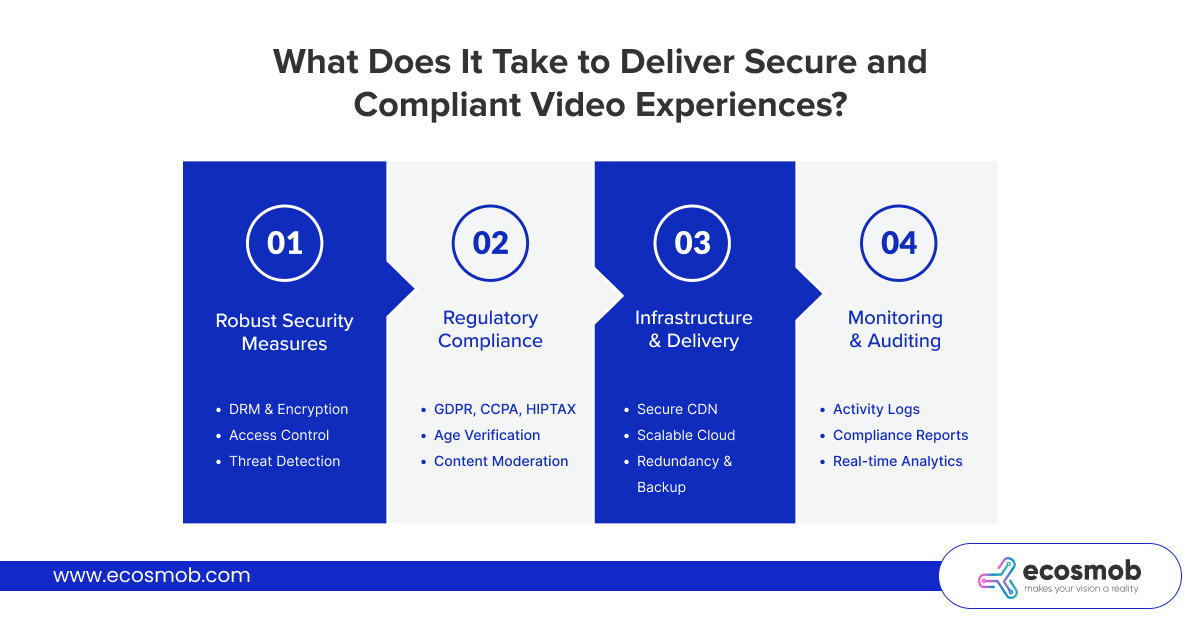
Security is where video moves from a “nice-to-have” to a non-negotiable requirement. Without it, sensitive conversations done via video conferencing in healthcare, finance, or government become easy targets.
What can go wrong?
- A doctor gives a telehealth consultation over an unsecured app → patient records are exposed.
- A bank advisor shares investment strategies on a generic platform → a hacker records the session.
These risks are real, but they can be avoided if providers take the right approach.
- End-to-End Encryption – Every conversation should be encrypted from start to finish. This ensures that even if data is intercepted, it’s unreadable to outsiders.
- Authentication & Access Control – Security starts with knowing who’s on the call. Multi-factor authentication and strict access controls ensure only authorized users can join.
- Compliance Frameworks – Industries like healthcare (HIPAA), finance (PCI-DSS), and global enterprises (GDPR) require providers to follow strict guidelines. Building video solutions with these frameworks in mind isn’t optional; it’s the foundation of trust.
Consumer-grade apps may overlook these safeguards, but enterprises can’t afford to. This is where telephony providers’ video integration becomes more than just a feature; it’s a strategic advantage. Providers who deliver secure, compliant video services position themselves as trusted partners, solving challenges that generic platforms like Zoom or Teams can’t address.
 How Do Telephony Providers Stay Ahead as AI, AR, and VR Redefine Communication?
For telephony providers, staying competitive means weaving AI, AR, and VR into the roadmap, starting with video.
Video isn’t the finish line; it’s the starting block. The real transformation is what comes next.
Already, we’re seeing:
- AI-powered transcription and real-time translation make global meetings searchable and barrier-free.
- Virtual assistants that schedule calls, take notes, and even highlight action points.
- AR tools for field service, imagine an engineer fixing equipment while an expert guides them remotely, drawing instructions right on their screen.
- VR meetings where teams don’t just see each other, but feel like they’re in the same room.
For providers, the takeaway is clear: adopting video today lays the foundation for tomorrow’s innovations. Those who delay risk being locked out of this future entirely.
And it’s not just the enterprise world. Education is evolving rapidly, with schools and universities adopting video conferencing in education to connect students with classrooms, tutors, and peers across the globe. This shift proves video is no longer optional; it’s the bridge to modern, inclusive learning.
If telephony providers do video integration smartly, it doesn’t just add video; it sets up a modular system ready for AI, AR, and VR to plug in when the time is right.
What Happens If You Don’t Adapt to the Change?
There’s always the temptation to say, “Our customers still use voice, we’re fine.” But the real risk isn’t today, it’s tomorrow.
What happens is simple:
- Customers bolt on video with third-party apps.
- Those apps become the hub for all communication.
- The provider? Reduced to being just “the pipe.”
And once you’re just a pipe, the only thing left to compete on is price, which means shrinking revenue, shrinking relevance, and shrinking future.
Not sure if your customers really want video? Let’s look at the data together.
What Are the Biggest Myths About Video Calling Solutions in the Telephony Industry?
When providers consider adding video, a few common concerns always come up. The truth? Most of these are just myths holding them back.
Myth 1: “Video will slow down our network.”
Not really. Modern video calling solutions for telephony providers are designed with bandwidth optimization in mind. With the right setup, video actually runs smoother than many old-school VoIP calls.
Myth 2: “Customers don’t care about video.”
They do. Customers may not ask directly, but the moment they try a competitor who offers telephony providers video integration, they feel the difference. Video is no longer “nice to have”; it’s the baseline for trust and engagement.
Myth 3: “It’s too expensive to add.”
That used to be true, but not in 2026. Providers don’t need to rip out their old systems; video layers neatly on top of SIP, VoIP, and PBX setups. Think of it as upgrading your old phone with a new app, not buying a whole new device.
Myth 4: “Security will always be a problem.”
Only if you cut corners. With end-to-end encryption, compliance frameworks, and authentication, secure video isn’t just possible, it’s standard.
The takeaway? These myths delay providers while competitors keep moving forward. Video is easier, faster, and safer to integrate than most believe.
Checklist for Telephony Providers Before Adding Video Calling Solutions
If you’re a telephony provider considering video integration, here’s a straightforward checklist to guide your next steps:
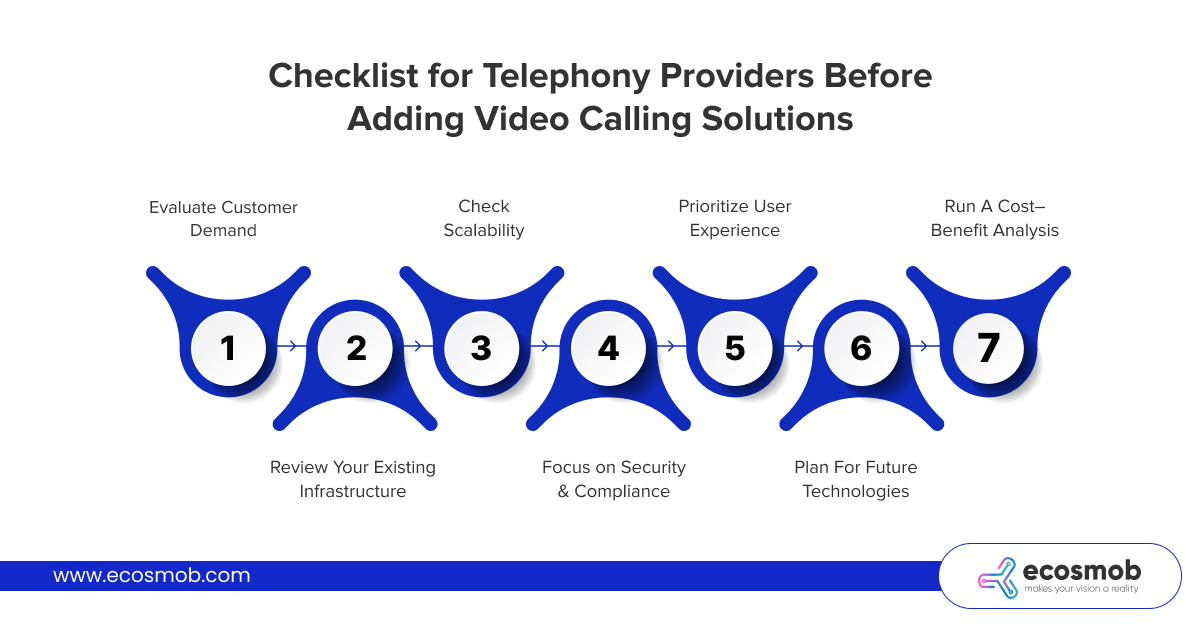
- Evaluate customer demand – Are your clients looking for richer interactions in areas like healthcare, finance, or customer support? If so, the video may already be overdue.
- Review your existing infrastructure – Assess whether your SIP, VoIP, or PBX system can support telephony providers’ video integration without a complete overhaul.
- Check scalability – Make sure your solution can handle thousands of concurrent calls without quality issues.
- Focus on security and compliance – The right video-calling solutions for telephony providers should include encryption and comply with regulations such as HIPAA and GDPR.
- Prioritize user experience – A simple, intuitive interface encourages adoption, while complexity drives users away.
- Plan for future technologies – Select a platform that leaves room for AI, AR, and VR enhancements, so you’re not boxed in later.
- Run a cost–benefit analysis – Compare implementation costs with potential revenue streams unlocked through video services.
If most of these boxes are ticked, your business is ready to move beyond voice and deliver modern, future-ready communication experiences.
What Mistakes Do Telephony Providers Need to Avoid When Adding Video Calling Solutions?
Adding video sounds exciting, but if it’s rushed or done without planning, it can backfire. Here are some of the most common pitfalls providers stumble into:
1. Forgetting About Compliance
Some providers treat video as “just another feature,” but in industries like healthcare or banking, failing to comply with HIPAA or GDPR is a deal-breaker. One slip can cost clients (and reputation).
2. Overcomplicating the Experience
Adding too many bells and whistles often makes the video clunky for end-users. Customers don’t want a maze of buttons; they want one click, and it just works.
3. Ignoring Scalability
Video calls may run smoothly for 50 users, but what happens when 5,000 log in? Not planning for peak demand is one of the fastest ways to lose business clients.
4. Treating Video as an Add-On, Not a Core Service
Some providers see video as “optional.” The reality? Customers now expect it. If it’s not front and center, third-party apps will step in to fill that role.
5. Neglecting Security at Scale
Encryption and authentication matter, but providers often forget about managing permissions, secure recordings, and safe integrations. Small gaps can become big liabilities.
The Fix?
Take a step-by-step approach: start simple, ensure compliance, keep it user-friendly, and scale smartly. Video isn’t just a “feature upgrade”, it’s a shift in how communication is delivered.
Wrapping It Up
Video calling is no longer a trend. It’s the new baseline for communication in 2026.
For telephony providers, the choice is simple:
- Depending solely on voice could limit your margins over time.
- Or embrace video calling solutions for telephony providers, integrate them smoothly into existing infrastructure, and unlock secure, scalable, future-ready services.
The providers who act now will define the future of connectivity. Those who delay risk fading quietly into the background while competitors seize the spotlight.
So ask yourself: in 2026, do you want to be remembered as the provider who kept selling minutes, or the one who enabled meaningful, modern connections with telephony providers’ video integration?
At Ecosmob, we help telephony providers move beyond minutes with powerful video calling solutions and seamless video integration. Partner with us to lead the shift in 2026. Get in touch with us today!
FAQs
Can internet telephony be used for video calls?
Yes. Modern internet telephony (VoIP) platforms support both audio and video. With the right infrastructure and telephony providers, businesses can integrate high-quality video calling into their existing systems without major overhauls.
Are phone calls becoming obsolete?
Traditional voice-only calls are not disappearing completely, but they are losing relevance. Customers increasingly prefer video or unified communication platforms that provide richer, more interactive experiences. Video-calling solutions for telephony providers help them stay competitive.
Are there any free VoIP services?
Yes, there are free VoIP options like Skype, Google Meet, or Zoom’s basic tier. However, these consumer tools often lack the reliability, scalability, and security that enterprises require, making professional-grade solutions the better choice for providers.
What is the most popular VoIP service?
Globally recognized VoIP services include Zoom, Microsoft Teams, and Cisco Webex. But popularity can vary by region and industry. For telephony providers, success lies not in competing directly with these giants, but in offering tailored telephony providers video integration that meets industry-specific needs.
How can telephony providers add video calling to existing systems?
Telephony providers don’t need to replace their SIP, VoIP, or PBX infrastructure to add video. Through APIs, SDKs, and cloud-based extensions, video calling solutions can be layered on top of existing systems. With expert telephony providers' video integration, the transition is seamless, secure, and cost-effective.