












QUICK SUMMARY
Choosing the right Class 4 Softswitch solution involves understanding your concurrent call needs and selecting software designed for scalability, routing, and reliability.
In this blog, you’ll learn how to assess softswitch performance, key differences from Class 5 Softswitch open source platforms, and what makes an open source softswitch effective for wholesale VoIP traffic.
The Class 4 Softswitch solution is one of the most vital elements amongst the wide range of solutions that the vast USD 178.89 billion VoIP market offers.
There are different types of VoIP Softswitches, in which the VoIP Class 4 Softswitch is necessary to traverse the wholesale VoIP call traffic. A trustworthy Class 4 Softswitch solution is thus required for any wholesale VoIP business, whether it already exists or is about to do so. The industry offers a wide range of possibilities for Class 4 Softswitch systems, which makes choosing one extremely challenging.
In this article, we’ll provide some tips that assist you in finding and buying the best Class 4 Softswitch solution based on concurrent calls, which will help you grow your business in this digital era. We’ll also briefly compare Class 4 vs Class 5 Softswitch. But first, let’s understand what concurrent calls are.
Every call matters. Let’s make sure your softswitch handles 10 or 10,000 seamlessly.
What are Concurrent Calls?
The meaning of concurrent calls is pretty simple. Concurrent calls are the total number of active calls occurring at the same time on your VoIP system. This includes calls that are in progress between two parties, calls waiting in a queue, or on hold.
Understanding what concurrent calls are is critical whenever a VoIP business owner is evaluating an open-source softswitch, especially Class 4 Softswitch open source platforms that deal with wholesale traffic. The ability to handle a high number of concurrent calls is one of the most important benchmarks for selecting the right platform.
Let’s see the factors that affect concurrent calls.
Factors Affecting Concurrent Calls
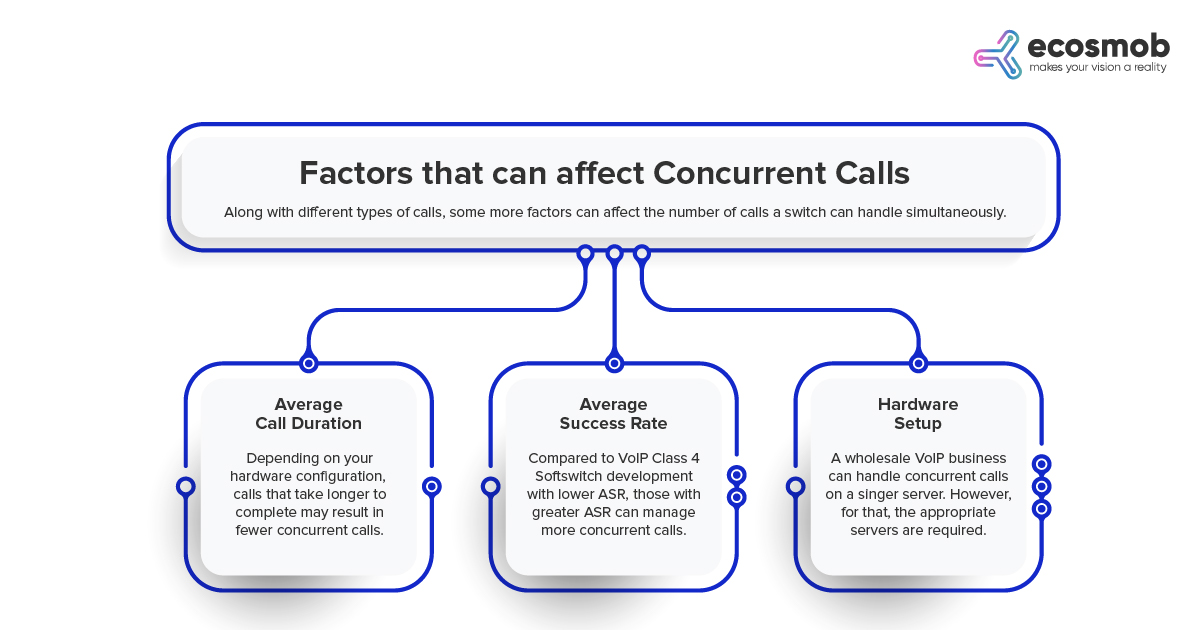
Along with different types of calls, some factors can affect the number of calls a VoIP softswitch can handle simultaneously.
Average Call Duration
Depending on your hardware configuration, calls that take longer to complete may result in fewer concurrent calls.
Longer calls consume more system resources. If your average call duration is high, you’ll handle fewer concurrent calls with the same hardware.
ASR or Average Success Rate
Low ASR can cause more signaling load, leading to less efficient session usage, which may affect effective concurrency under hardware limits.
Class 4 Softswitch solutions with higher ASR are more efficient and may support more concurrent calls by reducing dropped or failed calls.
Hardware setup
A wholesale VoIP business can handle concurrent calls on a single server. However, for that, the appropriate servers are required.
More powerful or clustered servers can support more SIP trunk concurrent calls. Proper optimization of load balancing and failover is essential.
Tips to Buy the Best Class 4 SoftSwitch Solution
Here are some key aspects you need to consider to find and buy the best Class 4 Softswitch solution selected based on concurrent calls:
Check the Feature List
The features of the various Class 4 SoftSwitches depend on the provider. Therefore, evaluating the characteristics offered by the Class 4 Softswitch solution you intend to purchase is crucial. The call routing rules, reporting, remote access, and the integrated billing solution are some of the most essential features.
You must ensure that the call routing rules contain all the rules you will need to manage your business successfully.
Also, check if the open-source softswitch offers robust SIP header management and advanced codec handling, especially if your traffic mix includes international carriers.
Check the Capacity to Handle Concurrent Calls
The number of SIP trunk concurrent calls that a Class 4 switch can handle is not just a performance metric, it’s your business capacity.
Check for maximum SIP concurrent calls and evaluate how performance is affected during peak loads. Some Class 4 Softswitch solutions even offer call session control modules or cluster-based scaling for high concurrency.
Check Scalability
Growth is inevitable in any wholesale VoIP business. Your softswitch solution must grow with your business.
Look for flexible license models (per channel or unlimited), active support for virtualized deployment, and seamless integration with monitoring tools. This ensures your Class 4 Softswitch solution can scale across multiple regions or data centers.
To help you make a better decision, let’s look at the most essential features of Class 4 Softswitch solutions based on concurrent calls.
Features of Class 4 Softswitch for Concurrent Calls
With a wide range of features, Class 4 Softswitch solutions form the backbone of high-volume VoIP routing. Here’s what to look for when evaluating capabilities for handling concurrent calls:
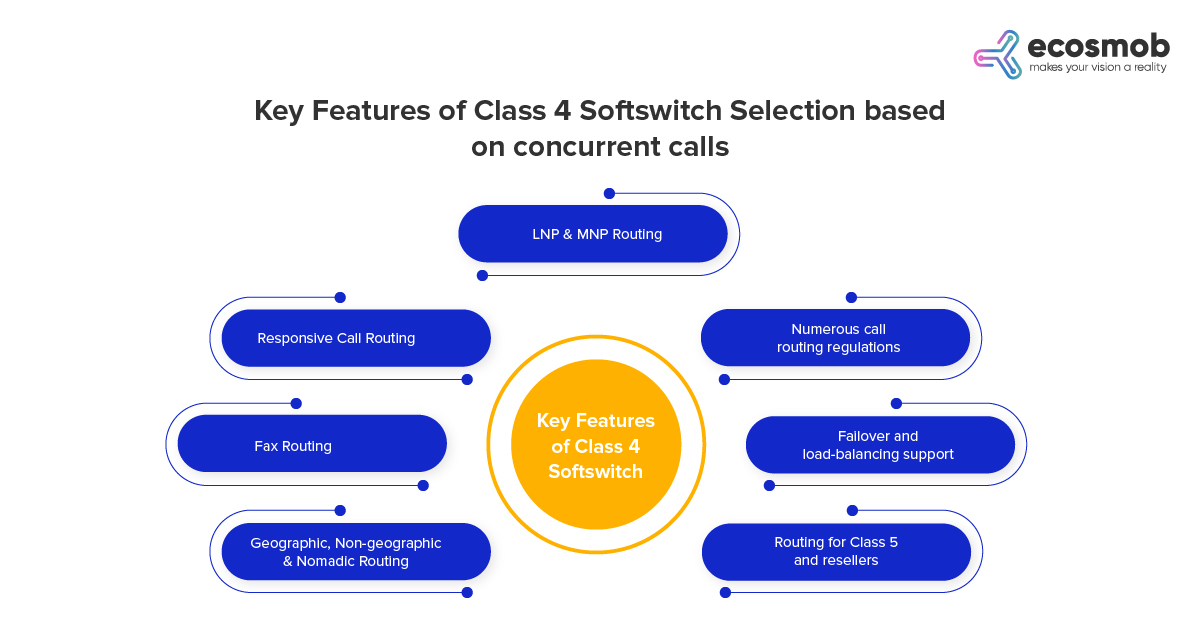
Intelligent Call Routing
The VoIP Class 4 Softswitch is designed to route large volumes of voice traffic efficiently. Intelligent routing reduces latency, avoids congestion, and cuts costs.
Geographic, Non-geographic & Nomadic Routing
Flexible routing options support a variety of number types and portability conditions in your Class 4 Softswitch solution.
LNP & MNP Routing
Local and mobile number portability (LNP/MNP) routing helps make sure that call delivery is compliant and accurate.
Routing for Class 5 and Resellers
The solution supports routing for Class 5 Softswitches and downstream reseller networks.
This allows VoIP providers to manage traffic not just across carrier routes, but also into end-user platforms and multi-tenant reseller environments. Whether you run a small operation or a globally distributed cluster, your softswitch should support hybrid routing models and hierarchical traffic delegation.
Failover and Load-balancing
Two of the most crucial characteristics of a VoIP Class 4 Softswitch solution are load balancing and failover support. These features allow service providers to provide a constant and uninterrupted connection, eliminating the chances of server breakdown or system slowdown. This software switch’s load-balancing capability enables it to manage an enormous burden without degrading service quality or causing a system crash.
And the failover support feature in a Class 4 Softswitch guarantees that the backup system will keep the solution operating smoothly and without any interruptions in the event of a system failure.
Numerous Call Routing Regulations
Class 4 Softswitches come with a wide range of routing methods that impact both cost and quality of service.
Modern systems support intelligent call routing, percentage-based distribution, and codec-aware routing logic. This flexibility allows providers to manage multiple rate cards, enforce policy-based routing, and dynamically reroute traffic during outages or congestion.
Combined with SIP header validation and fraud detection rules, these routing strategies ensure compliance, security, and optimized margins for every call path.
SIP Security and Header Authentication
Support for validating P-Asserted-Identity, Contact, and From headers is now essential to prevent spoofing and SIP-level fraud.
Real-Time Monitoring & Alerting
Live dashboards and threshold-based alert systems help detect call spikes, registration floods, or gateway failures during high concurrency.
REST APIs and Automation Hooks
Open APIs allow providers to automate call routing changes, query SIP sessions, or integrate with CRM/billing systems for real-time control.
Benefits of Class 4 Softswitch Selection Based on Concurrent Calls
A VoIP Class 4 Softswitch built for high concurrent call handling offers various business advantages:
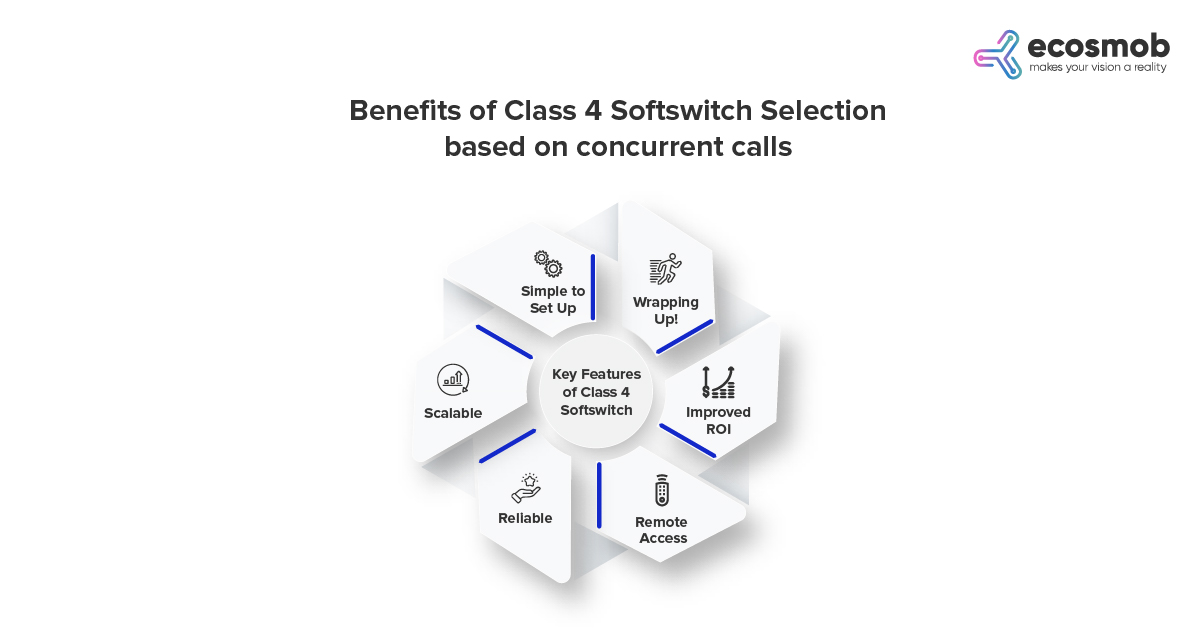
Easy Deployment
The Class 4 Softswitch solution is as simple to set up as it is to use. Software-based systems eliminate the need for bulky hardware. Installation and upgrades are typically seamless.
Scalable
The significant advantage of the Class 4 Softswitch is that businesses can scale up quickly and efficiently to support their growing business requirements. Whether you’re a small carrier handling a few hundred calls or a Tier 1 provider managing tens of thousands of SIP trunk concurrent calls, a scalable architecture ensures long-term value.
Resilient & Reliable
With built-in load balancing and failover, VoIP Class 4 Softswitches maintain uptime and preserve call quality during traffic surges or node failures.
Remote access
Web-based access portals make it easy to configure and monitor Class 4 Softswitch solutions from anywhere.
Improved ROI
A Class 4 Softswitch solution can lower the additional costs for a more substantial ROI. Making administration more comfortable and convenient reduces costs while ensuring the system’s short-term smooth operation.
Lower overhead, better call control, and optimized SIP session routing directly reduce your per-call cost and increase profitability at scale.
What Is the Difference Between Class 4 and Class 5 Softswitch?
Before finalizing your open-source softswitch, it’s essential to understand how Class 4 and Class 5 differ, not just in scope, but in technical capability.
Class 4 softswitch solutions focus on routing high volumes of calls between carriers. They’re optimized for long-distance traffic, concurrent call control, and protocol translation.
Class 5 softswitches are designed for end-user functionalities like voicemail, IVR, call forwarding, and presence.
Here’s a quick breakdown:
| Feature | Class 4 Softswitch | Class 5 Softswitch |
| Main Use | Routes calls between carriers | Connects users within local networks |
| Target Audience | Wholesale VoIP providers | Retail VoIP providers, end-users |
| Features | Routing, transcoding, LNP/MNP, call limits | Voicemail, IVR, call forwarding, caller ID |
| Scale | High-volume call routing | Low-volume, feature-rich calling |
| Protocol Support | SIP, H.323, SS7 | Mostly SIP |
To learn about it in more detail, read the Difference Between Class 4 Softswitch and Class 5 Softswitch.
One of the most overlooked metrics when choosing a VoIP platform is how well it handles concurrent calls. That single factor can make or break your growth as a wholesale provider.
A modern Class 4 Softswitch open source platform with SIP trunk concurrent call support, dynamic routing, and elastic scaling isn’t just a cost-saver; it’s your infrastructure advantage.
Make sure your softswitch isn’t just surviving traffic, it’s designed to thrive under it.
Need help modernizing your Class 4 Softswitch setup for concurrency at scale?
Let’s make your VoIP infrastructure ready for the business growth you’ve been planning for!
Need concurrent call optimization built into your Class 4 Softswitch?
FAQs
What is a Class 4 Softswitch used for?
A Class 4 Softswitch solution routes large volumes of VoIP calls between carriers and manages protocol translation for long-distance traffic.
What is the difference between Class 4 and Class 5 Softswitch?
A Class 4 Softswitch solution is for carrier-to-carrier routing, whereas Class 5 Softswitches are for user features like voicemail, IVR, and local service delivery.
What does concurrent calls mean in VoIP?
Concurrent calls refer to how many SIP calls your system can handle at the same time. This is crucial for wholesale VoIP platforms.
Can open-source softswitches support concurrent calls?
Yes, but performance varies. Look for open source softswitches optimized for SIP session control and concurrency scaling.
What is SIP trunk concurrent call handling?
SIP trunk concurrent call handling means managing multiple calls through a SIP trunk simultaneously, which is key for resellers, call centers, and service providers.