












QUICK SUMMARY
The article below briefs about the latest stats and market impacts of Artificial intelligence, its strategic use cases, and how and why it can be a go-to option for automating your telecom.
AI in telecommunications refers to the application of artificial intelligence technologies — including machine learning, deep learning, natural language processing, generative AI, and agentic AI — to optimize network operations, automate processes, enhance customer experiences, and strengthen security across telecom networks. The AI in telecom market is projected to grow from $3.34 billion (2024) to $58.74 billion by 2032, at a 43.1% CAGR, with 89% of operators increasing AI budgets in 2026.
So, as we know, Artificial Intelligence (AI) is transforming workflows in every sector and unveiling a new dimension of business operations. It has accelerated the pace of digital transformation across every industry, and the telecommunication industry is no exception. But,,,
Do You Know?
What are the Latest AI Telecom Statistics & Market Impact?
The application of AI for telecom was valued at USD 2.36 billion in 2023 and is projected to grow from USD 3.34 billion in 2024 to USD 58.74 billion by 2032, exhibiting a CAGR of 43.1% during the forecast period.
The Cherry on the Cake, 5G, and IoT are amplifying AI’s potential to revolutionize connectivity and unlock more intelligent solutions. As I see it, the future of AI in the telecom industry is only getting brighter.
The telecommunication industry serves as the backbone of business communication worldwide. As growing customer demands put pressure on the sector, implementing AI has enabled it to deliver more intelligent services faster.
Get a Tailored AI Telecom Solution!
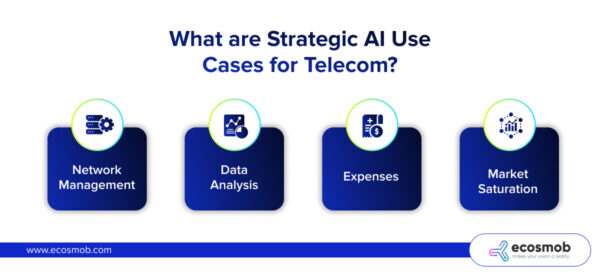
What are Strategic AI Use Cases for Telecom?
 Started a new business and want your business to reach worldwide? No worries! AI has got your back!
Geographical borders no longer bind enterprises. What’s more, global communication traffic has also grown exponentially. In such a scenario, the telecommunication industry has to equip itself with a digital transformation strategy that can overcome the emerging challenges of the current business landscape. Some of the dominant challenges in the telecom industry include –
-
Network Management
As communication networks expand worldwide, it has become difficult to control the complexity of network management. The amount of network equipment is rising, and so is its price. Network management has become expensive and complicated.
-
Data Analysis
Data has become the economy’s fuel, and organizations strive to harness its power in all possible ways. The telecommunication industry has collected large volumes of data. Unfortunately, it is struggling to structure, categorize, and cleanse this data to drive valuable insights.
-
Expense
The telecom industry requires huge investments to equip itself with the right infrastructure, which will help it advance on the road to digitalization. According to a survey, the telecommunication industry’s global operating expenditure is forecasted to increase by billions of dollars, which might push it into a financial crunch.
-
Market Saturation
With multiple reputed players in the telecommunication market, customers are spoilt for choice. Today’s customers have specific demands for business communication, so they will likely switch vendors when their expectations are unmet.
AI is emerging as a critical factor that can help the telecommunication industry overcome these challenges. The application of AI in the telecommunication market provides the capability to optimize and automate network management while reducing operational costs. Therefore, most telecommunication companies are racing to gain a competitive edge by adopting AI.
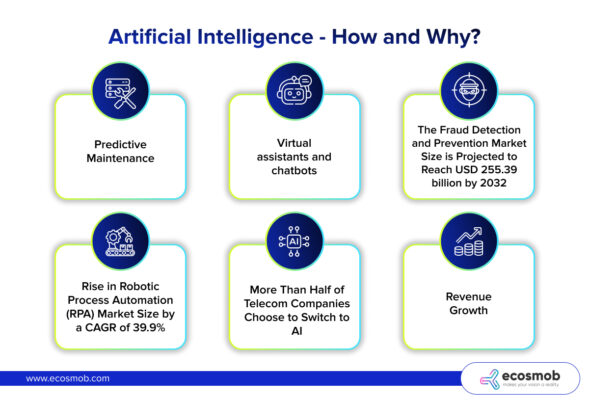
Artificial Intelligence – How and Why?
 Artificial Intelligence is transforming the telecommunications industry, leading to significant business benefits. As a result, more telecom companies are prioritizing investment in AI to tackle various industry challenges. Let’s explore some key areas where AI is making a significant impact.
-
Predictive Maintenance
Telecommunication network expansion is complex, but Artificial Intelligence (AI) and Machine Learning offer solutions mainly through predictive algorithms. By analyzing historical data, companies can identify patterns that forecast hardware failures, allowing for proactive issue resolution and minimizing downtime. This enhances user experience and aids Communication Service Providers (CSPs) gain valuable business insights to improve margins and optimize pricing.
-
Virtual assistants and chatbots
Conversational AI platforms are widely used in telecoms to enhance customer service. They reduce wait times and improve self-service, allowing businesses to handle large customer requests efficiently. Chatbots and virtual assistants provide 24/7 service, making them increasingly popular for boosting ROI. As AI technology advances, chatbots will likely take on more complex customer queries, potentially replacing human operators.
-
The Fraud Detection and Prevention Market Size is Projected to Reach USD 255.39 billion by 2032
As businesses navigate cyberspace, the importance of fraud prevention is becoming clear. Malicious attacks can lead to significant annual losses, with the global fraud detection and prevention market valued at USD 43.97 billion in 2023 and projected to reach USD 255.39 billion by 2032, growing at a CAGR of 21.8%.
The use of Artificial Intelligence in fraud analytics has shown positive results. It allows for the detection of suspicious activities and the immediate blocking of users to prevent fraud. In telecommunications, AI helps filter and block fake profiles and unauthorized access, protecting businesses and minimizing potential attack damage.
-
Rise in Robotic Process Automation (RPA) Market Size by a CAGR of 39.9%
Several industries are adopting AI automation to improve workflow and reduce workload. In telecommunications, manual data entry can lead to errors due to the high volume of data. Robotic Process Automation (RPA) uses AI to enhance data entry, order processing, billing, and other back-office operations, increasing efficiency and accuracy. RPA also automates repetitive tasks, allowing staff to focus on core business functions.
The global robotic process automation market size was valued at USD 2,942.7 million in 2023 and is projected to grow at a compound annual growth rate (CAGR) of 39.9% from 2023 to 2030, with widespread adoption expected in the next five years. RPA can transform cognitive computing across all industries, including telecommunications.
-
More Than Half of Telecom Companies Choose to Switch to AI
As the number of networks grows, the telecommunication industry needs optimization to minimize downtime and maintain communication. Artificial intelligence aids communication service providers (CSPs) by enabling self-optimizing networks (SONs) that detect and resolve anomalies proactively. This technology significantly enhances network performance, leading many companies to invest in AI for optimization.
According to a Statista report, more than half of global telecommunications firms responding to a 2023 survey invested in machine learning technology, the highest share of any AI-related technology surveyed. Meanwhile, only 30 percent said they were investing in digital twin and/or metaverse technology.
-
Revenue Growth
AI can drive actionable insights in the telecommunications industry by analyzing vast amounts of data from devices, networks, and customer profiles. By predicting customer behavior, businesses can enhance upselling and cross-selling strategies. With real-time data and AI analytics, communication service providers (CSPs) can grow revenue by presenting suitable offers at the right time through appropriate channels. This approach can also boost the average revenue per user (ARPU) and subscriber growth rate.
Real-world Scenarios of AI for Telecom
Here are some real-world examples of businesses leveraging AI in telecom –
- AT&T – Uses AI for predictive maintenance to identify network issues before they impact customers.
- Vodafone – Implements AI-powered chatbots like TOBi for customer support.
- Verizon – Employs AI to detect and prevent network fraud.
- Telefonica – Uses AI in its “Aura” platform to enhance customer interactions.
- China Mobile – Integrates AI for efficient 5G network optimization and traffic management.
How Generative AI is Powering the Present and the Future?
Generative AI is revolutionizing the telecom sector by enabling advanced capabilities such as automated content creation, dynamic customer interactions, and intelligent network management. It powers the present by enhancing customer experiences through AI-driven chatbots, crafting personalized solutions, and enabling real-time problem resolution.
For the future, generative AI holds the potential to design self-optimizing networks, create immersive virtual communication experiences, and facilitate seamless integration with emerging technologies like 6G and the metaverse, driving innovation and redefining connectivity.
The Future of AI in Telecommunication Market and Road Ahead
The future of AI in telecom industry is poised for groundbreaking advancements driven by trends like autonomous networks, hyper-personalized services, and edge AI. Innovations such as AI-powered 6G networks promise ultra-fast connectivity with seamless integration of IoT, AR/VR, and smart city infrastructure. Predictive analytics refine network management, while generative AI revolutionizes customer engagement through tailored, dynamic content.
Additionally, AI’s role in cybersecurity will expand, enabling real-time threat detection and mitigation. As telecom embraces AI-driven automation and innovation, it will redefine global communication and connectivity standards.
See How AI Transforms Telecom Solutions!
FAQs
What is the importance of AI in telecommunication?
AI enhances network efficiency, improves customer experience, enables predictive maintenance, and supports advanced services like 5G and IoT.
What is the future of AI in the telecom industry?
AI will drive automation, enable hyper-personalized services, manage 5G complexities, and play a critical role in emerging technologies like edge computing and autonomous networks.
How does AI reduce telecom costs?
AI minimizes costs by automating repetitive tasks, predicting and preventing equipment failures, optimizing resource allocation, and reducing fraud-related losses.
How does AI improve customer service in telecom?
AI powers chatbots and virtual assistants, which provide 24/7 support, resolve common queries and escalate complex issues to human agents. By analyzing user behavior, AI also enables personalized recommendations.
How does AI support 5G networks?
AI helps manage the complexity of 5G networks by optimizing spectrum allocation, automating network slicing, and ensuring low-latency communication through real-time adjustments.
What is agentic AI in telecom?
Agentic AI refers to AI systems that go beyond prediction and recommendation to autonomously observe, decide, and act within defined guardrails. In telecom, agentic AI powers self-healing networks, automated fault resolution, and real-time traffic optimization with minimal human intervention. NVIDIA's 2026 survey found autonomous networks deliver the highest ROI of any telecom AI use case.
What are the biggest challenges of AI in telecom?
Key challenges include data fragmentation across legacy systems, difficulty integrating AI with existing OSS/BSS infrastructure, a shortage of AI-skilled telecom engineers, high upfront implementation costs, and concerns about AI governance, bias, and regulatory compliance.
What is the difference between generative AI and traditional AI in telecom?
Traditional AI in telecom handles prediction, pattern recognition, and anomaly detection — such as predicting network congestion or detecting fraud. Generative AI creates new content, generates synthetic training data, powers natural-language virtual assistants, and simulates network scenarios for testing.
How does AI help with telecom fraud detection?
AI monitors network activity in real-time, identifying unusual patterns like SIM swap fraud, call spoofing, and unauthorized access. ML models differentiate legitimate behavior from suspicious activity, enabling telecom providers to block fraudulent transactions before damage occurs.
Can small telecom companies afford AI implementation?
Yes. Cloud-based AI services, pre-built AI models, and managed AI solutions from development partners like Ecosmob make AI accessible to mid-size telecom operators without massive upfront infrastructure investment. Starting with targeted use cases like AI-powered IVR or call analytics delivers quick ROI.