
The discussions on customer communications have been very swiftly shifting from ‘Aging PBX Systems vs. Cloud Contact Center Solutions’ to the very fast evolving innovative ways of improving CX.
Every leader has been wondering, “How can I make sure my business doesn’t fall behind as the industry shifts?”
To answer this question, we need to understand the trends the industry currently stands on, in which direction it’s moving, and what the top providers are offering.
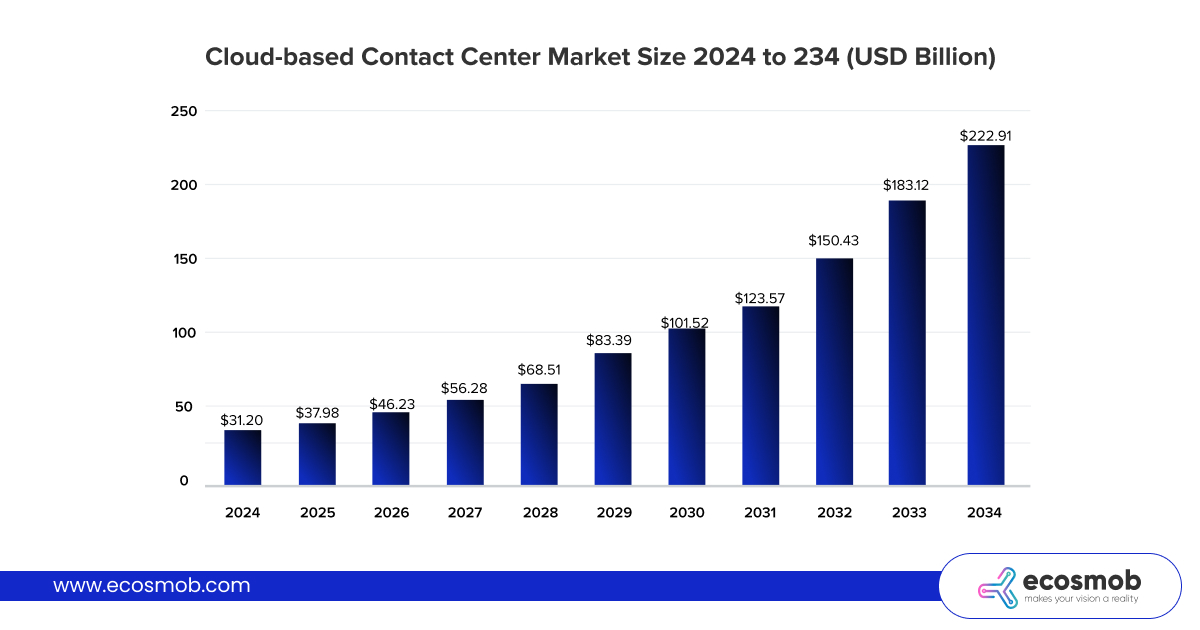
The cloud-based contact center market analysis bluntly tells the story: cloud-based contact center solutions reached $31.20 billion in 2024 and are projected to reach $222.91 billion by 2034. That’s a 21.73% compound annual growth rate driven by businesses that got tired of losing customers to better experiences.
 Your competitors are probably already routing calls based on customer sentiment analysis. Their agents are getting real-time coaching during conversations. And when systems go down, their calls get automatically rerouted to backup centers in different states.
Contact centers have become the front line of customer loyalty, and if you want your customers to come back for more, you need to study the trends enabling that and learn how the top providers are utilizing them.
What Are the Top Cloud Contact Center Trends Shaping 2026?
Several forces are converging to make ‘cloud’ the default choice. What’s pushing enterprises into the cloud isn’t just cost; it’s the much-improved capability. The cloud-based contact center market is evolving faster than ever, and what we’re seeing today is only the beginning of the future of cloud computing in a long-term forecast for enterprise CX transformation.
AI Automation
Forget chatbots that frustrate customers with scripted responses. Modern cloud contact center trends use conversational AI that understands context, learns from conversations, and handles complex queries without making customers want to throw their phones.
Research backs this up: Gartner predicts that by 2026, conversational AI will reduce agent labor costs by $80 billion globally.
What This Delivers
- Real-time sentiment analysis that alerts supervisors when conversations go sideways
- Automatic response generation that sounds human, not robotic
- Predictive routing that connects customers to agents before problems escalate
- Quality monitoring that identifies training opportunities without human review
Most platforms treat AI as a marketing checkbox rather than a core architecture. The difference between AI that helps and AI that annoys comes down to implementation quality and training data. (Remember, these are areas where off-the-shelf solutions can fall short of promises.)
Also, a very attractive number to note: studies show that the early adopters of generative AI were 34% less likely to report overwhelmed agents.
Also Read: AI in Call Centers: Benefits, Use Cases, and Best Practices
Ecosmob Expert Tip
Don’t deploy AI features as isolated add-ons. Train them on your business-specific data (CRM, support history, FAQs) to avoid the “generic bot” problem. This creates AI that reflects your workflows and improves with every customer interaction.
Omnichannel Integration
Your customers start conversations on social media, continue them via email, and expect agents to have full context when they finally call. That’s the new table stakes for customer retention.
According to Zendesk, 73% of consumers want to start conversations on one channel and continue on another without repeating themselves. That’s not a number a business can ignore.
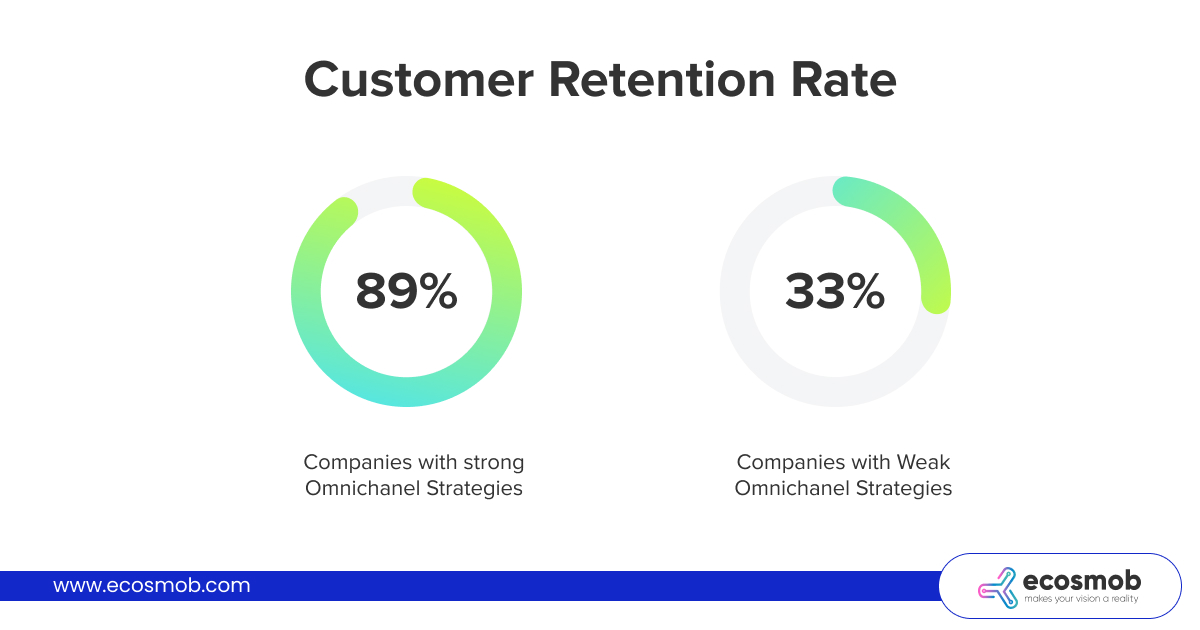
Businesses with solid omnichannel strategies retain 89% of customers versus 33% for weak strategies. So, the revenue impact of getting your omnichannel contact center strategy wrong can be immediate and definitely measurable.
 What This Delivers
- Customer history that follows across every channel and interaction
- Agent dashboards showing complete conversation context regardless of touchpoint
- Seamless handoffs between channels without information loss
- Unified analytics showing customer journey patterns across all touchpoints
True omnichannel requires deep integration with existing CRM systems, custom databases, and third-party tools. Many platforms promise omnichannel but deliver glorified chat widgets that don’t connect meaningfully to your existing customer data.
Real-Time Analytics
Historical reports showing last month’s call volume don’t help when you need to staff for tomorrow’s product launch or handle a sudden spike in support requests. Modern contact centers run on predictive intelligence that anticipates problems before they happen.
What This Delivers
- Predictive staffing models that forecast call volume based on marketing campaigns, weather, and historical patterns
- Real-time queue management that redistributes calls based on agent skills and current workload
- Customer risk scoring that prioritizes high-value customers before they become frustrated
- Performance alerts that identify training opportunities during calls, not weeks later
Real-time analytics requires serious computational power and sophisticated data integration. Many platforms may offer real-time dashboards, but struggle with the backend processing needed for truly predictive insights.
Autonomous Conversational Agents Replace Basic Automation
We’re moving past rule-based chatbots that frustrate customers with rigid decision trees. Autonomous conversational agents handle complex, multi-step processes that previously required human intervention.
What This Delivers
- Complex troubleshooting processes handled entirely through conversation
- Account changes and service modifications completed without agent transfer
- Multi-step problem resolution spanning multiple systems and databases
- Learning from every interaction to improve future responses
Autonomous agents require extensive training on company-specific processes, access to multiple backend systems, and sophisticated conversation management. Most platforms offer basic chatbot functionality but struggle with truly autonomous problem-solving.
Voice AI and Visual Support Integration
Contact centers are expanding beyond traditional voice calls to include screen sharing, AR assistance, and video troubleshooting.
What This Delivers
- Screen sharing that lets agents see exactly what customers are experiencing
- AR overlays that guide customers through complex procedures using their phone cameras
- Video troubleshooting for technical support scenarios
- Visual IVR systems that use images and videos instead of audio menus
These emerging capabilities reflect the future of cloud computing, a long-term forecast in which visual, voice, and AI converge for deeper customer engagement.
Hyper-Personalization Using Customer Data Intelligence
Cloud contact center solutions are beginning to deliver individualized experiences based on real-time customer data analysis, purchase history, sentiment patterns, and behavioral predictions. This goes far beyond “Welcome back, John” to predicting why customers are calling and presenting solutions before they ask.
What This Delivers
- Predictive issue identification based on customer usage patterns
- Dynamic IVR menus that adapt based on customer history and current context
- Proactive outreach for customers showing signs of dissatisfaction
- Personalized support resources such as short explainer content or video animations, tailored to a customer’s product usage or issue history
Hyper-personalization requires integration with multiple data sources, real-time processing capabilities, and sophisticated analytics engines. Many platforms struggle with the data integration complexity needed for truly personalized experiences.
Making the Cloud vs. Hybrid Contact Center Solution Decision
The question isn’t really whether cloud contact centers are the future, because they already are. The real question is whether your business should go all-in on cloud or take a hybrid approach that keeps some functions on-premises.
The hybrid contact center approach combines cloud flexibility with on-premises control, but it comes with complexity costs that many businesses underestimate.
You’re essentially managing two infrastructures with specialized IT expertise requirements, consistent security policies across platforms, and potential latency issues when data moves between systems.
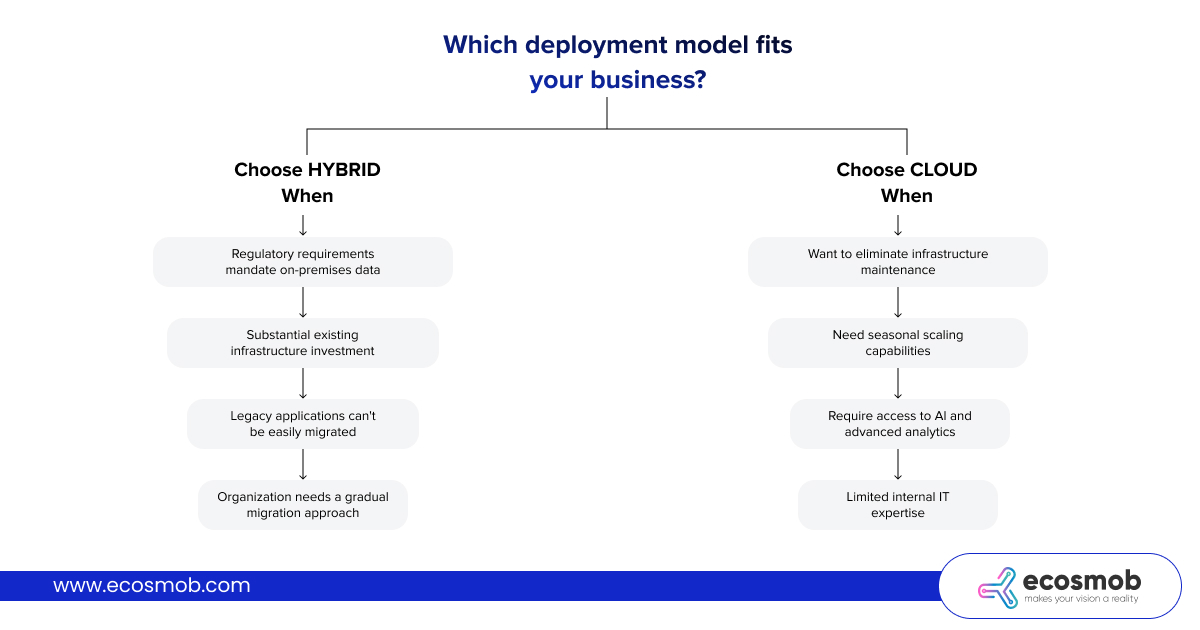
Here’s a simple framework for making this decision:
When to choose Cloud vs Hybrid Contact Center deployment?
How are Top Cloud Contact Center Providers Shaping the Market?
Looking at how market players approach cloud-based contact center solutions reveals both successful strategies and notable limitations that create opportunities for alternative approaches.
Each demonstrates why understanding the cloud-based contact center market size is essential before committing to a platform. Let’s dive in:
Avaya | Modernizing Through AI
Avaya positions itself as the go-to solution for large enterprises that need sophisticated compliance capabilities and integration with existing infrastructure. Their strength lies in handling complex organizational requirements that smaller platforms can’t accommodate.
Their approach focuses heavily on AI-powered real-time agent assistance, sentiment analysis, comprehensive quality monitoring systems, and speech analytics that integrate with knowledge management platforms.
What makes them stand out is their ability to maintain consistent omnichannel experiences across distributed agent locations (something critical for large organizations with multiple call centers).
Where Avaya Excels
- Deep integration with existing enterprise infrastructure
- Sophisticated compliance and security frameworks
- Multi-location consistency and management capabilities
- Advanced speech analytics and quality monitoring
Where You May Be Held Back
- Complex implementation requiring specialized expertise
- High total cost of ownership for mid-market companies
- Limited flexibility for custom workflows outside standard enterprise patterns
- Dependency on Avaya’s roadmap for new feature development
Five9 | Integration and Reliability at Scale
Five9 stands out because of the way it offers deep integration with Salesforce, advanced AI-driven dialing strategies, and a platform designed for efficiency at scale. What sets it apart technically is its approach to reliability.
Their technical architecture eliminates single points of failure through geographic redundancy across multiple data centers, with carrier redundancy spanning 18 domestic long-distance providers. This infrastructure approach means better uptime and faster disaster recovery than platforms cobbled together from acquired technologies.
Where Five9 Excels
- True cloud-native architecture with superior disaster recovery
- Comprehensive Salesforce ecosystem integration
- Scalable infrastructure designed for high-volume operations
- Rapid deployment capabilities for growing organizations
Where You May Be Held Back
- Limited customization options for unique business processes
- Salesforce integration dependency can create vendor lock-in concerns
- Per-seat pricing model becomes expensive as organizations scale
- Standard feature set may not address industry-specific requirements
Nextiva’s | Unified by Design
Nextiva takes a different approach by attempting to unify voice, chat, SMS, CRM, and AI workflows into a single unified communication platform.
Their technical infrastructure spans 8 data centers across the United States with 90-second disaster recovery capabilities and 99.99% uptime guarantees. The unified platform approach eliminates many integration headaches that plague multi-vendor contact center implementations.
Where Nextiva Excels
- Unified platform reducing integration complexity
- Strong disaster recovery and uptime guarantees
- Designed for rapid business growth and scaling
- Comprehensive feature set in a single platform
Where You May Be Held Back
- Jack-of-all-trades approach may sacrifice depth for breadth
- Limited ability to replace platform components with specialized alternatives
- Unified platform creates a single point of failure for all communication channels
- Customization options constrained by platform architecture decisions
Key Limitations of the Cloud-Based Contact Center Market
Every major provider excels at delivering standardized cloud contact center solutions. But “standardized” is precisely where businesses with unique requirements hit walls. And many businesses report never even using most of the cloud-based contact center market trends on standard platforms.
The gaps in off-the-shelf solutions become clear when you need:
- Industry-specific compliance workflows that go beyond standard PCI DSS or HIPAA requirements
- Complex integration scenarios with legacy ERP systems that weren’t designed for modern APIs
- Custom routing logic based on business rules that don’t fit standard skill-based routing
- Proprietary data sources that need real-time integration for personalized customer experiences
This is why businesses are turning to custom contact center development.
Custom solutions excel when you need:
- Seamless integration with existing CRM, ERP, and database systems without data duplication
- Industry-specific features like healthcare appointment scheduling or financial services compliance workflows
- Scalability that matches your growth patterns rather than standard seat-based pricing tiers
- Complete control over data and system modifications without vendor dependencies
And this is precisely why we’re so passionate about building our contact center development practice differently. Instead of forcing your workflows into pre-built boxes, our custom-built platforms are developed around your specific needs.
- Flexible architecture supporting thousands of calls
- Seamless integrations with major CRMs (Microsoft Dynamics 365, Zoho, Salesforce, etc.) and custom enterprise systems
- Built-in disaster recovery with automatic call rerouting
- Full source code ownership for total control
- Industry-specific application of the latest trends
For businesses serious about competitive differentiation through customer experience, the choice is between conforming to standard solutions or building something that gives you an unfair advantage.
The cloud-based contact center market trends toward AI automation, omnichannel complexity, and real-time analytics, but these trends don’t change this fundamental choice. They amplify the importance of making decisions that support your business objectives rather than forcing operational changes to accommodate standard platforms.
Your customers won’t wait for you to catch up. You need a cloud-based contact center solution tailored to your industry, your systems, and your growth.
Let’s design one your competitors can’t copy!
Frequently Asked Questions
AI streamlines repetitive workflows like call routing, data entry, and ticket tagging. It enables faster resolutions, reduces agent workload, and helps maintain consistency across customer interactions, boosting both productivity and service quality.
Common hurdles include legacy infrastructure, lack of integration with CRMs or PBX systems, and agent resistance to change. These can be minimized through phased rollout strategies, robust training programs, and alignment with leadership.
ROI can be tracked through reduced average handle time (AHT), improved CSAT/NPS scores, lower agent attrition, and higher first-contact resolution (FCR) rates. The key is connecting AI outcomes directly to operational cost savings and customer retention.
No. AI enhances, not replaces, human agents. It handles routine Tier-1 tasks, such as FAQs and account lookups, allowing agents to focus on complex, empathy-driven interactions that build stronger customer relationships.
Start small with high-impact use cases such as call summarization or chatbot deployment. Integrate AI with existing CRMs and VoIP systems, measure early results, and expand gradually to ensure smoother adoption and higher ROI.