
A CCaaS AI integration connects machine learning models directly into a contact center platform’s real-time audio plane, signaling layer, event brokers, and CRM systems to automate customer self-service, assist live agents, and orchestrate intelligent omnichannel routing.
The conversation around AI in customer care rarely stalls at the executive level. VPs of Customer Experience and CIOs agree on the goal: deflect routine tier-1 inquiries, assist agents with automated knowledge retrieval, and write clean summaries back into Salesforce or Zendesk.
The initiative hits friction when the engineering team opens the hood of the communications stack.
Most enterprise contact centers are built on years of custom routing logic, third-party carrier contracts, and mixed PBX topologies. Cloud Contact Center as a Service (CCaaS) vendors promote simple, one-click marketplace integrations.
Yet once you attempt to extract raw, unbuffered audio mid-call or push dynamic context back into legacy routing trees, you run into walled-garden APIs, vendor license add-ons, and severe latency bottlenecks.
You do not need to discard your functional contact center to deploy real-time intelligence. Here is the operational architecture required to integrate conversational models into your media and data planes cleanly.
Should You Add AI to Your Existing CCaaS Stack or Move to a Cloud-Native AI Platform?
When planning a CCaaS AI integration, teams face a core strategic dilemma: attach an external, best-of-breed AI layer to their existing communications infrastructure, or migrate entirely to an AI-native CCaaS vendor.
The right choice depends on the complexity of your current telephony footprint and how quickly you need to demonstrate return on investment.
Path 1: The Overlay Integration (Best-of-Breed AI Layer)
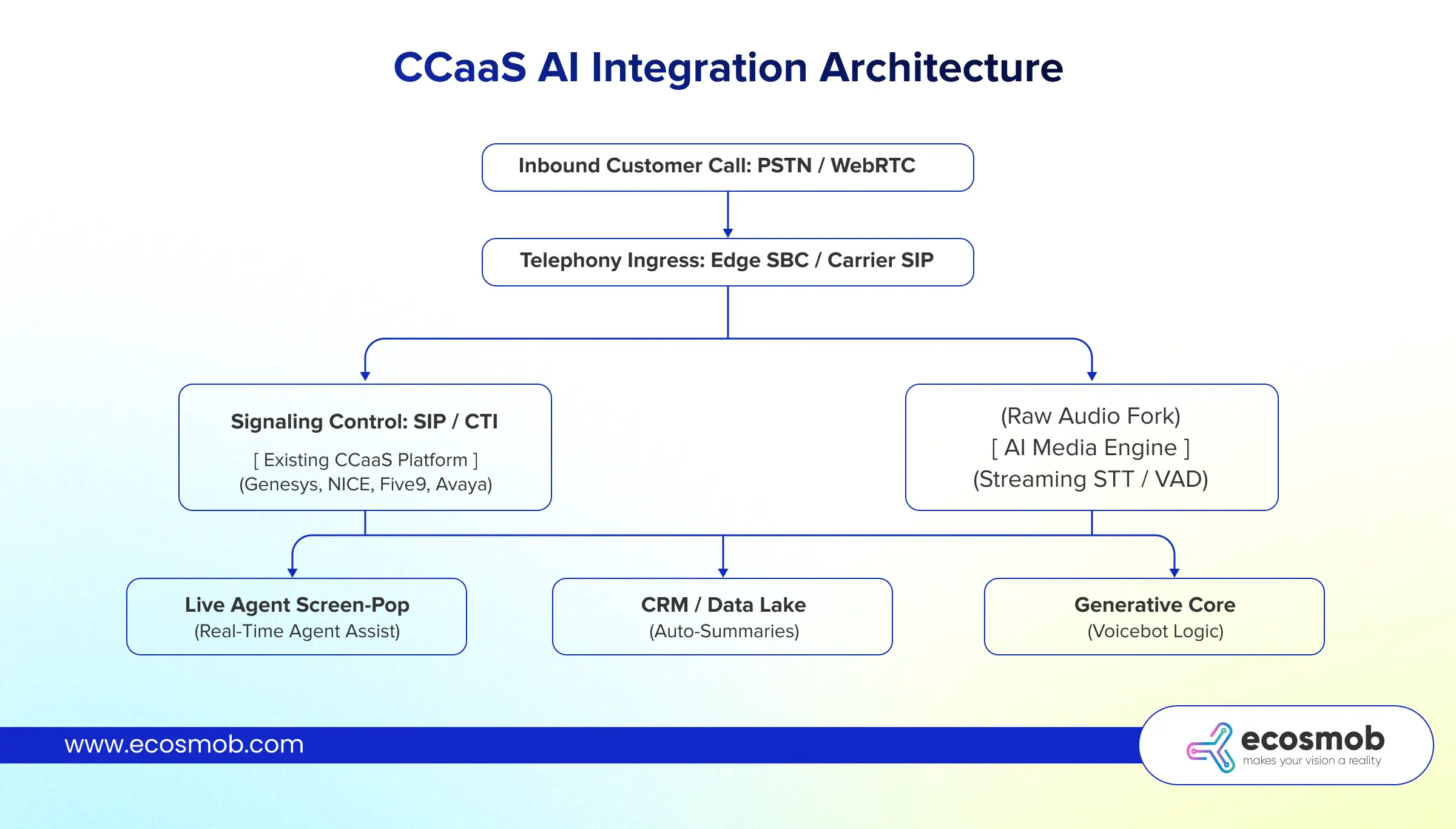
In this pattern, you keep your core CCaaS platform (such as Genesys Cloud, Five9, NICE CXone, or Cisco Webex Contact Center) for ACD routing, workforce management, and agent state tracking. You bolt on external AI engines via real-time media forking (SIPREC or WebSockets) and REST APIs.
- The Advantage: Zero downtime, no disruption to agent workflows, and the freedom to select leading models for speech-to-text, LLM cognition, and voice synthesis rather than accepting vendor-locked proprietary tools.
- The Trade-Off: Requires middleware engineering to synchronize call states, pass contextual data between systems, and ensure audio hand-offs don’t drop metadata.


Path 2: The Full Platform Replacement (AI-First CCaaS)
Here, you would abandon your legacy or traditional cloud CCaaS provider in favor of modern, AI-first platforms like AWS (Amazon Connect) or specialized AI engines that bundle telephony into their platform.
- The Advantage: Tightly coupled UI, unified data models, and zero custom middleware for basic co-pilot and transcription features.
- The Trade-Off: Heavy capital expenditure, extensive agent retraining, and long migration cycles that can take 9 to 18 months.
For organizations running established operations, ripping out a functional CCaaS core just to gain access to speech models creates needless risk. Building an agile overlay architecture delivers immediate AI capability while protecting your existing telephony investments.
Why Legacy Contact Center Stacks Block AI Projects
Before writing integration code, engineering teams must recognize why legacy telephony stacks resist artificial intelligence. Traditional contact center platforms were designed for deterministic, circuit-switched or basic SIP routing: If a caller presses 1, route to queue 204.
AI operations, by contrast, require continuous, streaming media access and sub-second bidirectional state synchronization.
The technical friction between legacy infrastructure and generative tools is widespread across the industry. According to global contact center benchmark research from Deloitte Digital, 72% of contact center leaders cite the integration of technology, systems, and tools as their primary operational obstacle, with 58% pointing directly to legacy systems as the main blocker preventing them from realizing value from AI.
When an organization attempts to bolt conversational models onto an unprepared telephony plane, these architectural deficits stall deployments before the pilot ever touches live traffic.
1. The Media Black Box
Standard contact center platforms often treat audio as a closed stream terminated inside proprietary softphones or cloud media servers. Getting real-time access to live linear PCM audio for external transcription engines requires proprietary license add-ons or relies on post-call .wav recordings that make real-time agent assist impossible.
2. Fragmented Customer Context
An AI model is only as smart as the context fed into its prompt window. In mature contact centers, customer profile data is scattered across legacy on-prem mainframes, disparate CRMs, and isolated billing engines (BSS/OSS). If your backend API takes 1,800ms to return an account balance, your conversational AI bot will produce awkward dead air on the line.
3. Walled-Garden Vendor Pricing
Many traditional CCaaS platforms charge significant markups for external API calls, storage events, and concurrency streams. What looks like an affordable $120/seat monthly license quickly doubles once you enable real-time audio streaming hooks across a large agent pool.
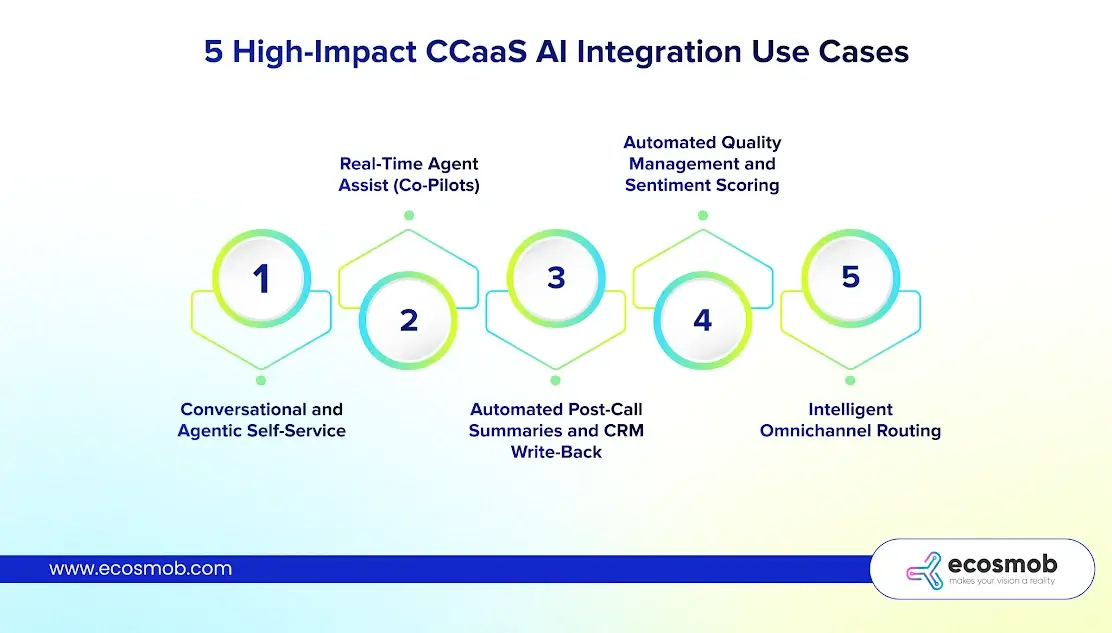
5 High-Impact CCaaS AI Integration Use Cases
To avoid scope creep, focus your CCaaS AI integration on five established capabilities, each with a defined integration point and measurable business outcome.
1. Conversational and Agentic Self-Service
- Integration Point: Ingress telephony layer (Carrier SIP trunk or edge SBC).
- How It Works: Rather than forcing callers through rigid numeric menus, conversational AI voicebots ingest streaming audio at the front door. The engine evaluates caller intent using streaming STT, queries backend systems via APIs, and resolves requests autonomously. If the inquiry requires human empathy, the bot transfers the call along with a complete structured transcript.
- Target Metric: 25% to 45% tier-1 containment rate; zero caller navigation friction.
Moving past brittle touch-tone IVR trees to conversational models represents a massive shift in contact center capacity. Research from Gartner projects that agentic AI will autonomously resolve 80% of common customer service inquiries without human intervention by 2029.
For enterprise engineering teams, capturing that level of deflection requires a telephony layer capable of sub-second streaming audio transcription and deterministic API tool execution at the ingress switch.
2. Real-Time Agent Assist (Co-Pilots)
- Integration Point: Dual-channel live media fork (SIPREC or WebRTC) + Agent Desktop CTI.
- How It Works: As the agent and caller speak, an out-of-band speech engine transcribes both sides of the conversation in real time. An orchestration engine feeds the transcript to a retrieval-augmented generation (RAG) pipeline, serving up exact policy answers, compliance reminders, and troubleshooting steps directly onto the agent’s screen-pop interface.
- Target Metric: 20% to 35% reduction in Average Handle Time (AHT); slashed agent onboarding cycles.
3. Automated Post-Call Summaries and CRM Write-Back
- Integration Point: Call disconnection event stream (Webhook) + CRM REST API.
- How It Works: The moment a call terminates, an LLM processes the full conversation log, extracts the core problem, notes the resolution, tags customer sentiment, and writes structured notes directly into the CRM ticket.
- Target Metric: Elimination of 60 to 90 seconds of manual After-Call Work (ACW) per transaction.
4. Automated Quality Management and Sentiment Scoring
- Integration Point: Data lake / Call recording repository.
- How It Works: Traditional QA teams manually review less than 2% of calls. Automated AI inspection ingests 100% of audio recordings, scoring interactions for regulatory compliance, script adherence, customer friction indicators, and escalation risk.
- Target Metric: 100% auditable interaction coverage with real-time churn alerts.
5. Intelligent Omnichannel Routing
- Integration Point: Automatic Call Distribution (ACD) routing engine APIs.
- How It Works: Instead of basic round-robin distribution, the platform evaluates customer history, recent web session behavior, and voicebot intake sentiment to pair the caller with the specific agent possessing the highest probability of resolving the issue on first contact.
- Target Metric: 15% to 20% increase in First Contact Resolution (FCR).
Key Benefits of Integrating AI Into CCaaS
While software marketing often emphasizes vague customer satisfaction promises, an engineering-led CCaaS AI integration can give you concrete, auditable financial gains:
- Lower Cost per Contact: Automating routine transactional inquiries (such as account resets, balance confirmations, and shipment tracking) eliminates human triage labor for high-volume, low-complexity interactions.
- Elastic Capacity During Volume Spikes: When weather events, service outages, or product launches cause queue spikes, conversational voice agents handle concurrent call surges instantly without blowing past carrier queue capacity.
- Actionable Interaction Telemetry: Transforming unstructured acoustic phone calls into structured vector data uncovers root-cause failure points across your products, giving product and operations teams immediate visibility into customer pain points.

Ready to bridge conversational voice AI into live SIP trunks in 4-8 weeks?
How to Integrate AI Into CCaaS? The Technical Integration Blueprint
Executing a seamless CCaaS AI integration without tearing down your working call center requires structuring the pipeline across three decoupled architectural planes.
1. The Media Plane (The Audio Fork)
To process speech with sub-second responsiveness, the AI engine must receive uncompressed, raw audio frames.
- Use SIPREC (Session Recording Protocol) on an edge Session Border Controller (such as Kamailio, AudioCodes, or Ribbon) to duplicate live RTP media legs.
- Direct the caller’s audio track directly to a low-latency speech pipeline over WebSockets, keeping caller and agent audio on isolated channels to ensure acoustic separation for transcription models.
2. The Signaling Plane (The Telephony Hand-Off)
When a self-service voicebot escalates to a human, the transfer must not feel like a blind disconnect.
- Use standard SIP signaling (SIP REFER or INVITE with Replaces) to move the call from the voice AI media engine back into the primary CCaaS ACD queue.
- Attach the generated session ID and summary payload as custom SIP headers (e.g., X-Context-ID), or pass the session token across a WebSocket event bus to ensure the receiving agent’s browser desktop immediately populates the full interaction history.
3. The Application Plane (Context Synchronization)
Your AI core must connect cleanly to operational enterprise databases.
- Build decoupled microservice connectors that execute asynchronous database lookups against your CRM and billing engines.
- Use in-memory key-value caches like Redis to manage session states, ensuring LLM tool-calling functions return verified data to the conversational engine in under 200 milliseconds.
Ecosmob Expert Tip
Running real-time audio transcription directly inside agent browser clients using local WebRTC taps frequently causes audio jitter and browser memory leaks under high multi-tab concurrency.
Always execute media forking server-side at the Session Border Controller or SIP proxy layer. Transcribe the audio centrally in your cloud infrastructure and push lightweight text tokens to the agent desktop over lightweight WebSockets.
This eliminates client workstation load and guarantees consistent transcription accuracy.
What Can Go Wrong During CCaaS AI Integration?
Enterprise AI rollouts in contact centers frequently run into these technical and organizational hurdles:
1. The Latency Trap
Chaining generic, non-streaming cloud APIs (standard speech-to-text + chat completion LLM + text-to-speech) creates turn-taking latency of 2 to 3 seconds. Over a phone line, two seconds of silence feels broken. Real-time voice agents require streaming token architectures that respond in under 600 milliseconds.
2. Ignoring Clean Telephony Audio
Telephones operate on narrowband G.711 codecs (8kHz audio). Ingesting low-resolution, noisy phone audio into speech models trained on clean 16kHz microphone audio causes word error rates (WER) to spike. Speech engines must be tuned specifically for telephony acoustic profiles.
3. Over-Relying on Agent Free-Form Text
If your agent-assist co-pilot generates long paragraphs of text, agents will ignore it. Agents need concise, structured bullet points, direct knowledge links, and pre-formatted action buttons that can be consumed in three seconds during a live call.
4. Deploying Without Guardrails
Giving an autonomous model unmonitored write access to customer databases invites corrupted records. Enforce deterministic API schemas that validate LLM tool outputs before executing updates against persistent billing or CRM systems.
Accelerate Your Contact Center AI Roadmap With Ecosmob
Integrating artificial intelligence into complex communications environments requires deep expertise across both applied machine learning and real-time telecom protocols.
At Ecosmob, our specialized telecom engineers build the critical connective tissue that bridges advanced conversational models to enterprise contact centers.
Whether you are seeking to deploy an out-of-band real-time agent assist pipeline, bridge conversational voicebots into your carrier SIP trunks, or audit your existing communications core, we help you take solutions from concept to live production traffic.
Move from an isolated voice AI sandbox to live call traffic in 4 to 8 weeks. We help bridge your custom conversational models directly into your live SIP trunks, WebRTC connections, and enterprise CRM/BSS workflows, delivering production-ready pilots designed to scale without costly re-architecture.
Frequently Asked Questions
Yes. By deploying server-side media forking via SIPREC or WebSockets at your edge Session Border Controller or carrier proxy, you can stream live audio to an external AI engine without modifying your core CCaaS routing logic or replacing legacy agent desktops.
For established enterprises with complex routing, active carrier contracts, and custom CRM integrations, adding an external AI layer delivers faster time to value with zero downtime. Replacing the entire platform makes sense only when legacy infrastructure maintenance costs exceed the capital expense of a complete migration.
Most organizations see the fastest operational return by starting with automated post-call summaries (reducing after-call work immediately) and real-time agent assist. Once transcription pipelines and knowledge retrieval are tuned, conversational self-service voicebots can be deployed to handle tier-1 call deflection.
Contact center AI projects typically fail due to excessive conversational latency (over 800ms turn-taking delay), poor transcription accuracy over compressed 8kHz telephone audio, lack of real-time CRM data integration, and attempting complex generative self-service before validating agent-assist workflows.
An AI voice agent executes a transfer using standard SIP signaling (SIP REFER or carrier bridge routing). The system passes a unique interaction identifier within custom SIP headers or via an event bus, allowing the receiving human agent to see the caller’s verified identity, full conversational transcript, and real-time intent immediately upon pickup.