
Playing a canned “This call may be recorded for quality and training purposes” announcement does not help you obey GDPR call recording rules.
Under the EU General Data Protection Regulation (GDPR) and the UK GDPR, human voice audio is treated as identifiable personal data. If you capture, process, transcribe, or store audio streams involving EU or UK residents, every single byte of that media pipeline falls squarely under data protection law.
For engineering leads, CTOs, and compliance architects building CPaaS, CCaaS, UCaaS, or conversational AI platforms, GDPR call recording is an architectural challenge. You cannot simply hit “record all” on your Session Border Controller (SBC) and store audio files indefinitely in an unencrypted S3 bucket.
Here’s how GDPR compliance call recordings work, how to establish a valid lawful basis, and how to enforce programmatic consent and retention controls directly in your voice infrastructure.
What Are the Mandatory Legal Requirements for GDPR Call Recordings?
Under the GDPR call recording rules, an organization cannot record a phone conversation unless it satisfies four foundational requirements before the media stream begins:
- Establish an Article 6 Lawful Basis: You must establish and document a valid legal ground prior to initiating the recording.
- Provide Real-Time Transparency (Articles 13 & 14): Callers must be informed that recording is taking place, who is recording, the exact purpose, and how their data will be processed before audio capture starts.
- Uphold Data Subject Rights (Articles 15, 17, & 21): Your platform must have technical mechanisms to locate, export, or permanently erase specific audio recordings and AI transcripts if a caller submits a Subject Access Request (SAR) or exercises their right to be forgotten.
- Implement Technical Security Measures (Article 32): Call audio and derived transcripts must be protected using end-to-end encryption in transit, encryption at rest, strict role-based access control (RBAC), and immutable access logging.
Establishing a Lawful Basis: Consent vs. Legitimate Interests
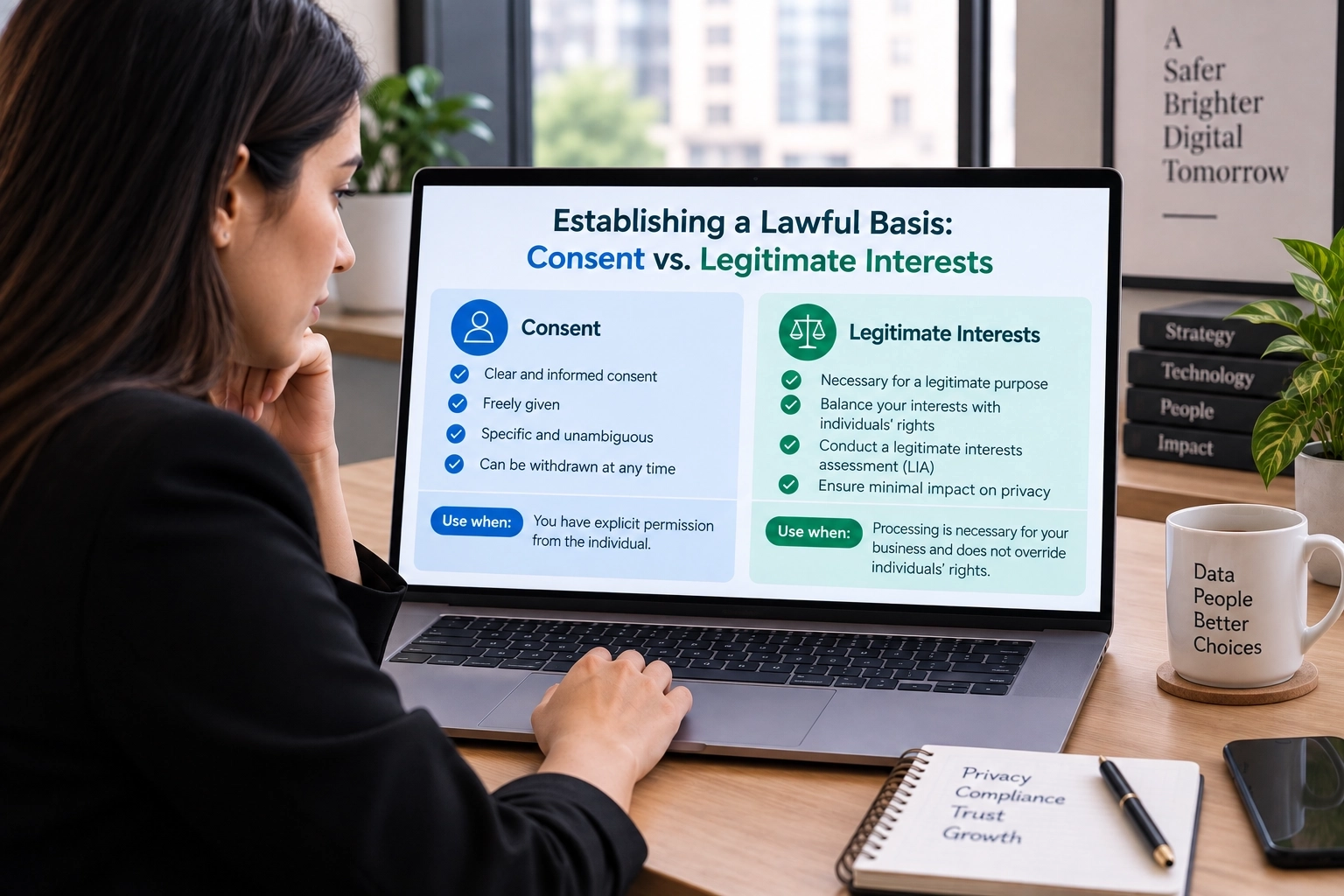
Under GDPR Article 6, there are six available legal bases for processing personal data. In enterprise telephony and voice AI platforms, GDPR compliance call recordings typically rely on one of four primary grounds:
- Consent (Article 6(1)(a))
If you rely on consent, you must give it freely in a specific, informed, unambiguous way, granted via an affirmative action.
- The Telephony Rule: Passive notices (e.g., staying on the line implies consent) do not satisfy GDPR standards for consent. If relying on consent, the system must capture an active opt-in (such as pressing 1 via DTMF or stating “Yes, I agree”) before triggering SIP recording hooks.
- Revocation: The caller can withdraw consent mid-conversation or post-call. Your system must be able to stop recording on the fly or flag that file for deletion.
- Legitimate Interests (Article 6(1)(f))
Many commercial organizations rely on legitimate interests for standard quality assurance, employee training, or dispute prevention. However, this is not a blank check.
- The Legitimate Interests Assessment (LIA): According to official Information Commissioner’s Office (ICO) legitimate interests guidance, you must complete and document a formal three-part test before recording:
- Purpose Test: Identify the specific commercial benefit (e.g., training, fraud detection).
- Necessity Test: Demonstrate that call recording is strictly necessary and that the goal cannot be achieved with less intrusive means (e.g., screen capture or post-call surveys).
- Balancing Test: Prove that your business interest does not override the caller’s fundamental privacy rights and reasonable expectations.
- The Right to Object (Article 21): If a customer objects to recording under legitimate interests, the system must immediately pause recording or route the call to an unrecorded line.
- Legal Obligation (Article 6(1)(c))
Regulated financial institutions operating under MiFID II (Markets in Financial Instruments Directive) or FCA rules are legally mandated to record all client communications that lead to transactions. In these scenarios, the lawful basis is legal obligation, meaning caller consent is not required (and cannot be used to opt out of mandated recording).
- Performance of a Contract (Article 6(1)(b))
Applies when a call recording is indispensable to completing a contract requested by the individual, such as executing verbal contracts or taking verbal trade confirmations.
Regional and Sectoral Telephony Call Recording Regulations (GDPR vs. MiFID II, PCI-DSS, and ePrivacy)
Your call recording architecture must account for multiple overlapping statutory frameworks:
| Regulatory Framework | Core Requirement | Impact on Call Recording Architecture |
| EU / UK GDPR | Transparency, minimal retention, data subject rights. | Automated deletion schedules, SAR metadata tagging, explicit consent or documented LIA. |
| MiFID II / FCA | Mandatory recording of all trade-related communications. | Strict 5 to 7-year retention schedules; WORM (Write Once, Read Many) compliance storage. |
| PCI-DSS (v4.0) | Strict prohibition on storing Sensitive Authentication Data (SAD). | Real-time DTMF clamping (RFC 2833) or pause-and-resume to prevent storing CVV/PAN codes in audio. |
| ePrivacy Directive | Confidentiality of electronic communications across public networks. | Interception/listening by third parties prohibited without explicit consent or statutory exemption. |
How Long Can You Retain Call Recordings Under GDPR?
Under GDPR Article 5(1)(e), you can retain call recordings only for as long as strictly necessary to fulfill the specific purpose for which they were captured. GDPR sets no universal retention number; indefinite storage is strictly illegal, requiring distinct time-to-live (TTL) limits for different call types.
Here’s how you can structure a compliant retention schedule:
- QA & Training Audio: Internal coaching recordings must be purged within 30 to 90 days once evaluation cycles conclude.
- Dispute Resolution & Billing: General transaction records can be retained across standard statutory limitation windows (typically 1 to 6 years).
- Financial Transactions (MiFID II / FCA): Financial trade calls must be locked in write-once-read-many (WORM) storage for 5 to 7 years under statutory mandates.
- Automated Cryptographic Shredding: When a file’s TTL expires, the underlying telephony database and cloud object store must execute programmatic, permanent deletion (not soft-deletion database flags).
- Legal Hold Exceptions: Your media repository must allow authorized compliance officers to flag specific calls with an immutable legal hold, suspending auto-deletion during active audits or litigation.
How to Engineer Compliant SIP Media Pipelines? ( Practical Architecture)
To maintain GDPR call recording compliance, data protection rules must be integrated directly into your Session Border Controllers, media servers, and database schemas.
- Dynamic SIPREC Media Forking with Contextual Metadata
Instead of recording calls locally on PBX instances, use the SIPREC (SIP Recording, RFC 7865) protocol to fork audio from your SBC (e.g., Kamailio or RTPEngine) to a centralized, hardened recording server. The SIPREC session must pass key metadata (such as the caller’s phone number (CLI), destination, timestamp, and unique Call-ID), allowing easy lookup for future Subject Access Requests.
- In-Flight DTMF Suppression (PCI-DSS & Data Minimization)
To comply with both GDPR data minimization (Article 5(1)(c)) and PCI-DSS, configure your media proxies to clamp or mute RFC 2833 DTMF tones before the audio reaches the recording disk or speech-to-text transcriber. This ensures sensitive credit card details and bank account numbers are never committed to disk.
- Fulfilling Subject Access Requests (SAR) and Erasure (Article 17)
When a customer requests a copy of their audio (Article 15) or demands deletion (Article 17), searching through terabytes of raw audio is impossible without structured indexing. Every audio file and accompanying AI transcript must be mapped to a unified customer entity identifier inside your Records of Processing Activities (ROPA, Article 30) framework.
How to Handle Voice Data Breaches According to GDPR Call Recording Rules?
Under GDPR Article 33, any unauthorized access, leak, or exposure of stored call recordings or AI voice transcripts must be reported to your competent supervisory authority (such as the UK ICO or CNIL in France) within 72 hours of finding out about the breach.
As voice platforms, you must execute three mandatory steps:
- Determine Risk to Natural Persons: Because audio streams contain vocal biometrics and personal context, breaches are generally classified as high-risk, triggering mandatory public notifications unless files were secured with unbreakable end-to-end encryption at rest.
- Execute Mandatory DPIAs (Article 35): Platforms deploying automated voice recording, biometric identity matching, or AI sentiment analysis at scale must conduct a formal Data Protection Impact Assessment prior to production rollout.
- Appoint a Data Protection Officer (DPO): If your infrastructure processes large-scale, systematic monitoring of customer communications, you must designate an independent DPO to oversee compliance logging and regulatory communications.
Complying with GDPR call recording rules isn’t just about avoiding regulatory fines. You need to engineer privacy directly into your media infrastructure.
At Ecosmob, we help you build compliant SIPREC pipelines, dynamic IVR consent workflows, and automated retention engines right inside your media plane. If you need to secure your recording stack or audit your voice infrastructure, reach out to our engineering team today!
Frequently Asked Questions
Under GDPR, businesses must establish an Article 6 lawful basis (such as consent or legitimate interests), provide clear pre-call notice to participants, collect only necessary data, protect audio files with encryption and access controls, and delete recordings once the defined retention period expires.
Recording a phone conversation is a breach of GDPR if it is done without a valid lawful basis, without informing participants beforehand, or without adequate security and retention controls. However, recording is fully lawful when conducted in compliance with Article 6 principles and transparency mandates.
Under GDPR, businesses generally cannot record calls without informing the customer. In certain legal scenarios (such as statutory financial mandates under MiFID II or national security investigations), calls may be recorded under a legal obligation without explicit consent. For individuals, purely personal or domestic recordings are exempt from GDPR, provided they are not shared publicly or commercialized.
GDPR does not specify a fixed number of days for call retention. Under Article 5(1)(e), organizations must define and justify their own retention schedule based on operational necessity (e.g., 30–90 days for training, or 5–7 years if mandated by financial regulations like MiFID II). Keeping call recordings gdpr indefinitely is strictly unlawful.
Yes, organizations can use legitimate interest (Article 6(1)(f)) for purposes like quality monitoring, staff training, and fraud prevention. However, you must conduct and document a formal Legitimate Interests Assessment (LIA) and honor the caller’s right to object under Article 21.