















QUICK SUMMARY
Microservices in 2026 have shifted from simple decoupling to intelligent orchestration, AI-native design, and operational maturity. This blog breaks down the defining trends reshaping enterprise architecture, from Agentic AI and Zero Trust service mesh to platform engineering and the pragmatic return of modular monoliths. Backed by lessons from Netflix, Uber, and Airbnb, it shows why success today depends on disciplined design and governance, not service count.
As we move deeper into 2026, the focus of software engineering has shifted from basic service decoupling to mastering high-level orchestration and system intelligence. The latest microservices architecture trends 2026 are now being shaped by Agentic AI, automated resilience, and sustainable “green” computing. For organizations aiming to stay competitive, understanding these microservices trends is no longer optional; it is a prerequisite for building resilient, future-proof systems.
To navigate this evolving landscape, it is critical to ensure your infrastructure is not just modular but truly optimized for modern market demands. Whether you are scaling through advanced web development or specialized DevOps consulting to orchestrate your workloads, staying aligned with microservices architecture trends in 2026 will be your biggest strategic advantage.
What is a Microservice?
At its core, a microservice is an architectural design pattern that breaks an application into a set of independently deployable, loosely coupled services organized around specific business capabilities. Unlike a traditional monolithic architecture, where all features (database, UI, and logic) are bundled into a single unit, microservices break the system down into independent components.
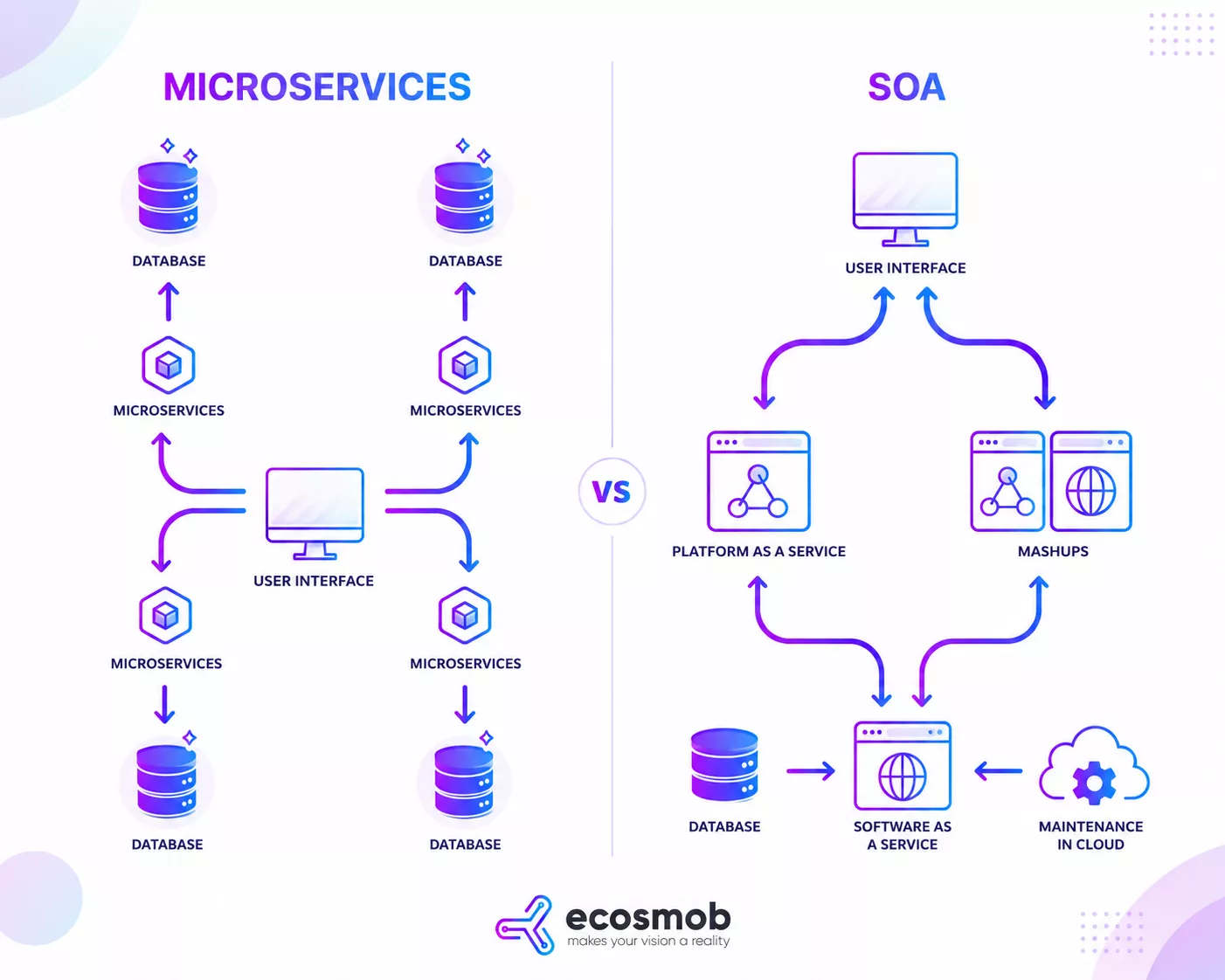
Key Characteristics of Microservices:
- Single Responsibility: Each service focuses on one specific business function (e.g., a “Payment” service or a “User Authentication” service).
- Independent Deployment: Because services are decoupled, developers can update, fix, or scale a specific service without redeploying the entire application.
- Decentralized Data: To ensure true independence, each microservice typically manages its own private database, preventing “tangled” data dependencies that slow down development.
- Polyglot Programming: Teams have the freedom to choose the best tech stack (language, database, or framework) for a specific task rather than being forced into a “one-size-fits-all” language for the whole company.
This modularity is the primary driver behind the microservices adoption trends we see today. It allows global enterprises to iterate faster and instantly scale specific parts of their systems. However, as the number of services grows, so does the complexity of their interactions, which is why staying informed about microservices trends in 2026 is essential for maintaining a healthy, high-performing ecosystem.
Competitors are rebuilding around microservices. Are you?
The Microservices Market in 2026: A Market Worth Paying Attention To
Microservices architecture is no longer a forward-looking concept; it is the operating standard for enterprises building at scale.
In 2026, the global microservices architecture market is valued at approximately $8.94 billion, up from $7.4 billion in 2025, growing at a CAGR of around 20.9%.
Meanwhile, the other numbers tell a compelling story:
- Over 75% of enterprises have adopted cloud-native infrastructure, with microservices at the center of that strategy
- 84% of organizations use Kubernetes as their container orchestration platform
- 78% of organizations moving away from monolithic systems are integrating microservice-based frameworks.
These figures highlight a fundamental shift: microservices are no longer a “niche” technical choice but the backbone of global economic scaling. With the market projected to nearly double by 2030, the ability to orchestrate these distributed systems has become a top-tier competitive advantage.
Organizations that successfully navigate these microservices adoption trends aren’t just building better software; they are building the high-velocity infrastructure required to lead in an AI-driven, cloud-native world.
Real-World Case Studies: How Industry Leaders Use Microservices?
Before diving into the trends, it’s worth grounding the discussion in how the world’s most successful companies actually use microservices today.
From streaming to ride-sharing, here is how the industry’s biggest players have mastered these systems at scale:
Netflix: 1,000+ Microservices at Global Scale
Netflix serves over 325 million subscribers across 190+ countries and processes more than a trillion events per day from devices worldwide. Their entire backend is built on a cloud-native microservices architecture running on AWS. Each function, from recommendation engines to playback tracking, runs as an independent microservice communicating via APIs, event queues (Kafka), and service discovery mechanisms.
In 2025, Netflix migrated its relational workloads to Amazon Aurora PostgreSQL, achieving up to 75% performance improvement and 28% cost savings through managed scaling and shared storage. Their AI orchestration system, Maestro, is itself built on stateless microservices to handle hundreds of thousands of ML workflows daily.
Netflix proves that microservices, when built with strong observability and failure isolation, can support global-scale personalization and streaming with near-zero downtime.
(Source: https://netflixtechblog.com/automating-rds-postgres-to-aurora-postgres-migration-261ca045447f )
Uber is a cautionary tale that’s also a success story. As the company scaled rapidly, it accumulated over 1,000 microservices, many of which had tangled dependencies so complex that engineers internally referred to the architecture as the “Death Star.” The lesson: microservices without clear domain boundaries and governance can create more complexity than they solve.
Uber responded by adopting domain-driven design, restructuring service boundaries, and investing heavily in resilience engineering and API gateways. The experience shaped a more pragmatic industry approach to microservices, prioritizing intentional design over sheer service count.
(Source: https://www.uber.com/in/en/blog/microservice-architecture/ )
Airbnb: Modular Growth on AWS
Airbnb runs hundreds of microservices on Amazon EKS, with services for search, bookings, messaging, and payments scaling independently. AWS Fargate handles stateless workloads, while S3 and Kinesis power their data pipeline. As Airbnb scaled to support over 1.5 billion guests, its microservices architecture enabled it to rapidly iterate on product features and expand into new markets without system-wide disruptions.
(Source: https://aws.amazon.com/solutions/case-studies/airbnb-case-study/ )
These case studies reveal a critical truth: while microservices offer unmatched agility, they also demand a level of operational maturity that is driving the latest trends in microservices architecture this year.
Build microservices that are AI-ready by design.
What are the Leading Microservices Architecture Trends Reshaping the Enterprise in 2026?
As we navigate through 2026, the conversation around distributed systems has shifted from “how to build” to “how to optimize and secure.” The latest microservices architecture trends 2026 are no longer just about splitting codebases; they are about embedding intelligence, ensuring zero-trust security, and achieving operational pragmatism. For organizations to thrive, staying aligned with these microservices trends is the difference between a high-performing ecosystem and a “Death Star” of unmanageable complexity.
From AI-native orchestration to the rise of modular monoliths, here are the core pillars of the latest microservices architecture trends you need to track:
1. AI-Native Microservices: The Biggest Shift of the Decade
The convergence of AI and microservices is the defining development of 2026. Organizations are now designing architectures where LLMs and autonomous agents are first-class citizens. This mirrors the original shift from monoliths to services: instead of one massive AI model, enterprises are deploying “model fleets”, small, specialist models that collaborate.
Microservices architecture trends in 2026 heavily feature containerized inference (such as NVIDIA’s NIM), allowing models to be packaged with their dependencies and scaled via Kubernetes, just like any other functional service.
Modern AI tech stacks in 2026 embrace microservices architecture directly: Docker containers package models with their dependencies, Kubernetes orchestrates scaling, and API gateways manage inference endpoints. This enables organizations to deploy hundreds of models simultaneously while maintaining consistency and reliability.
NVIDIA’s NIM microservices, a set of containerized inference microservices for deploying AI models, have become an important building block in enterprise GenAI stacks, allowing teams to build, customize, and manage domain-specific language models at scale.
What this means for your architecture:
- AI inference must be treated as independently deployable services with their own scaling, versioning, and monitoring.
- LLM integration requires careful API contract design; the same principles that govern any microservice apply to AI components
- Observability becomes even more critical: you need to trace AI decisions, not just code paths
2. Agentic AI and Microservices: Distributed Intelligence
Closely linked to AI-native design is the rise of Agentic AI. In 2026, the microservices adoption trends have evolved into an “agentic revolution.” Single, all-purpose agents are being replaced by teams of specialized agents (researchers, coders, analysts) that communicate via emerging standards like Anthropic’s Model Context Protocol (MCP). This shift is a core part of the microservices trends for 2026, in which orchestration logic is now an engineering discipline focused on inter-agent conflict resolution and state management.
The architectural challenges are also familiar: inter-agent communication protocols, state management across agent boundaries, conflict resolution mechanisms, and orchestration logic are now core engineering concerns. You are essentially building distributed systems, but with AI agents instead of traditional microservices.
Emerging standards like Anthropic’s Model Context Protocol (MCP) and Google’s Agent-to-Agent Protocol (A2A) are establishing HTTP-equivalent communication standards for agentic systems, signaling that the agentic AI space is maturing into a proper engineering discipline.
3. Service Mesh Evolution: From Infrastructure to Intelligence Layer
Service meshes like Istio and Linkerd are evolving from simple traffic tools into intelligent layers. Modern meshes now handle Zero Trust enforcement with mTLS and AI-driven traffic optimization. Given that a system with 40 services can have over 240 distinct authentication points, the latest microservices architecture trends prioritize automating policy-as-code (using OPA) to eliminate the risk of manual misconfiguration.
Modern service meshes (Istio, Linkerd, Consul Connect) now handle:
- Zero Trust security enforcement with mutual TLS between every service.
- AI-driven traffic optimization, dynamically routing traffic based on real-time service health and cost signals.
- Distributed observability, deep telemetry, tracing, and anomaly detection across hundreds of services.
- Policy-as-code with tools like Open Policy Agent (OPA), enabling teams to define and enforce complex authorization rules programmatically.
The scale of what a misconfigured service mesh can expose is significant. Security researchers have noted that in a system with 40 services across 3 environments and 2 authentication methods, there are 240 distinct authentication configurations, and a single misconfiguration can create a security gap. Modern service mesh tooling addresses this by automating policy enforcement rather than relying on manual configuration.
4. Kubernetes Maturity and Platform Engineering
Kubernetes has moved from cutting-edge to expected baseline. With 76% adoption across production workloads, the question is no longer “should we use Kubernetes?” but “how do we use it well?”
In 2026, the dominant theme is platform engineering: the practice of building internal developer platforms (IDPs) on top of Kubernetes that abstract away infrastructure complexity and enable development teams to self-serve. Instead of every team managing their own Kubernetes configs, a platform team builds golden paths: standardized, opinionated environments that teams can deploy into without becoming Kubernetes experts.
Key developments in this space:
- Crossplane and similar tools for managing cloud infrastructure declaratively alongside application workloads.
- GitOps workflows (ArgoCD, Flux) for treating Kubernetes configuration as code with full audit trails.
- With FinOps integration and containerization now covering over 76% of production workloads, cost visibility and optimization have become critical disciplines.
- Multi-cluster management for enterprise organizations spanning multiple clouds and regions.
5. Event-Driven Architecture and Serverless Integration
Serverless computing and event-driven patterns have emerged as powerful complements to microservices, particularly for workloads with variable demand, real-time processing needs, or cost-sensitive operations. The global serverless architecture market reached $17.81 billion in 2025 and $21.93 billion in 2026 and growing annually at a rate of 23.1%
The combination of microservices + serverless + event-driven design is especially compelling for:
- Fintech platforms handling variable transaction volumes without over-provisioning infrastructure
- E-commerce applications with predictable seasonal traffic spikes
- Healthcare analytics requiring real-time event processing from IoT medical devices
- AI inference pipelines where workloads are bursty and latency-sensitive
Apache Kafka remains the dominant event-streaming backbone for enterprises connecting microservices asynchronously, with significant adoption in financial transactions and AI inference pipelines. The decoupling that event-driven architecture provides allows services to produce and consume events without direct dependencies, making distributed systems significantly more resilient.
6. Multi-Cloud and Hybrid Cloud Microservices
The multi-cloud strategy has moved from aspiration to standard operating procedure. Over 78% of organizations run hybrid cloud environments in 2026, and microservices architecture is the primary vehicle for achieving true cloud portability.
The benefits are clear: organizations can leverage best-of-breed services from different cloud providers, avoid vendor lock-in, and build resilience by spreading workloads across multiple environments.
The practical challenge is operational consistency across clouds. Service mesh technologies, particularly those built on the Envoy proxy, have become key enabling technologies for multi-cloud microservices, providing a consistent layer for traffic management, security, and observability regardless of the cloud where the workload runs.
7. API-First Design and API Management at Scale
APIs are the connective tissue of a microservices architecture. Every service boundary is an API.
The discipline of API management has matured into a sophisticated practice encompassing:
- API Governance Frameworks: Standardized rules for versioning, deprecation, security, and documentation across teams.
- Developer Experience (DX): Internal developer portals that simplify API discovery, access, and usage.
- GraphQL Federation: A distributed architecture enabling teams to own domain-specific graphs while exposing a unified API.
- Rate Limiting and Throttling at Scale: Control mechanisms to prevent service overload and ensure system stability.
- Contract Testing: Pre-deployment validation of API contracts to detect and prevent breaking changes early.
8. Pragmatic Microservices: The Rise of the Modular Monolith
One of the most important, and often overlooked, trends in 2026 is a more mature, pragmatic approach to microservices adoption. Not every system should be microservices. The industry has learned this the hard way.
According to the CNCF Annual Survey, approximately 42% of organizations that initially adopted microservices are consolidating some services into larger, deployable units, or modular monoliths, to reduce complexity and operational overhead. This isn’t a step backward; it’s a sign that the industry has moved past the hype phase and into disciplined execution.
The guiding principle: use microservices where they solve a real problem (independent scaling, large distributed teams, high fault isolation requirements), and use simpler architectures where they don’t.
Companies like Shopify have demonstrated that a well-architected monolith can handle billions in Black Friday transactions. Stack Overflow serves millions of developers without microservices. The lesson is not that microservices are wrong; it’s that business constraints, not technology trends, must drive that architecture.
9. Zero Trust Security for Microservices
Security is no longer an afterthought in microservices architecture; it is an architectural requirement. The distributed nature of microservices dramatically expands the attack surface: each service, each API endpoint, each service-to-service communication channel is a potential vulnerability.
The Zero Trust model, never trust, always verify, has become the security foundation for modern microservices deployments. Key implementation pillars include:
- Mutual TLS (mTLS) for encrypting and authenticating all service-to-service communication.
- API gateway-based centralized control for authentication, rate limiting, and traffic inspection.
- Secrets management with tools like HashiCorp Vault or AWS Secrets Manager, with automated credential rotation.
- Automated API discovery to detect shadow APIs and unauthorized endpoints before they become breach vectors.
- Shift-left security, integrating security checks into CI/CD pipelines rather than treating security as a post-deployment concern.
The evolution of these platforms demonstrates that the latest microservices architecture trends for 2026 are no longer just about technical separation. Instead, the focus has shifted toward building “intelligent” systems that are governed by automated platforms, secured by Zero Trust, and optimized for real-world costs. As we analyze these shifts, it becomes clear that staying informed on microservices trends 2026 is the only way to build infrastructure capable of supporting the next generation of AI-driven enterprise applications.
By mastering these trends, organizations can ensure their transition to microservices delivers on the promise of agility without falling into the trap of unmanageable complexity.
Industry-Specific Microservices Challenges and Applications
Microservices adoption looks different across industries. Each vertical brings unique compliance requirements, data sensitivity concerns, and scaling patterns.
Here’s how the major industries are navigating microservices in 2026:
| Industry | Primary Driver | Key Challenges | Notable Use Cases |
| BFSI | Real-time transaction processing, regulatory compliance | Data consistency across distributed services, PCI DSS and SOX compliance, and auditability. | Payment microservices, fraud detection pipelines, and core banking modernization |
| Healthcare | Patient data integration, telemedicine scaling | HIPAA compliance across service boundaries, real-time analytics with patient privacy, interoperability with legacy systems | EHR integration, remote patient monitoring, and AI diagnostic services |
| Telecom | Network function virtualization, 5G enablement | Ultra-low latency requirements, massive concurrent connections, carrier-grade reliability | VoIP services, SIP-based communication, and network slicing |
| Retail & E-Commerce | Seasonal traffic spikes, personalization at scale | Inventory consistency across services, cart and checkout reliability, and recommendation latency | Order management, product catalog, personalized recommendations |
| Media & Entertainment | Global streaming, content delivery | CDN integration, real-time encoding pipelines, multi-region failover | Content recommendation, playback services, live streaming |
| Manufacturing & IoT | Edge computing, real-time sensor data | Latency constraints, security at the edge, intermittent connectivity | Predictive maintenance, supply chain visibility, and industrial automation |
| Government & Public Sector | Digital service delivery, legacy modernization | On-premise compliance requirements, data sovereignty, and procurement cycles | Citizen portals, benefit management, and inter-agency data sharing |
What are the Key Microservices Challenges Organizations Face in 2026?
Even as microservices adoption trends accelerate, these systems remain notoriously difficult to master. The move toward decentralized architecture introduces operational friction that can quickly spiral into unmanageable complexity. In 2026, the focus has shifted from simply “going micro” to overcoming the inherent hurdles of distributed networking and data silos.
To build a truly resilient system, organizations must address these three critical pain points:
Service Sprawl and Complexity
The “Death Star” effect, where hundreds of tangled services create an unreadable map of dependencies, is a primary concern. To counter this, microservices trends 2026 favor Platform Engineering. By using Internal Developer Platforms (IDPs), companies enforce architectural standards that make the “right way” to build a service the easiest way.
Data Consistency
Ensuring data integrity across service boundaries is a persistent hurdle in the latest microservices architecture trends. Traditional transaction methods fail at scale, leading teams to adopt the Saga pattern. This allows for eventual consistency and robust error handling without the performance bottlenecks of older, tightly coupled systems.
Observability at Scale
Debugging a request through 50+ services is significantly harder than in a monolith. In 2026, the latest microservices architecture trends have made OpenTelemetry and AI-powered anomaly detection mandatory. These tools allow engineers to cut through system “noise” and identify root causes in real time, which is essential for the adoption of modern microservices.
While the obstacles are significant, the latest microservices architecture trends in 2026 provide blueprints, such as Sagas and Platform Engineering, needed to turn distributed complexity into a long-term competitive advantage.
Sprawl, drift, and security gaps, we have solved all three.
How Ecosmob Approaches Microservices
At Ecosmob, we have spent over a decade building communication infrastructure, VoIP platforms, SIP-based services, and real-time communication APIs that demand the resilience, scalability, and modularity provided by a microservices architecture. Every communication platform we build is designed around independently deployable services, enabling our clients to scale specific functions (call routing, transcoding, analytics, billing) without system-wide disruptions.
Whether you are modernizing a monolithic communication platform, building a new cloud-native VoIP solution, or integrating AI into an existing microservices architecture, our team brings the domain expertise and engineering depth to help you get it right.
Ready to explore what microservices architecture can do for your communication infrastructure? Talk to our experts today.
FAQs
What is the biggest microservices architecture trend in 2026?
AI-native microservices are the defining shift of the year. Enterprises are deploying containerized inference (such as NVIDIA NIM), treating LLMs and AI agents as first-class, independently deployable services that scale via Kubernetes, just like any other workload.
Are microservices still worth adopting in 2026, or is the modular monolith winning?
Both have a place. A growing share of organizations are consolidating some services into modular monoliths to reduce complexity, but that is not a retreat from microservices. The rule in 2026 is simple: use microservices where independent scaling, fault isolation, or large distributed teams genuinely demand it. Otherwise, simpler architectures win.
Why is service mesh becoming so important for microservices?
Service mesh has evolved from a traffic-routing tool into an intelligence layer that enforces Zero Trust security, automates mTLS between services, applies policy-as-code, and delivers deep observability. With 40 services creating up to 240 distinct authentication points, an automated mesh policy is now essential to avoid security gaps.
What are the biggest microservices challenges enterprises face in 2026?
Three challenges dominate: service sprawl (the "Death Star" effect), data consistency across distributed services, and observability at scale. Most organizations are solving these with Internal Developer Platforms, the Saga pattern for eventual consistency, and OpenTelemetry paired with AI-driven anomaly detection.
How does Zero Trust fit into modern microservices architecture?
In 2026, Zero Trust is no longer optional; it is architectural. Every service-to-service call is authenticated via mTLS; secrets are managed with automated rotation; API gateways centralize control; and security checks shift left into CI/CD pipelines, treating every endpoint as a potential breach vector until verified.