
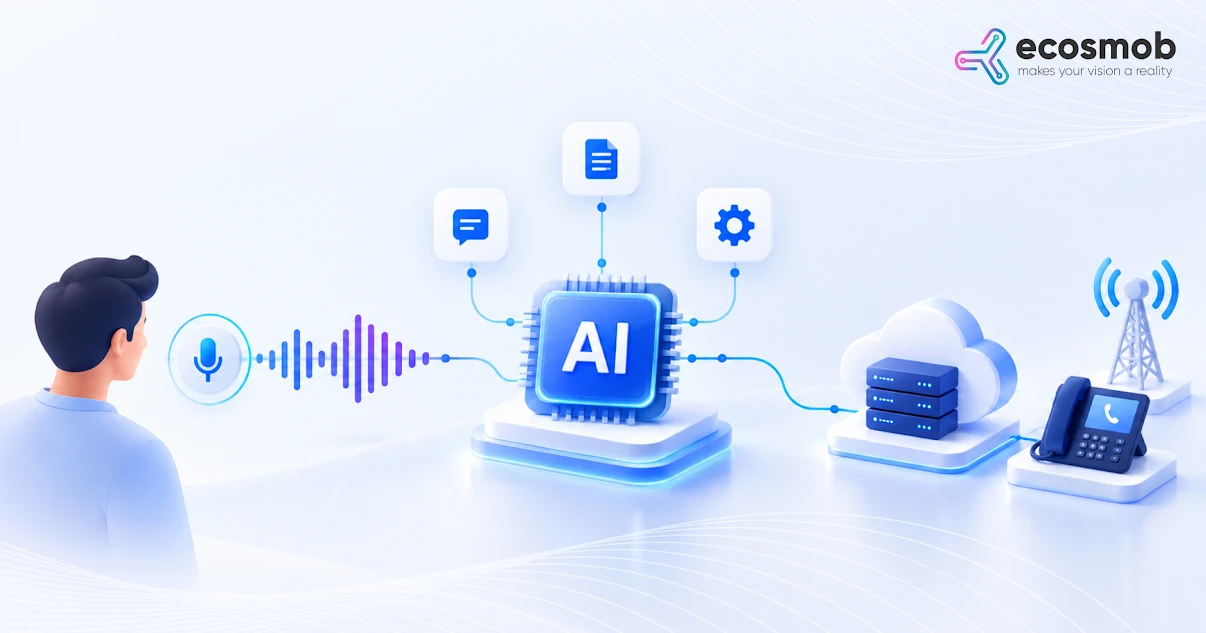
A custom voice AI engine is an integrated, low-latency software pipeline that captures streaming audio, extracts speaker intent, executes business logic, and synthesizes natural vocal responses in real time.
At a baseline architectural level, every conversational voice engine follows a simple three-stage formula:
Audio In (STT) ⟶ Cognition (LLM + Tools) ⟶ Audio Out (TTS)
Building an engine that functions over live phone calls and browser streams is an infrastructure challenge. If you rely on closed SaaS aggregators, you rent their proprietary turn-taking heuristics, accept unconfigurable buffering, and pay a heavy per-minute markup on underlying model compute.
When you choose to build custom voice AI engine open-source systems, you decouple your transport from your cognitive layers. You can run weights locally, audit data retention down to the bare metal, and eliminate third-party API dependencies.
Here is the architectural blueprint to design, assemble, and deploy an open-source voice AI engine capable of holding natural, sub-second conversations.
How To Build A Custom Voice AI Engine With Open Source Tools?
To build a custom voice AI engine with open-source tools, assemble a modular pipeline connecting low-latency audio transport (WebSockets/WebRTC), local Voice Activity Detection (Silero VAD), streaming Speech-to-Text (faster-whisper), open LLM inference via vLLM, and streaming Text-to-Speech (Kokoro or Piper).
Rather than treating speech as a monolithic black box, building an enterprise-grade engine requires decoupling your system into six discrete layers:
Layer 1: Transport and Audio I/O
This layer terminates inbound connections and manages raw audio buffers. It ingests 16kHz or 8kHz linear PCM frames over WebRTC data channels, secure WebSockets (WSS), or carrier RTP audio legs.
Layer 2: Voice Activity Detection (VAD) and Turn Detection
The engine must detect when a human starts speaking, when they pause to think, and when they finish their turn. This layer runs local neural acoustic checks every 10ms to trigger conversational barge-in interruptions and suppress background noise.
Layer 3: Streaming Speech-to-Text (STT)
Incoming audio chunks pass through an acoustic transcription model. Instead of waiting for a complete sentence, streaming STT emits partial transcript tokens sequentially to prime downstream reasoning.
Layer 4: LLM and Tool Execution
The language core evaluates user context, executes deterministic API tool calls (such as database queries or CRM updates), and streams text response tokens. Open-weights models run locally on high-throughput inference engines like vLLM.
Layer 5: Streaming Text-to-Speech (TTS)
The synthesis layer consumes LLM text tokens the moment punctuation or clause boundaries appear, generating playable binary audio chunks without waiting for the full response text.
Layer 6: Orchestration and Observability
The glue that coordinates frame lifecycles between worker threads. It captures pipeline metrics, logs Word Error Rates (WER), and tracks voice-to-voice latency percentiles.
Turnkey Platform vs. Framework: Which Custom Voice AI Architecture Should You Build?
When building a custom voice AI engine, choose a turnkey platform (like Dograh AI) for pre-built GUIs and rapid prototyping, or a framework-led build (like LiveKit Agents or Pipecat) for granular control over media pipelines, SIP integrations, and horizontal scaling.
Here is a detailed comparison of the two self-hosted development paths:
| Architectural Dimension | Turnkey Open-Source Platforms (Dograh AI, OpenVoiceOS) | Modular Framework Build (Pipecat, LiveKit Agents) |
| Setup Complexity | Low. Pre-packaged container stacks with administrative UIs. | Moderate to High. Requires Python or Go systems engineering. |
| Component Flexibility | Constrained. Harder to swap underlying VAD or media-switching logic. | Total. Every stage (STT, LLM, TTS, transport) is hot-swappable. |
| Telephony Integration | Often relies on third-party webhook relays or limited SIP modules. | Native. Bridges directly into custom FreeSWITCH or Asterisk media ports. |
| Concurrency Ceiling | Bound by the platform’s internal message bus architecture. | Scalable. Workers deploy as decoupled microservices on Kubernetes. |
| Best Suited For | Rapid internal POCs and smart hardware appliances. | Carrier-grade telecom bots, enterprise CCaaS, and custom voice SaaS. |
Which Open-Source Models Are Best For A Custom Voice AI Engine?
A production-grade custom voice AI engine requires four core model components: Silero VAD v5 for speech detection, faster-whisper or NVIDIA NeMo for streaming transcription, Llama 3.1 or Qwen 2.5 on vLLM for cognition, and Kokoro-82M or Piper for streaming speech synthesis.
VAD & Audio Cleanup
Silero VAD (v5) is the enterprise baseline. It evaluates 30ms audio windows with sub-1ms processing overhead, providing accurate voice-versus-noise classification.
Streaming STT
Faster-whisper (Whisper re-implemented in CTranslate2) provides high accuracy on multilingual inputs. For ultra-low English word-error rates at scale, NVIDIA NeMo Parakeet-CTC offers streaming transcription with under 90ms chunk latency.
Note: Cloud APIs like Deepgram are closed SaaS services, not self-hosted open-source software.
LLM Reasoning
Llama 3.1 (8B or 70B) and Qwen 2.5 (7B or 14B) hosted on vLLM deliver production performance. vLLM uses PagedAttention to optimize KV-cache memory, keeping Time-to-First-Token (TTFT) under 100ms.
Streaming TTS
Kokoro-82M delivers exceptional voice naturalness with an ONNX-runtime footprint that synthesizes the first audio chunk in under 80ms. For lightweight or edge deployments, Piper provides fast, deterministic synthesis on standard CPU hardware.
Step-By-Step Implementation Of A Custom Voice AI Pipeline
To assemble a custom voice AI pipeline, ingest raw audio frames over WebSockets, apply neural VAD for barge-in cancellation, stream buffered audio into faster-whisper, pipe incremental text tokens to vLLM, and synthesize clause-level audio chunks via Kokoro.
Here is the exact engineering sequence to wire your custom voice AI engine:
Step 1: Establish Real-Time Media Ingestion
Set up your media listener to receive raw audio frames. For WebSockets, configure an asynchronous server (using FastAPI or aiohttp) that ingests 16-bit linear PCM audio sampled at 16kHz or 24kHz.
Step 2: Configure VAD and Interrupt Handling
Pipe incoming audio buffers directly into Silero VAD. When the VAD flags active speech while the bot is currently playing audio, issue an immediate cancellation event to your TTS buffer and audio transport channel to execute clean barge-in.
Step 3: Wire Streaming Speech Recognition
Route non-silent audio frames to your STT worker. Use an asynchronous queue to stream frames into faster-whisper using a VAD-assisted circular buffer, emitting partial transcripts as confident tokens resolve.
Step 4: Stream Context to the LLM
Send validated user transcripts to your local vLLM instance using an OpenAI-compatible SSE (Server-Sent Events) streaming endpoint. Instruct the model system prompt to keep sentences short and conversational to feed the speech synthesizer quickly.
Step 5: Synthesize and Stream Audio Chunks
Pass LLM text tokens into a sentence-boundary chunker. As soon as a comma, semicolon, or period appears, dispatch that clause immediately to Kokoro or Piper. Stream the resulting PCM or Opus bytes directly back over the client socket.
How to Connect a Custom Voice AI Engine to SIP Trunks and PBXs?
To connect a custom voice AI engine to SIP trunks and enterprise PBXs, terminate incoming carrier calls on a Session Border Controller or FreeSWITCH media server, fork the live RTP audio as linear PCM over WebSockets using mod_audio_fork, and handle line echo cancellation at the media layer.
Bridging your custom voice AI engine into public carrier phone lines requires an enterprise media plane architecture:
1. Audio Forking with mod_audio_fork
Configure FreeSWITCH to duplicate the incoming RTP audio stream and fork it as raw binary WebSockets directly to your voice engine server. This eliminates the need to record .wav files to disk.
2. Codec Resampling
Telephone networks typically carry G.711 (narrowband 8kHz) audio. Your telecom bridge must resample audio from 8kHz to the 16kHz or 24kHz wideband audio expected by speech recognition models without introducing jitter.
3. PSTN Acoustic Echo Cancellation (AEC)
Unlike headphones, phone lines suffer from hybrid acoustic echo. FreeSWITCH or your edge Session Border Controller (SBC) must enable hardware-level line echo cancellation to prevent the bot from hearing its own speech and triggering false barge-ins.
What Is the Latency Budget for a Real-Time Voice AI Engine?
A production real-time voice AI engine requires an end-to-end latency budget between 320ms and 580ms, distributed across network transport (30ms), VAD endpointing (80ms), streaming STT (100ms), LLM time-to-first-token (150ms), and initial TTS chunk synthesis (80ms).
Tracking voice-to-voice delay across each stage keeps turn-taking natural and prevents conversational collisions:
| Pipeline Stage | Target Latency | Optimization Lever |
| Network & Ingress Transport | 20ms – 40ms | Regional server placement and UDP/WebSockets transport. |
| VAD Endpointing Decision | 50ms – 100ms | Tune Silero minimum silence duration between 200ms and 300ms. |
| Streaming STT First-Token | 80ms – 140ms | Use quantized CTC models (faster-whisper int8 or NeMo Parakeet). |
| LLM Time-to-First-Token (TTFT) | 100ms – 180ms | Run vLLM with FlashAttention-2 and AWQ/GPTQ 4-bit quantization. |
| TTS First Audio Chunk | 70ms – 120ms | Synthesize at clause/comma boundaries using Kokoro or Piper. |
| Total Voice-to-Voice Budget | 320ms – 580ms | Streaming text directly into audio synthesis. |
How Do Custom Voice AI Engines Handle Barge-In and Interruption?
Custom voice AI engines handle barge-in interruptions through dual-state cancellation: local Voice Activity Detection detects user speech during bot playback, instantly clearing downstream audio output buffers on the media gateway and issuing abort signals to active LLM and TTS inference worker threads.
A robust turn-taking implementation solves two key edge cases:
- Barge-In and State Cancellation: When a caller interrupts the bot mid-sentence, the system must immediately stop audio playback. This requires a two-step kill signal: flush the audio output queue on the media server, and send an interrupt signal to the LLM and TTS tasks to abort ongoing generation.
- Semantic Endpointing: Humans pause mid-sentence naturally to think. If your VAD cuts off after 200ms of silence, the bot will interrupt the user constantly. If you wait 800ms, the bot feels sluggish. A robust approach uses a fast acoustic VAD (250ms) paired with a lightweight classifier that inspects partial transcripts to determine if the speaker’s thought is grammatically complete.
How to Measure the Performance of a Custom Voice AI Engine?
To measure custom voice AI performance, track Word Error Rate (WER) on 8kHz telephone audio, p95 voice-to-voice turn-taking latency, speech interruption precision, and autonomous task containment rates.
You need to monitor each of these production telemetry benchmarks:
- Word Error Rate (WER) on 8kHz Telecom Audio: Speech models perform differently on noisy phone audio compared to clean 48kHz microphone audio. Benchmark your STT model against telephone audio containing background noise.
- Voice-to-Voice Latency (p50 / p95): Measure elapsed time from the moment the user stops speaking (VAD silence threshold) to the exact millisecond the first audio packet arrives at the client speaker. Maintain a p95 latency under 650ms.
- Turn-Taking Interruption Accuracy: Track how often the engine cleanly aborts speech during genuine interruptions versus false cutoffs triggered by coughs or line clicks.
- Task Completion and Containment Rate: The percentage of conversations resolved autonomously without requiring escalation to a human agent.
How Does a Custom Voice AI Engine Ensure Data Privacy and Compliance?
A self-hosted custom voice AI engine ensures regulatory compliance by keeping raw media streams and conversation transcripts entirely within private VPC boundaries. This eliminates third-party data transmission to satisfy GDPR, HIPAA, and PCI-DSS data residency requirements.
Self-hosting gives enterprise security teams complete administrative control:
- Data Residency: All voice media and transcript tokens remain within your private VPC, satisfying strict GDPR, HIPAA, and regional data sovereignty mandates.
- Automated PII Redaction: Implement real-time regex and Named Entity Recognition (NER) filters in your streaming pipeline to strip Social Security numbers, credit card data, and medical details before transcripts hit persistent databases.
- SIPREC Call Recording: For regulated contact centers, use standard SIPREC protocols on your Session Border Controller to split call recordings directly to encrypted storage vaults (like AWS S3 Glacier) with immutable audit logging.
Which Custom Voice AI Architecture Matches Your Business Needs?
To choose the right voice AI deployment model for your use case, evaluate your internal engineering resources against your monthly call concurrency requirements:
| Build Path | Best Suited For | Main Benefit | Primary Operational Trade-off |
| 1. Managed SaaS APIs | Early-stage MVPs (< 20,000 mins/mo) | Fastest launch time (days). | High per-minute cost and vendor lock-in. |
| 2. Turnkey Open Source | Private appliances, internal prototypes | Pre-built web dashboards. | Inflexible pipeline modifications. |
| 3. Framework-Led Build | Scalable voice SaaS, modern CCaaS | Modular stack control with fast time to market. | Requires dedicated Python/Go engineers. |
| 4. Fully Custom RTC Core | Global carriers, high-volume dialers | Minimum latency and custom media routing. | High upfront engineering investment. |
Building a custom voice AI engine using open-source tools allows you to own your technology stack, escape recurring software license fees, and protect user data privacy.
Turning an open-source pipeline into a reliable production system requires balancing real-time communications constraints with applied machine learning. If you need senior engineering expertise to architect your media plane, bridge open-source models to live SIP trunks, or deploy high-throughput GPU clusters, Ecosmob is here to help.
AI Voice Agent Development & Integration
Move from an isolated voice AI sandbox to live call traffic in 4 to 8 weeks. Ecosmob’s engineers bridge your custom conversational models directly into your live SIP trunks, WebRTC connections, and enterprise CRM/BSS workflows—delivering production-ready pilots designed to scale without costly re-architecture.
Frequently Asked Questions
A custom voice AI engine is an integrated software system that combines streaming audio transport, Voice Activity Detection (VAD), Speech-to-Text (STT), Large Language Models (LLMs), and Text-to-Speech (TTS) to conduct real-time, interactive spoken conversations without human intervention.
Yes. By pairing modern frameworks like Pipecat or LiveKit with open models such as Silero VAD, faster-whisper, Llama 3.1 or Qwen 2.5 on vLLM, and Kokoro or Piper TTS, you can assemble a fully self-hosted, commercial-grade voice engine.
At scale, yes. While cloud API platforms cost between $0.06 and $0.12 per minute, running self-hosted models on dedicated GPU hardware drops the effective compute cost to under $0.015 per minute once call volume exceeds 50,000 to 100,000 monthly minutes.
You connect the engine to phone networks by pairing a Session Border Controller (SBC) or media server like FreeSWITCH or Asterisk with your application layer. FreeSWITCH forks incoming RTP audio streams over WebSockets directly to your voice pipeline, handling G.711 carrier codecs and echo cancellation.
Turn-taking latency is driven by three main bottlenecks: slow Voice Activity Detection endpointing, high LLM Time-to-First-Token (TTFT), and waiting for full sentences before starting text-to-speech synthesis. Streaming tokens continuously across each stage keeps total delay under 500 milliseconds.