
A lot of teams assume that launching voice AI agents is purely a machine learning challenge: pick a state-of-the-art model, write clever system prompts, and point an API at your customer database.
Then the system meets live telephone traffic.
A caller interrupts the bot mid-sentence, but the audio buffer keeps playing for another 800 milliseconds. A database lookup hangs for half a second, triggering an awkward, silent void on the line. An edge Session Border Controller (SBC) runs out of worker threads trying to transcode 8kHz G.711 carrier streams into 16kHz linear PCM, and the entire media gateway starts dropping packets.
The uncomfortable reality? Voice AI projects rarely fail because the AI model was horrible. They usually fail because the underlying telephony, media planes, and integration APIs are not built for real-time streaming.
Deploying autonomous agentic AI in telecom and modern conversational AI contact center stacks demands carrier-grade plumbing. Before spending engineering cycles building voice AI agents, use this 10-point checklist to evaluate whether your CPaaS, UCaaS, or CCaaS infrastructure is actually ready for AI agents in telecom.
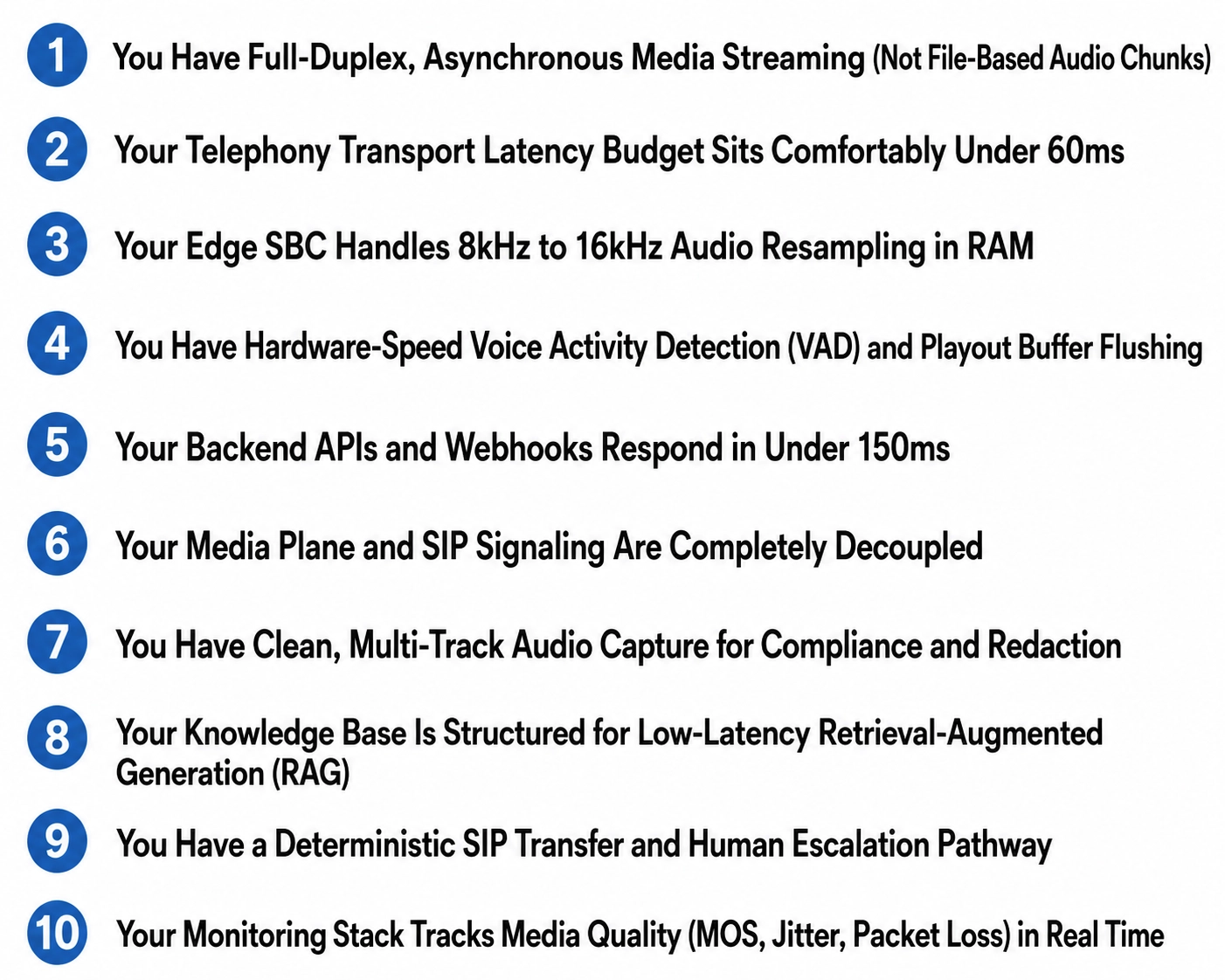
1. You Have Full-Duplex, Asynchronous Media Streaming (Not File-Based Audio Chunks)
If your platform still processes voice by recording a .wav file, waiting for silence, sending an HTTP POST to a cloud transcriber, and waiting for an audio file in return, your architecture cannot support real-time voice AI agents.
Deploying a high-performance conversational AI contact center requires full-duplex, bidirectional audio streaming. Your media layer must be capable of tapping the live channel using native media hooks (such as FreeSWITCH mod_audio_stream or Asterisk AudioSocket) to fork raw LPCM audio frames into a persistent, low-overhead WebSocket (WSS) pipeline every 20 milliseconds.
If your core switches can stream raw binary audio to an external orchestrator while concurrently receiving synthesized speech frames over an independent audio injection path, you have cleared the single largest architectural hurdle for agentic AI in telecom.
2. Your Telephony Transport Latency Budget Sits Comfortably Under 60ms
Human conversational turn-taking operates on an average gap of roughly 200 milliseconds, according to cross-linguistic psycholinguistic research published in PNAS. On the telecom transport layer, the ITU-T G.114 standard sets 150ms as the maximum threshold for one-way network transmission delay before conversational quality noticeably degrades.
When you layer AI pipeline execution (VAD silence detection, LLM token generation, and TTS synthesis) on top of carrier routing, your total round-trip latency budget is razor-thin. Telemetry across real-world voice workloads shows that the moment total response lag climbs past 700ms, human callers assume the line died, speak over the bot, or hang up in frustration.
Before your Speech-to-Text (STT) and Large Language Model (LLM) engines even receive their first audio byte, the physical network and media plane consume valuable time.
Your transport layer is production-ready for voice AI agents if:
- Carrier ingress packetization time (ptime) buffering averages 20ms.
- Edge Session Border Controller (SBC) routing adds no more than 10ms.
- Internal WebSocket transport from the media gateway to the AI orchestrator takes under 20ms to 30ms.
If your network transport eats more than 60ms of your total latency budget, even the most optimized AI agents in telecom will sound sluggish to a caller on a mobile phone.
3. Your Edge SBC Handles 8kHz to 16kHz Audio Resampling in RAM
Carriers and PSTN networks deliver audio in narrowband G.711 (μ-law/a-law) sampled at 8kHz. AI speech recognition models and multimodal neural engines, however, expect clean, wideband audio sampled at 16kHz or 24kHz.
If you rely on your cloud AI vendor or central application layer to execute audio resampling, your compute costs will balloon and audio pipeline latency will spike.
Your infrastructure is ready for voice AI agents if your edge media gateways (such as Kamailio, RTPEngine, or FreeSWITCH) execute in-memory Digital Signal Processing (DSP) resampling directly in RAM, passing clean slin16 audio frames upstream with zero disk I/O to power agentic AI in telecom workflows.
4. You Have Hardware-Speed Voice Activity Detection (VAD) and Playout Buffer Flushing
A conversational voice agent that cannot handle interruptions is unusable in production. When a customer says “Wait, that’s not what I asked” while the bot is speaking, the bot must stop generating audio immediately.
In standard human-to-human telephony, media flows symmetrically between endpoints without interruption logic. For agentic AI in telecom, applications in a conversational AI contact center must support instant barge-in mechanics:
- A local, low-latency Voice Activity Detection (VAD) module (such as Silero VAD or WebRTC VAD) detects human speech in under 50ms.
- The orchestrator fires an immediate cancellation command (such as a FreeSWITCH uuid_break or custom socket interrupt) to purge the outbound RTP playout queue.
- The bot goes silent on the caller’s ear within 100ms, eliminating awkward audio overlap for your voice AI agents.
5. Your Backend APIs and Webhooks Respond in Under 150ms
A conversational bot doesn’t just chat; it executes actions. Deploying autonomous AI agents in telecom means looking up account balances, rescheduling appointments, querying knowledge bases, and checking inventory in real time.
Every mid-conversation database query or CRM webhook is a potential bottleneck. If your customer-lookup API takes 800ms to return a JSON payload, your voice AI agents will freeze mid-sentence, forcing awkward dead air.
Your platform is ready for a conversational AI contact center if your core enterprise APIs are optimized, indexed, and respond to tool-call invocations within 100ms to 150ms under heavy load.
6. Your Media Plane and SIP Signaling Are Completely Decoupled
When scaling AI agents in telecom to thousands of concurrent calls, the computing resources needed for SIP signaling (handling INVITE, 200 OK, BYE packets) are radically different from the resources needed for audio media streams (transcoding, jitter buffering, and WebSocket relaying).
If your architecture runs signaling and audio processing inside a single, monolithic PBX process, a traffic burst will exhaust your system’s CPU cores and crash active calls.
A production-ready architecture for agentic AI in telecom uses stateless SIP proxies (like Kamailio or OpenSIPS) at the network edge to manage session signaling, while routing the actual RTP media streams across an independently scalable pool of stateless media servers supporting voice AI agents.
7. You Have Clean, Multi-Track Audio Capture for Compliance and Redaction
In heavily regulated industries like banking, healthcare, and insurance, deploying a conversational AI contact center means recording an AI conversation with strict compliance and audit controls.
Your platform is ready for enterprise voice AI agents if your recording infrastructure supports:
- Dual-Track Channel Separation: Capturing caller audio on Track A and synthetic agent audio on Track B, allowing exact transcription audits for AI agents in telecom.
- In-Flight DTMF Clamping: Suppressing credit card tones (RFC 2833) directly at the media proxy so sensitive payment details never enter cloud LLM prompt logs.
- Dynamic Pause-and-Resume: Triggering automatic recording silences via API when callers recite sensitive personal data (HIPAA/PCI-DSS) to keep agentic AI in telecom fully compliant.
8. Your Knowledge Base Is Structured for Low-Latency Retrieval-Augmented Generation (RAG)
Many organizations assume their existing knowledge base is ready for AI agents simply because they have internal wiki pages or customer PDF manuals.
However, raw documents are toxic to real-time voice AI agents. If an AI has to search through a messy 40-page PDF, synthesize a response, and format it for speech, the query latency will exceed two seconds. Furthermore, the bot will likely read out bullet points, website URLs, or formatting artifacts that sound terrible over a phone line.
Your data layer is ready for a conversational AI contact center if your knowledge sources are:
- Chunked into atomic, conversational Q&A snippets designed for agentic AI in telecom.
- Indexed in high-speed vector databases capable of sub-50ms hybrid semantic search.
- Free of visual formatting, raw URLs, or markdown tables that voice synthesizers cannot pronounce naturally.
9. You Have a Deterministic SIP Transfer and Human Escalation Pathway
Autonomous voice AI agents that cannot transfer a caller to a live human are an operational failure. When a caller becomes frustrated or requests a supervisor, your platform must execute a warm handoff without dropping the line.
Your telephony layer is ready for AI agents in telecom if it supports:
- SIP REFER Call Deflection: Sending an out-of-dialog REFER packet to instruct the carrier switch to bridge the caller directly to a human agent queue (tearing down the AI media session to free up server compute).
- Contextual SIP Header Injection: Passing conversation summaries, customer intent, and authentication tokens directly inside custom SIP headers (e.g., X-AI-Summary or X-Auth-Token) so the human agent in your conversational AI contact center receives the context on their screen without forcing the customer to repeat themselves.
10. Your Monitoring Stack Tracks Media Quality (MOS, Jitter, Packet Loss) in Real Time
If your operational monitoring only alerts you when a server crashes, you will miss most of your voice AI issues. A server can show 20% CPU usage while your customers endure choppy audio, dropped syllables, or bad connection quality.
Under the IETF RFC 3550 standard for Real-Time Transport Protocol (RTP), continuous media session statistics and QoS feedback via RTCP receiver reports are essential for identifying packet delay variation and transmission faults. Your platform is observable and ready for voice AI agents if your engineering team monitors:
- Real-Time Mean Opinion Scores (MOS): Calculating audio clarity dynamically via the ITU-T G.107 E-model on active RTCP streams for all AI agents in telecom.
- Directional Packet Loss & Jitter: Separately monitoring ingress (caller → SBC) and egress (SBC → carrier) packet streams to isolate asymmetric network drops in your conversational AI contact center.
- AI Pipeline Telemetry: Tracking Time-to-First-Token (TTFT), ASR Word Error Rates (WER), and WebSocket connection dropouts in real time via OpenTelemetry to keep agentic AI in telecom running smoothly.
Signs Your CPaaS/UCaaS/CCaaS Is Ready for AI (Summarized)
The table below holds the key differences between an experimental voice sandbox and a carrier-grade production environment built for voice AI agents:
| Platform Component | Experimental / Pilot Architecture | Carrier-Grade Production Architecture |
| Audio Transport | Chunked .wav HTTP file uploads | Persistent bidirectional 20ms LPCM WebSockets for voice AI agents. |
| Media Resampling | Done in cloud AI API (adds latency) | In-memory DSP upsampling (8kHz → 16kHz) on edge SBC. |
| Barge-In Handling | Bot talks over caller until audio finishes | Low-latency VAD + instant socket buffer purge (<100ms) for agentic AI in telecom. |
| Concurrency Model | Monolithic PBX handling signaling & media | Decoupled Kamailio (SIP) + scalable media nodes (RTP) in a conversational AI contact center. |
| Human Escalation | Call disconnects or restarts in queue | Clean SIP REFER with X-AI-Summary headers. |
| Observability | Post-call CDR log reviews | Real-time RTCP/HEP telemetry and per-leg MOS tracking for voice AI agents. |
Ecosmob’s Voice AI Readiness Assessment (De-Risk Your Deployment)
Building an enterprise voice AI product is half telecom engineering and half AI orchestration. If your underlying communication infrastructure isn’t prepared, even the most sophisticated voice AI agents will struggle under production conditions.
Through our Voice AI Readiness Assessment, we help your leadership team get a complete, objective evaluation of your communication ecosystem before you write a single line of application code.
Here’s what we evaluate in your environment:
- RTC & Telephony Infrastructure: Auditing your SIP trunking, RTP media routing, SBC configurations, codec compatibility, and packetization parameters for agentic AI in telecom.
- Voice Network Performance: Measuring real-world jitter, packet loss distribution, transit latency, and MOS scores under simulated carrier load for AI agents in telecom.
- Enterprise API & System Integration: Assessing CRM webhooks, authentication services, and database query response times for real-time tool calling in a conversational AI contact center.
- Knowledge Base & Data Quality: Auditing documentation structure, search latency, and RAG retrieval pipelines for conversational readiness.
- Security & Compliance Controls: Verifying call recording separation, in-flight PII/PCI scrubbing, and access governance policies for voice AI agents.
If your RTP streams stutter or your webhooks lag, the smartest neural model on earth will still sound broken to a paying customer. Skipping infrastructure validation before launch is the fastest way to turn an expensive AI initiative into an operational headache.
Fix your media pipelines, tune your edge proxies, and harden your latency budgets first. Once the real-time plumbing is solid, your voice AI agents can actually deliver the seamless, human experience your customers expect.
If you are planning an enterprise rollout and want to know whether your media core can handle the load, let’s look at the telemetry together.
Schedule a Voice AI Readiness Assessment with Ecosmob today!
Frequently Asked Questions
Most legacy SIP stacks require re-architecting at the media layer to support voice AI agents. While traditional VoIP systems are designed to bridge audio statically between two human endpoints, modern AI agents in telecom require full-duplex, asynchronous media streaming over WebSockets (e.g., via FreeSWITCH mod_audio_stream or Asterisk AudioSocket), in-memory audio resampling from 8kHz to 16kHz, and instant buffer-clearing controls for barge-in.
Barge-in for agentic AI in telecom requires coupling a local, low-latency Voice Activity Detection (VAD) module on your incoming audio stream with an active playout buffer purge mechanism. The moment the caller speaks, the VAD triggers an interruption event that cancels the active LLM generation queue and fires a socket command (such as uuid_break) to flush the outbound audio buffer in under 100 milliseconds.
When agentic AI in telecom triggers an escalation, your orchestration layer summarizes the interaction and injects that context into custom SIP headers (e.g., X-AI-Summary or X-Customer-Intent) attached to a SIP REFER or invite packet. This passes the conversation history directly to your ACD without requiring a database roundtrip.
If you are validating product-market fit or testing a simple prototype, third-party managed voice APIs provide a fast start for voice AI agents. However, if you operate a high-concurrency CPaaS, UCaaS, or CCaaS platform, deploying native AI agents in telecom on an open, decoupled media layer (using tools like Kamailio, FreeSWITCH, and your own LLM orchestration) reduces per-minute costs by more than half and ensures total data privacy compliance.
Not necessarily, but you must move transcoding to the media edge when deploying voice AI agents. While PSTN carriers operate on narrowband 8kHz G.711, speech AI models require 16kHz linear PCM. Your edge media proxies (such as RTPEngine or FreeSWITCH) must execute in-memory DSP resampling (8kHz → 16kHz) to deliver clean audio frames upstream without overloading CPU or storage in your conversational AI contact center.