
If your AI voice agent sounds so realistic that callers can’t tell it’s a computer, you’ve built a great product. But you’ve also entered a legal regulatory minefield.
Regulators worldwide are cracking down on automated transparency. Between federal telecom rulings, state consumer protection statutes, and international AI frameworks, the days of launching an unannounced voicebot are over. Failing to disclose that a customer is speaking with a synthetic assistant (or failing to give them a quick way to reach a human) can result in major financial penalties and blocked carrier trunks.
The good news? You don’t have to ruin your call conversion rates with long, robotic legal scripts. Here is what the law actually requires, and how to build compliance controls directly into your voice pipeline.
What Must an AI Voice Agent Tell a Caller, and When?
An AI voice agent must state plainly that the caller is speaking with an artificial or synthetic assistant at the very beginning of the interaction. It needs to identify the operating business, state the purpose of the call, provide an opt-out mechanism, and offer a path to a human agent.
When designing compliant call flows, enterprise architecture teams must enforce six AI voice agents required disclosures across all inbound and outbound voice pipelines:
- Immediate Identity Disclosure: Identify the bot in the opening line. State plainly that the caller is speaking with an artificial or synthetic voice assistant. Avoid vague euphemisms like “digital team member” or “virtual helper.”
- Company & Purpose Identification: State the business entity initiating or receiving the call and clearly explain the operational purpose of the interaction before gathering personal details.
- Human Escalation Path: Provide an explicit, non-blocking route to transfer the caller to a live human agent upon request at any point during the conversation flow.
- Interactive Outbound Opt-Out: Provide an immediate keypress (DTMF) or voice-activated opt-out mechanism on all outbound calls allowing callers to revoke consent and join internal do-not-call lists.
- Re-Disclosure Post-Transfer: If a human customer service representative transfers a live caller to an AI voice agent, the system must trigger a fresh disclosure context at the moment of transfer.
- Synthetic / Cloned Voice Disclosure: If the voice agent utilizes a cloned voice model of a real individual (such as a celebrity or executive), the system must explicitly disclose that the voice is a synthetic rendering.
Where Do AI Voice Disclosure Obligations Originate?
AI voice disclosure obligations originate from three distinct legal tiers: United States federal telecom regulations (TCPA/FCC), individual US state statutes, and international governance mandates like the EU AI Act.
To maintain total compliance, enterprise software teams must align their telephony media engines with three primary regulatory layers:
- United States Federal Layer (FCC & TCPA)
The Federal Communications Commission (FCC) explicitly treats AI-generated synthetic voices as “artificial or prerecorded voices” under the Telephone Consumer Protection Act (TCPA). Key federal mandates regarding AI disclosure requirements to consumers include:
- Prior Express Written Consent: Outbound marketing calls generated by an AI voice agent require prior express written consent from the recipient before the call is placed.
- Anatomy of an Outbound Disclosure: The FCC requires all artificial voice calls to state the identity of the business at the start of the call, along with a telephone number or address for opt-out requests.
- Emerging In-Call Disclosure Rules: Federal regulators enforce real-time, in-call disclosure rules for all automated conversational AI calls operating over public switched telephone networks (PSTN).
- United States State Layer
In the absence of a single unified federal AI statute, individual states enforce targeted state laws AI calling disclosure requirement mandates:
- California (BOTS Act – Bus. & Prof. Code 17941): Makes it unlawful to use an automated bot (voice or text) to incentivize a commercial transaction or influence a vote without disclosing its artificial identity at the start of the interaction.
- Utah (Artificial Intelligence Policy Act – Utah Code 13-69): Requires clear disclosure when interacting with generative AI. For regulated occupations (like healthcare or finance), proactive disclosure is mandatory; for general commercial activities, disclosure must be provided immediately upon user request.
- Colorado (AI Act – SB 24-205): Requires developers and deployers of high-risk AI systems to disclose artificial interactions to consumers to prevent deceptive practices.
- European Union Layer (EU AI Act Article 50)
The European Union AI Act enforces stringent EU AI Act synthetic voice disclosure requirements for generative audio systems:
- Article 50 Transparency Mandates: Under EU AI Act Article 50, deployers of AI systems that interact directly with natural persons must inform users that they are interacting with an AI system.
- Synthetic Media Marking: Audio output generated or manipulated by AI (synthetic voice clones) must be detectable as artificially created content and marked in a machine-readable format.
Comparing Regional Disclosure Triggers and Compliance Rules for AI Voice Agents
Understanding the technical variations across legal jurisdictions is crucial for enterprise platforms routing traffic nationally or globally. The comparison table below highlights how key regulatory frameworks handle AI disclosure requirements to consumers:
| Jurisdiction / Law | Primary Disclosure Trigger | Scope (Inbound vs. Outbound) | Required Timing | Technical / Mandatory Controls |
| US Federal (FCC TCPA) | Telemarketing / Automated Synthetic Voice | Outbound Primary | Immediate (Call Ingress) | Interactive DTMF Opt-out; Prior Express Written Consent for marketing. |
| California (BOTS Act 17941) | Commercial Transactions & Voting Influence | Inbound & Outbound | Opening Statement | Clear disclosure of automated bot identity prior to transaction prompts. |
| Utah (AI Policy Act 13-69) | Commercial & Regulated Services | Inbound & Outbound | Proactive / Upon Request | Mandatory proactive disclosure for licensed fields; on-demand for commercial bots. |
| Colorado (SB 24-205) | High-Risk Consumer & Financial Decisions | Inbound & Outbound | Prior to Interaction | Automated consumer notification; explicit algorithmic impact disclosures. |
| European Union (EU AI Act Art. 50) | Any Human-AI Interaction & Synthetic Audio | Inbound & Outbound | Immediate Contact | Machine-readable audio watermarking; human escalation pathways. |
How to Embed Disclosure Controls Into SIP Call Flows Without Hurting Conversion?
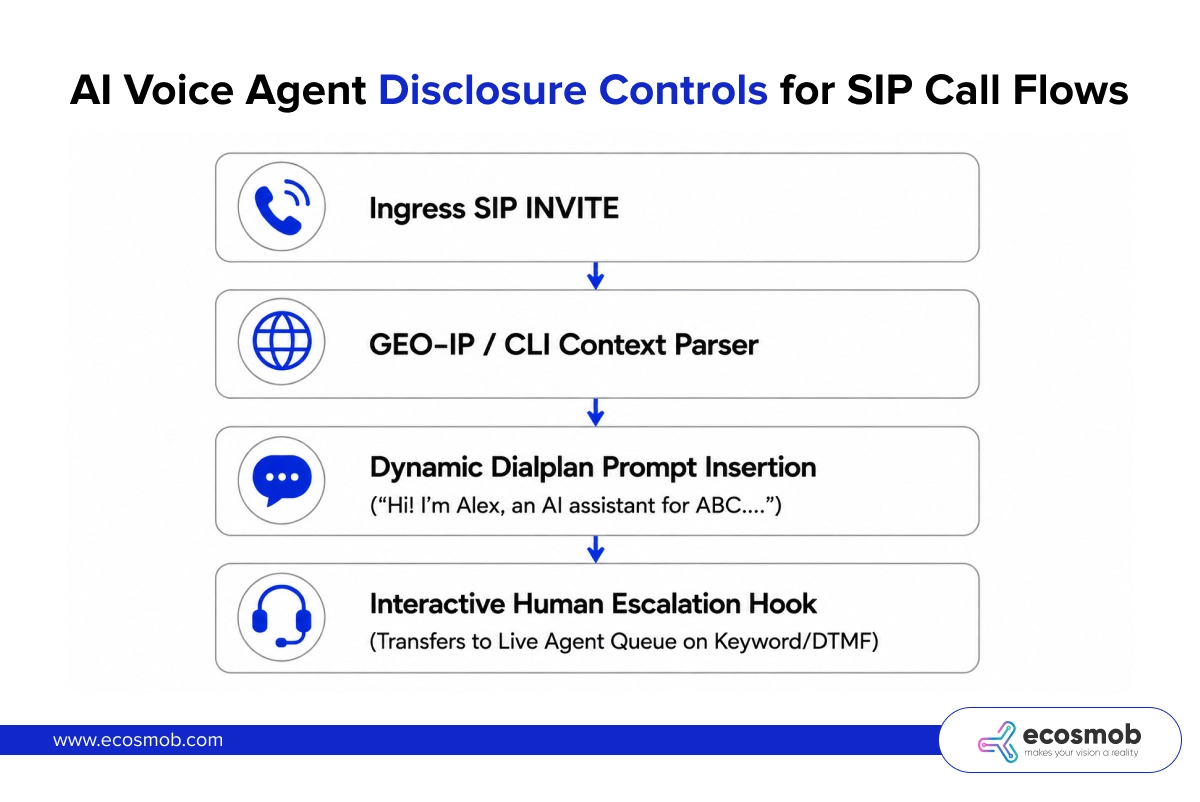
You can embed disclosure controls into SIP call flows without hurting conversion by placing concise 3-second disclosure phrases into the initial dialplan context and dynamically adjusting scripts based on caller location headers.
Enterprise teams often worry that a rigid legal disclosure will sound robotic and cause callers to hang up immediately. By structuring your dialplan and prompt design carefully, you can satisfy AI disclosure requirements to consumers while maintaining natural engagement.
- The “Concise Hybrid” Opening Script Strategy
Avoid long, overly formal legal disclaimers. Use clear, concise phrases that fulfill AI voice agents’ required disclosures directly within the greeting:
- Compliant Example (Service): “Hi! Thanks for calling ABC Support. I’m Alex, an AI voice assistant. How can I help you today?”
- Compliant Example (Outbound): “Hello John, this is an automated call from ABC Health using an AI voice assistant. I’m calling to confirm your appointment…”
- Geo-Targeted SIP Routing Logic
Instead of applying a blanket legal prompt across all global traffic, use your edge Session Border Controller (SBC) or FreeSWITCH/Asterisk dialplan to parse incoming Caller-ID (CLI) headers and enforce state laws AI calling disclosure requirement rules conditionally:
<!– FreeSWITCH Inbound Dialplan Context for Geo-Targeted AI Disclosure –>
<extension name=“california_inbound_disclosure”>
<condition field=“${caller_id_number}” expression=“^1(310|415|619|213)”>
<action application=“set” data=“ai_disclosure_mode=mandatory_proactive”/>
<!– Play AI disclosure message before connecting the call –>
<action application=“playback” data=“prompts/ca_ai_disclosure_greeting.wav”/>
<!– Forward the call to external middleware for further AI call handling –>
<action application=“socket” data=“127.0.0.1:8084 async”/>
</condition>
</extension>
- Asynchronous Human Escalation Routing
Enforce AI voice agents’ mandated disclosures regarding human access by maintaining an active Event Socket Layer (ESL) or AudioSocket hook. If the caller says “Let me speak to a real person” or presses 0, the system should instantly issue a non-blocking uuid_transfer command, moving the call to a human agent queue without dropping the session.
How to Mark Synthetic Audio in a Machine-Readable Format for AI Voice Agents?
You mark synthetic audio in a machine-readable format by embedding standardized cryptographic metadata tags (such as C2PA) or inaudible high-frequency acoustic watermarks directly into the raw audio stream during speech synthesis.
Simply put, meeting the EU AI Act synthetic voice disclosure requirement via machine-readable marking means stamping an invisible digital fingerprint onto the voice stream. Downstream telecom networks and security tools can read this hidden stamp to confirm the audio was generated by an AI, even if a human caller can’t hear the difference.
n-Band Acoustic Watermarking
Injecting imperceptible acoustic signals (often in the 18kHz to 20kHz high-frequency spectrum) directly into the uncompressed audio buffer prior to encoding. These watermarks survive lossy mobile codec compression (G.711, Opus) and allow security software to detect synthetic origins instantly.
Out-of-Band SIP Header Extensions
Attaching cryptographic provenance tags to outbound SIP INVITE signaling packets using custom header fields (e.g., X-Synthetic-Audio-Signature: c2pa=v1.0; hash=…).
The Risks of Non-Compliance for AI Voice Agents
Ignoring AI voice agents’ required disclosures isn’t just a regulatory issue, but a direct threat to your bottom line and network uptime.
- TCPA Statutory Fines: Under US federal law, non-compliant automated voice calls carry statutory damages ranging from $500 to $1,500 per individual call. In enterprise campaigns running thousands of daily calls, unconsented or undisclosed outreach can lead to multi-million dollar class-action lawsuits.
- State Consumer Protection Penalties: Violating state laws’ AI calling disclosure requirement mandates (such as California’s BOTS Act or Utah’s AI Policy Act) exposes businesses to state attorney general enforcement actions and administrative fines of up to $2,500 to $5,000 per violation.
- Upstream Carrier Blocking (STIR/SHAKEN): Tier-1 telecom carriers actively monitor network traffic for deceptive automated calling patterns. Unidentified synthetic voice bursts that generate high consumer spam complaints will result in attestation demotions (lowering your STIR/SHAKEN trust score from A to C) or immediate carrier-level IP blocking.
Adopting AI voice technology shouldn’t force your organization to choose between operational efficiency and legal compliance. By embedding transparent disclosure hooks, automated human escalation paths, and synthetic media markers directly into your core telephony stack, you protect your business from financial penalties (while building long-term trust with your callers!).
If your team is deploying AI voice agents (let’s say for your contact center) and needs to ensure that it’s within industry regulations, our telecom compliance experts are here to help!
Schedule an RTC Compliance Implementation Audit with Ecosmob today!
Frequently Asked Questions
An AI voice agent must fulfill AI voice agents’ required disclosures by explicitly stating that it is an artificial or synthetic assistant at the very beginning of the call. It must also identify the operating business, state the purpose of the call, provide an interactive opt-out mechanism for outbound calls, and offer a clear path to transfer to a human agent upon request.
The FCC currently treats AI-generated voices as artificial voices under the TCPA, making prior express written consent mandatory for outbound telemarketing calls. While explicit in-call AI disclosure rules are being actively expanded at the federal level, several states already enforce active state laws AI calling disclosure requirement rules.
California (BOTS Act 17941) requires disclosure for automated bots involved in commercial transactions or voting influence. Utah (AI Policy Act 13-69) requires disclosure when interacting with generative AI. Colorado (SB 24-205) requires clear notification before consumers interact with AI systems that influence significant decisions.
Inbound calls require disclosure if they operate in jurisdictions enforcing state laws AI calling disclosure requirement rules (like California or Utah) or if they collect sensitive biometric voice data, health details (HIPAA), or financial information (PCI-DSS). Outbound calls carry stricter federal obligations under the TCPA, requiring upfront consent and identity disclosure.
Article 50 of the EU AI Act defines the EU AI Act synthetic voice disclosure requirement, mandating that natural persons are informed when interacting with an AI system. Additionally, AI-generated synthetic audio (voice clones) must be marked in a machine-readable format to ensure artificial content is detectable.