
You have your AI use case picked out. The business case makes sense, your leadership team is on board, and your vendor says you can get started in weeks.
Then someone asks a simple question: “Are we actually ready for this?”
You start checking your data, infrastructure, security, teams, and integrations. Suddenly, the project that looked ready on paper has gaps you never thought to measure.
The deeper you look, the more confusing it gets. One framework gives you five pillars, another gives you six, and a third gives you an AI readiness assessment score without telling you what that score actually means.
You need a practical way to assess your gaps, score your readiness, and determine whether your specific AI use case is production-ready, particularly when your AI adoption framework covers real-time communication.
That is what this guide is built for.
So, what exactly should you be measuring before calling your organization AI-ready?
What is an AI Readiness Assessment?
An AI readiness assessment is a systematic evaluation of whether your organization has the data, technology, strategy, governance, and people needed to adopt and scale AI successfully. It helps you identify gaps before they turn into costly deployment problems.
Think of it as a reality check for your AI plans.
You may already have a promising use case, but your data may not be ready for it. Your infrastructure may struggle with production workloads. Your teams may lack the skills or ownership needed to operate it.
That is why AI readiness is broader than simply asking, “Can we use AI?”
You need to know whether your organization can support the specific AI solution you want to deploy, from its underlying data and systems to security, operations, and the people responsible for it. This is also where understanding the AI capabilities CPaaS providers should evaluate can add useful context, particularly when your AI solution needs to work within an existing communications environment.
It also helps to separate three ideas that are often treated as the same:
- AI readiness: Are you equipped to adopt and deploy AI?
- AI maturity: How advanced are your existing AI capabilities?
- AI governance: Can you manage AI securely, responsibly, and in line with your requirements?
Your assessment should answer the first question while showing you what needs to be improved before you move from an AI idea to a production deployment.
To find those gaps, you need to examine what your AI use case will depend on long before it reaches production.
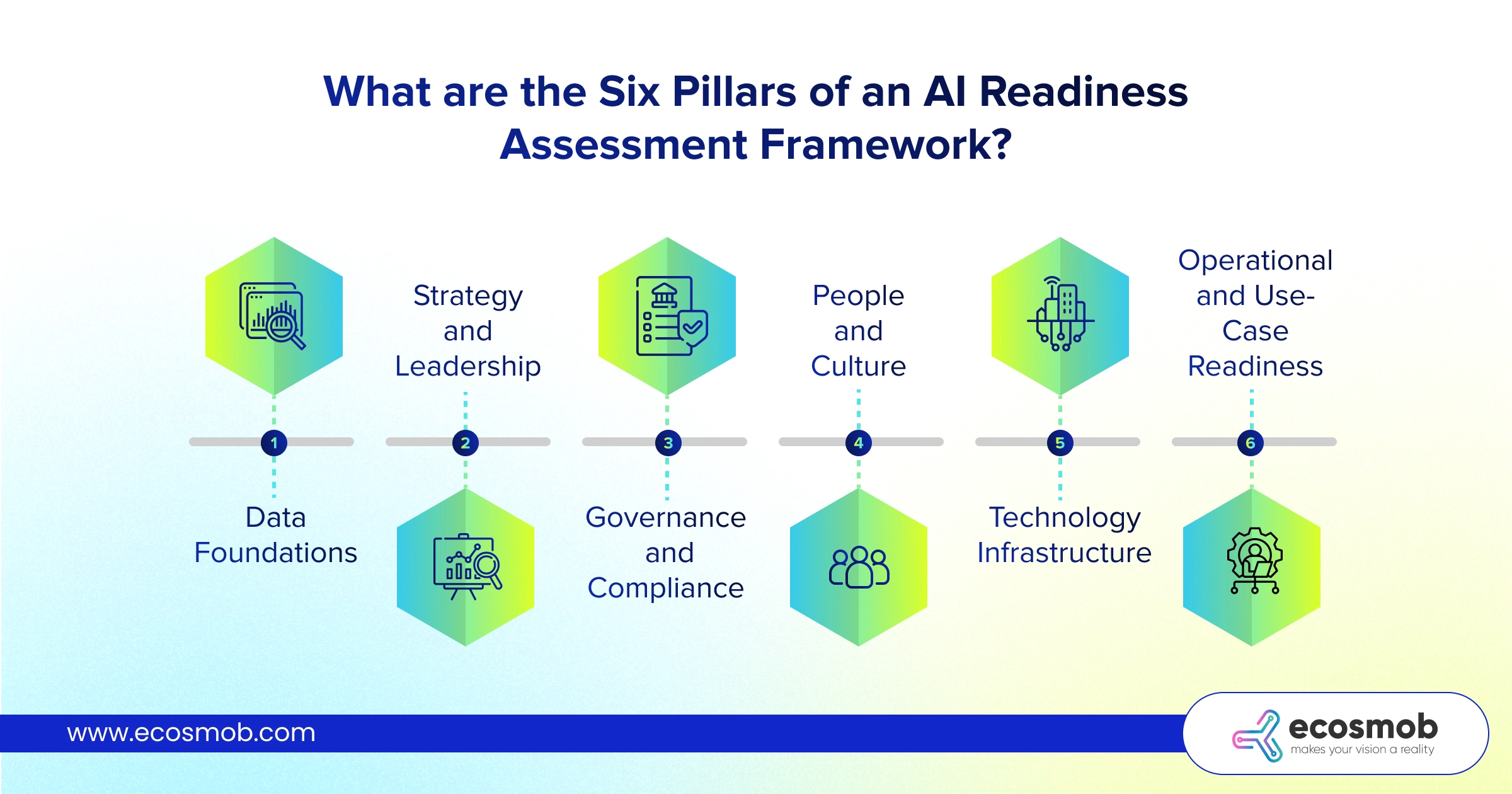
What are the Six Pillars of an AI Readiness Assessment Framework?
An AI readiness assessment framework typically evaluates six pillars: data foundations, strategy and leadership, governance and compliance, people and culture, technology infrastructure, and operational use-case readiness. Together, they show whether your organization is prepared to deploy AI successfully.
Think of these six pillars as the foundation beneath your AI plans. If one is weak, it can become the bottleneck that holds the entire deployment back.
1. Data Foundations
Your AI needs reliable, accessible, and relevant data to perform well. Check whether your data is:
- Available for the intended use case
- Accurate, structured, and accessible
- Properly governed and protected
- Suitable for real-time or historical processing, where required
For Voice AI, this also means looking at call data, recordings, knowledge sources, and the quality of information your AI will rely on. This foundation also supports AI escalation logic for AI voice systems, helping ensure conversations can move to the right human or system when needed.
2. Strategy and Leadership
You need a clear reason for deploying AI, not just an interesting use case.
Assess whether you have defined business goals, success metrics, leadership ownership, and investment priorities. Your chosen use case should connect to a measurable business outcome.
3. Governance and Compliance
Your AI cannot move safely into production if security and compliance are treated as an afterthought.
Review your privacy controls, access policies, authentication, AI risk processes, and regulatory requirements before deployment.
4. People and Culture
Your teams need to know who will build, manage, monitor, and improve your AI solution.
Look at your existing AI skills, training gaps, technical ownership, and readiness for changes to everyday workflows.
5. Technology Infrastructure
Your existing infrastructure needs to support the workload your AI will actually run.
Assess your cloud and compute environment, APIs, integrations, scalability, network performance, and monitoring capabilities.
6. Operational and Use-Case Readiness
Your overall readiness means little if your chosen AI use case cannot work reliably in its intended environment.
Check whether your systems, workflows, APIs, knowledge sources, monitoring, and human escalation paths can support the AI in production.
For demanding real-time use cases such as Voice AI, this may also mean checking SIP, RTP, codec compatibility, audio quality, network latency, and call data handling to fix voicebot latency real-time voice AI issues before they affect production.
Different AI readiness frameworks use different numbers of pillars because they group capabilities differently; Microsoft uses seven, while Cisco uses six.
What matters is whether your framework covers the capabilities your AI deployment actually depends on, rather than whether it follows a particular number.
Now that you know what to measure, the next step is to turn those areas into a practical AI readiness assessment checklist you can work through.
How Does an AI Readiness Assessment Checklist Work?
An AI readiness assessment checklist helps you test whether the foundations behind your AI use case are actually in place. It turns broad readiness questions into specific checks across data, infrastructure, integrations, security, knowledge, and operations.
Instead of asking whether your organization is “AI-ready” in general, use the checklist to uncover the gaps that could affect your particular deployment.
| What you assess | What to check |
| Data | If your data is accurate, accessible, relevant, and properly governed, |
| Infrastructure | Can your systems support the AI workload, scale, and performance requirements? |
| Integrations | Can your AI connect reliably with the API, CRM, databases, and applications it needs? |
| Security | Are authentication, access, controls, privacy, and compliance requirements covered? |
| Knowledge | Can your AI access accurate, current, well-structured knowledge sources? |
| Ownership | Do you have defined ownership, monitoring, workflows, and escalation paths? |
For more demanding use cases, your checklist should go beyond standard infrastructure checks. If you’re evaluating Voice AI, for example, you may also need to examine network latency, audio quality, SIP and RTP compatibility, call recordings, API response times, and real-time integrations.
The goal isn’t to collect a long list of “yes” and “no” answers. Your checklist should reveal where readiness is strong, where it breaks down, and which gaps could block production.
Your checklist shows where you stand, but what does that actually mean in numbers?
How to Measure AI Readiness for Real-time Communication?
You can measure AI readiness by scoring each area on a simple 0–5 scale, then applying weights based on its importance to your AI use case. This gives you a consistent score while showing where your biggest gaps are.
1. Start With a Simple Readiness Scale
Rate each area based on how well it is established:
| Score | Readiness level |
| 0 | Not in place |
| 1 | Initial |
| 2 | Partially Established |
| 3 | Defined and operational |
| 4 | Mature and consistent |
| 5 | Optimized and scalable |
For example, an API that exists but struggles under load should not receive a perfect score simply because it is available.
2. Give More Weight to Critical Areas
Some areas have a greater impact on deployment risk. A practical weighting model is:
| Readiness Pillar | Weight |
| Data Foundations | 25% |
| Strategy and Leadership | 15% |
| Governance and Compliance | 20% |
| People and Culture | 10% |
| Technology and Infrastructure | 20% |
| Operational and Use-case Readiness | 10% |
This gives 45% of the score to data and governance, reflecting their importance to reliable and responsible AI deployment.
3. Calculate Your Readiness Score
Combine your pillar scores using their weights to get a score out of 100.
For example, scores of 3, 4, 2, 3, 4, and 3 across the six pillars produce an overall score of 63/100.
Treat this as a baseline, not a pass-or-fail result. A 63% score with one critical governance gap means something very different from 63% with several minor gaps.
Your score tells you where you stand. Your gaps tell you what to do next.
What Do Different AI Readiness Scores Mean?
Your readiness score shows how prepared your organization is for AI, but the number alone is not enough. You need to interpret it alongside your critical gaps, operational capabilities, and the requirements of your specific AI use case, especially when evaluating AI use cases in telecom where technical and operational demands can vary significantly.
A simple maturity scale can help you understand what your score means:
- Low readiness: You have major gaps in foundational capabilities, and deployment may carry significant risk.
- Developing readiness: Some foundations are in place, but you still have important gaps to address.
- Strong readiness: Most required capabilities are established, with manageable gaps remaining.
- Advanced readiness: Your capabilities are mature, measurable, and positioned to support AI at scale.
Your score should help you answer a more useful question than “How AI-ready are you?”
It should tell you, “Are you ready for the AI you want to deploy?”
For example, a high overall score may not mean you are ready for a real-time voice solution if your network performance or integration latency falls short. Your RTC voice AI maturity score should reflect those use-case-specific requirements rather than hiding them behind a broad organizational average.
The same principle applies to any AI deployment. Your maturity level provides the context, while your use case sets the bar you need to clear.
How Do You Know If Your AI Use Case is Ready?
Your organization can have a strong overall readiness score and still be unprepared for a specific AI use case. You need to compare your current capabilities with the technical, data, security, and operational requirements of the solution you want to deploy.
Start by asking what your AI actually needs to work reliably.
| AI use case | What you need to validate |
| Generative AI | Knowledge quality, data access, security, model performance. |
| Predictive AI | Historical data, data quality, model accuracy, monitoring. |
| AI agents | APIs, workflows, permissions, human escalation |
| Real-time Voice AI | Latency, audio quality, SIP/RTP, integrations, uptime |
This use-case lens prevents you from treating every AI project the same way.
For example, your organization may have strong data governance and mature AI skills. But if your live voice workflow has high latency or poor audio quality, your voice solution may still struggle in production.
That is why your assessment should answer two questions:
Are you organizationally ready for AI?
Are you technically ready for this AI?
When both answers are positive, you have a much stronger foundation develop custom AI voice assistant for your business and move it toward production.
Once you know what to assess, score, and validate, you need a practical way to capture those findings.
When Should You Use an AI Readiness Assessment Template?
An AI readiness assessment template is useful when you want a repeatable way to document your findings, compare readiness across teams or use cases, and track improvements over time without rebuilding the assessment from scratch.
Your template should bring the assessment into one place, including:
- Readiness pillars: Data, strategy, governance, people, technology, and use-case readiness
- Assessment findings: What is already in place and where gaps exist
- Readiness scores: Scores for each pillar and your overall readiness level
- Use-case requirements: The specific technical and operational needs of your AI project
- Risk and priority levels: Which gaps need immediate attention
- Remediation actions: What needs to be fixed or improved
- Ownership and next steps: Who is responsible and what happens next
You can maintain the template as a working spreadsheet for ongoing assessments or turn the results into an AI readiness assessment PDF for leadership reviews and stakeholder discussions.
The goal is not to create another document that sits untouched. Your template should make it easy to answer three questions: Where are you ready? Where are the gaps? What should you do next?
How to Turn Your Assessment Into an AI Deployment Plan?
Once you know where your gaps are, turn them into a prioritized deployment plan. Your next move should focus on fixing the gaps that create the greatest technical, security, or operational risk.
Start with the gaps that could block your AI deployment completely. Then address issues that could affect performance, scalability, or user experience.
A practical priority order is:
- Critical blockers: Resolve security, data, infrastructure, or integration issues that could prevent deployment.
- High-impact gaps: Fix issues that could reduce AI accuracy, reliability, or performance.
- Optimization areas: Improve capabilities that can make your AI more efficient or scalable later.
This keeps you from trying to fix everything at once.
For example, if your AI depends on real-time conversations, you may need to resolve latency or integration issues before worrying about broader optimization. Your voicebot deployment plan should reflect those dependencies and the order in which they need to be addressed.
The result is a roadmap that connects your current readiness to your next practical steps, rather than leaving you with a score and a pile of unanswered questions.
So, you’ve measured your readiness. Now, let’s bring it all together.
The Bottom Line?
An AI readiness assessment should tell you more than whether your organization is “ready” or “not ready.” Your score should expose the gaps behind it, show which areas carry the most risk, and connect those gaps to the AI use case you actually plan to deploy.
Ecosmob approaches AI readiness by evaluating your infrastructure, data, integrations, security, technology, and operational requirements to identify gaps and build a prioritized path toward production.
If you skip these checks, a strong overall score can still hide a deployment blocker, such as latency, poor data quality, integration failures, or missing governance controls. That is the part generic frameworks often fail to reveal.
Frequently Asked Questions
AI readiness means having the data, technology, strategy, governance, and people needed to adopt and deploy AI successfully. It also means your organization can support the specific AI use case you want to move into production.
The seven levels of AI capability describe how AI systems can progress from basic functionality to more advanced capabilities. They are different from AI readiness levels, which measure whether your organization is prepared to adopt and operate AI.
The 30% rule has no universally accepted definition and is used inconsistently. It often refers to the share of AI project effort spent on modeling versus data and integration. For readiness, this assessment gives data and governance 45% of the total weight.
An AI readiness assessment should measure data foundations, strategy and leadership, governance and compliance, people and culture, technology infrastructure, and operational use-case readiness. Together, these areas show whether your organization and specific AI project are ready for deployment.
An AI readiness score can be calculated by rating each readiness pillar from 0 to 5, applying a weight to each pillar, and combining the weighted results into a score out of 100. This provides a consistent baseline for comparing readiness and identifying gaps.