You won’t find most enterprise voice AI projects dying in development. The moment they stumble is when they hit live traffic.
It’s easy to get excited when your voicebot pilot performs flawlessly during a clean desktop demo. But taking that same bot and exposing it to 5,000 simultaneous SIP calls over spotty mobile networks, background traffic noise, heavy regional accents, and sudden server failovers is a completely different ballgame.
If you’re a VP of Engineering or Telecom Architect staring down a nationwide rollout, that pre-launch anxiety is completely justified: Will our AI hold up under pressure, or will it stutter, freeze, and turn our customer support line into a viral meme?
Getting a voice agent to work in a sandbox is only step one. The real magic happens during production hardening: the systematic process of stress-testing scalability, media stream quality, system resilience, and regulatory compliance before your customers ever hear a single word.
Here is the exact blueprint to prove your voicebot is ready for prime time.
What Is AI IVR Testing and How Does It Differ From Traditional IVR Testing?
AI IVR testing is an automated engineering methodology that validates multiple aspects of conversational voice agents under real-world production conditions:
- End-to-end performance
- Speech accuracy
- Natural language understanding (NLU)
- Media stream quality
- Infrastructure resilience
If you’ve tested traditional IVR systems in the past, forget the old playbook. Traditional IVRs are rigid and predictable: a caller presses a key, an RFC 2833 DTMF tone fires, and a static audio file plays back from a server.
Conversational AI voice agents don’t work in neat, linear trees. They rely on full-duplex, asynchronous pipelines where raw 16kHz audio streams continuously over WebSockets, intent is parsed dynamically by non-deterministic language models, and response audio is synthesized on the fly while handling unexpected caller interruptions (barge-in).
Because conversational voicebots operate on non-deterministic data, your voicebot testing solution must evaluate three dynamic layers that standard keypad testing completely misses:
- Media Stream Integrity: Tracking packet loss, jitter, and MOS scores on raw LPCM audio passing through edge SIP proxies and persistent WebSockets.
- Real-World ASR & NLU Accuracy: Testing Word Error Rate (WER) and intent precision when callers speak with heavy background noise, local dialects, or overlapping phrases.
- Compounding Pipeline Latency: Measuring the microsecond delays added as audio travels across Speech-to-Text (ASR), LLM reasoning, database API tool calls, and Text-to-Speech (TTS) rendering.
How to Do Call Recording Compliance Testing in AI Voice?
When your voice agent handles live customer calls, compliance is non-negotiable. Validating call recording compliance testing requires securing payment card details and protecting customer voice data before raw audio ever touches cloud APIs.
- PCI-DSS Compliance & DTMF Suppression
If your AI voice agent collects payment information, test that raw credit card numbers never enter cloud LLM prompts or persistent transcript logs:
- Audio Muting & DTMF Clamping: Test that when the bot prompts for payment, the media proxy suppresses the audio path and captures DTMF tones directly via RFC 2833, masking card details on the transcript stream.
- Pause-and-Resume Mechanics: Validate that dual-tone multi-frequency (DTMF) clamping correctly silences call recording buffers during payment collection phases.
- Biometric Voiceprint Privacy & Data Vaulting
Under privacy laws like Illinois BIPA, GDPR, and US state regulations, a caller’s voice is legally classified as protected biometric data.
- Explicit Consent Hooks: Make sure your dialplan executes a mandatory disclosure context (“This call is recorded and processed using AI…”) before opening any streaming media socket.
- Encrypted Vault Storage: Confirm that all saved audio files and text transcripts are encrypted at rest using AES-256, supported by strict Business Associate Agreements (BAAs) across all third-party API processing nodes.
How to Load Test a Voice Agent for High-Concurrency Carrier Traffic?
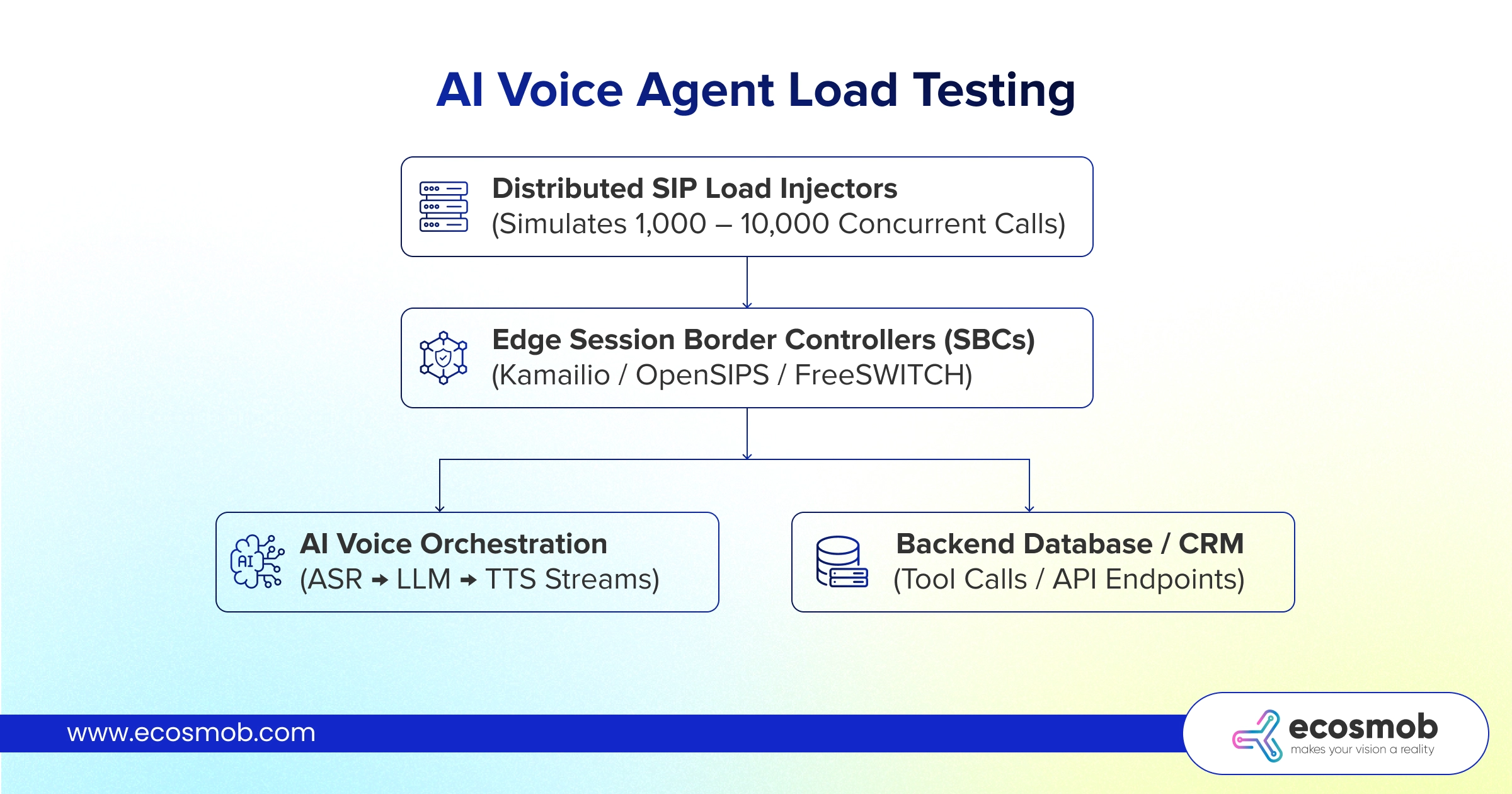
Testing an AI IVR for enterprise traffic isn’t as simple as firing thousands of HTTP requests at a web server. You must simulate real-world, full-duplex SIP/RTP call legs hitting your media edge, streaming binary audio data down to your AI orchestration services in real time.
- SIP Ingress & RTP Media Stream Injection
Deploy distributed load generation tools (like SIPp, Hammer, or Locust-SIP runners) across multiple cloud regions. Instead of silent audio, inject real customer call recordings complete with background street noise, varying volume levels, and different accents directly over G.711 μ-law or Opus RTP streams.
- Microservice Concurrency & Bottleneck Tracking
As your test ramps up toward peak concurrency (e.g., 10,000 simultaneous calls), monitor your infrastructure for three hidden bottlenecks:
- Streaming ASR Worker Scaling: Verify that your Speech-to-Text WebSocket workers scale horizontally without dropping initial connection handshakes.
- LLM Token & Rate-Limit Caps: Ensure your cloud API or local inference cluster doesn’t hit Tokens-Per-Minute (TPM) or Requests-Per-Minute (RPM) limits under heavy traffic bursts.
- Backend Tool-Call Thread Pools: Watch your database connections closely. If a mid-call CRM lookup slows down past 300ms during a traffic spike, confirm that your orchestration middleware uses short, non-blocking filler prompts (“Let me pull that up for you…”) to prevent awkward dead air.
What Accuracy and Latency Thresholds Must a Voice Agent Hit Before Launch?
To maintain a smooth, human cadence, your voice agent must hit an end-to-end latency budget of 300ms to 500ms and keep Word Error Rates (WER) strictly under control.
Neurological research shows that human conversation naturally operates on a 200ms to 300ms turn-taking window. If your voicebot takes longer than 700ms to start speaking, callers naturally assume the line died, talk over the bot, or hang up out of frustration.
The latency numbers below reflect live production telemetry across modern cloud ASR and LLM pipelines:
| Performance Metric | Production Target SLA | Unacceptable Threshold (Dealbreaker) | Architectural Root Cause |
| End-to-End Latency | 300ms – 500ms | > 800ms (P95) | Compounding buffer delays across ASR, LLM, and TTS. |
| Speech Recognition | < 5% (Clean) / < 12% (Noisy) | > 18% (Domain Jargon) | Unadapted acoustic models struggling with real-world noise. |
| Time-to-First-Audio (TTS) | < 180ms (P50) / < 250ms (P95) | > 400ms (P95) | Non-streaming TTS engines or un-cached system prompts. |
| Mean Opinion Score (MOS) | > 4.1 (G.711 / Opus) | < 3.5 MOS | RTP packet loss, buffer jitter, or CPU core starvation. |
| Barge-In Latency | < 100ms Buffer Purge | > 250ms Audio Tailing | Slow socket commands fail to clear playout buffers fast enough. |
| Task Containment Rate | 75% Resolution | < 50% Containment | Hallucinations, fragile NLU prompts, or database API timeouts. |
To set realistic voicebot testing solution expectations for your QA team, look at the research published by Deepgram’s Speech AI team.
A common trap for engineering teams is assuming that clean benchmark scores will hold up in production. In controlled lab environments, top-tier ASR models achieve impressive Word Error Rates under 2% on clean, studio-recorded speech.
However, Deepgram’s research reveals that real-world business audio (plagued by cellular packet loss, background noise, regional accents, and domain-specific jargon) causes production Word Error Rates to jump by 6x to 9x compared to clean benchmarks.
Furthermore, switching an ASR engine from offline batch processing to real-time streaming mode adds an additional 66% relative WER increase because the model processes audio incrementally without seeing the full sentence context.
This is why generic testing fails. Your AI IVR testing software must evaluate customized acoustic models and domain-specific vocabularies to close this accuracy gap before going live.
Evaluating the AI IVR Testing Software Landscape
When picking an AI IVR testing software stack, choose tools that match your specific engineering needs across:
- Load generation
- Speech accuracy analysis
- Media quality monitoring
| Testing Platform | Primary Engineering Focus | Telephony Protocol Support | Key Testing Capabilities | Production Target |
| Ecosmob Production Hardening for RTC AI | Telecom AI Hardening & Load Validation | Native SIP, WebRTC, PJSIP, ESL | Full-duplex load simulation, audio MOS scoring, chaos failover validation. | Telecom carriers, MVNOs, CPaaS, and enterprise contact centers. |
| Hammer Voice Explorer | Infrastructure & Carrier Load | Native SIP, PSTN, WebRTC | Load generation, network stress testing, TDM bridging. | Telecom operators and legacy enterprise contact centers. |
| Bespoken AI | End-to-End Bot QA | WebRTC, Cloud Voice APIs | Speech recognition accuracy, intent precision, regression suites. | Product teams testing conversational voice app logic. |
| Cyara | Omnichannel CX Testing | SIP, WebRTC, PSTN | Automated CX journey testing, synthetic campaign monitoring, voice QA. | Enterprise contact center operations teams. |
| PumpCX / Cekura | Pipeline Automation | SIP, WebSockets | Persona simulation, accent testing, CI/CD pipeline test automation. | DevOps teams embedding voice testing into CI/CD pipelines. |
What Should Your AI IVR Testing Software Test? (Beyond the Standard)
A truly comprehensive RTC AI production readiness framework should cover technical edge cases that standard software briefs usually overlook:
- Accent & Dialect Resiliency: Testing speech recognition performance against diverse regional accents and non-native speakers to prevent localized high drop-off rates.
- Network Degradation & Packet Loss Simulation: Intentionally injecting 5% to 15% packet loss and 50ms jitter into the RTP stream to verify how your codec jitter buffers and ASR models handle degraded audio.
- Acoustic Background Noise Immunity: Validating bot performance against real-world background soundscapes (e.g., street traffic, call center chatter, wind noise, speakerphones).
- Prompt Injection & Guardrail Security: Testing generative LLM layers against malicious caller inputs attempting to bypass bot boundaries, leak system prompts, or trigger inappropriate responses.
- Voicemail & Answering Machine Detection (AMD): Ensuring outbound voicebots accurately identify answering machine tones in under 300ms to prevent speaking over automated greeting messages.
Voicebot Testing Solution Production Readiness Scorecard (Your Go Live Checklist)
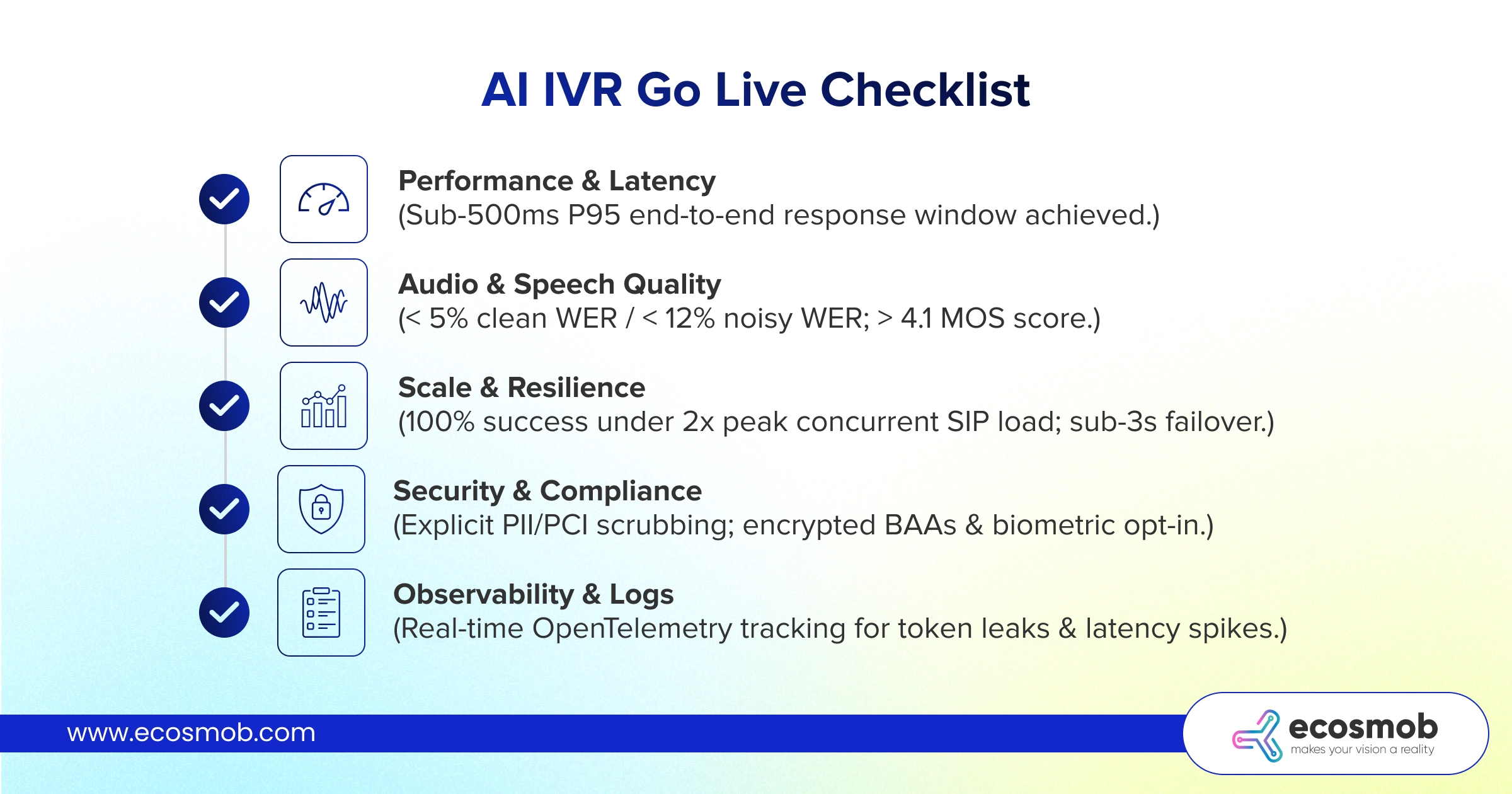
Before approving your voice AI agent for enterprise rollout, run it through this 5-point engineering checklist:
1. Performance & Latency Sign-Off
- End-to-end response latency averages 300ms to 500ms (P95 < 800ms) under simulated load.
- Time-to-First-Audio (TTFA) for Text-to-Speech synthesis stays under 200ms.
2. Media Quality & Speech Accuracy Sign-Off
- Word Error Rate (WER) stays under 5% on clean audio and under 12% in 15 dB background noise.
- Mean Opinion Score (MOS) remains consistently above 4.1 across active RTP channels.
3. Concurrency & Infrastructure Resilience Sign-Off
- The system sustains 2x projected peak concurrent call volume for 4 consecutive hours without memory leaks or dropped frames.
- Chaos testing confirms automatic failover to backup voice servers or human agent queues within 3 seconds of service failure.
4. Security & Compliance Sign-Off
- PCI-DSS DTMF suppression correctly masks payment card data during test transactions.
- Biometric consent disclosures execute reliably before opening streaming media sockets.
5. Observability & Telemetry Sign-Off
- OpenTelemetry traces are active across every pipeline component (ASR, LLM, TTS, DB) for real-time latency tracing.
- Automated alerts trigger the moment LLM token usage, WER, or call drop rates cross operational thresholds.
Ecosmob’s Production Hardening for RTC AI (Validating Voice AI for Enterprise Scale)
Building an AI solution is only half the challenge; ensuring it performs consistently under real-world production workloads determines long-term success. While initial integration connects AI with existing systems, Ecosmob’s Production Hardening provides the final technical validation before nationwide deployment, answering one critical question: “Can our AI solution reliably and securely handle real-world production traffic?”
Production environments introduce unpredictable stress:
- Thousands of simultaneous calls
- Packet loss
- Network outages
- High latency
- Infrastructure failures
- Traffic spikes
- Unexpected failovers
Without proper hardening, even a well-integrated AI system risks downtime, degraded performance, and poor customer experiences. We validate and optimize your integrated solution so it remains stable, responsive, and resilient under enterprise demands.
Some of what we validate before your rollout:
- Load & Scalability Testing: Validating system stability under heavy traffic spikes and up to 10,000 concurrent calls.
- Failover & High Availability (HA): Ensuring automatic server recovery and resilience if CRMs, APIs, or infrastructure nodes fail.
- SIP & RTP Quality Tuning: Optimizing low latency and voice quality under packet loss and heavy network load.
- Performance & AI Monitoring: Implementing monitoring frameworks to track real-time operational readiness and AI quality.
- Core Deliverables: A production-ready AI solution, monitoring framework, High Availability architecture, and comprehensive performance reports.
Building a conversational pilot is all about connection: wiring up WebSockets, hooking into CRMs, and making sure the AI can talk to your telephony stack. But preparing that integrated system to survive real-world enterprise traffic is a completely different challenge.
While initial integration proves that your voicebot can work, production hardening proves that it will work when thousands of customers call simultaneously. It’s the difference between building a race car in a garage and proving it can run a 24-hour endurance race without blowing an engine.
If your team has built a working AI IVR pilot and needs to validate scalability, eliminate latency bottlenecks, or complete a full pre-launch audit, we have experts who’ve been pioneering this! Schedule Production Hardening for RTC AI with Ecosmob today.
Frequently Asked Questions
Before going live, your AI IVR testing software should test five core dimensions: full-duplex load capacity under peak concurrent SIP calls, end-to-end latency (targeting sub-500ms), speech accuracy (WER) under real-world background noise, chaos failover resilience, and PCI/HIPAA compliance (including DTMF clamping and biometric privacy consent).
Traditional IVR testing evaluates deterministic, keypad-driven menus (“Press 1 for Billing”) and static audio files. A modern voicebot testing solution validates non-deterministic AI pipelines, measuring real-time 16kHz LPCM audio streams, dynamic barge-in handling, intent parsing precision, and compounding latency across streaming ASR, LLM, and TTS services.
Your AI IVR is ready for production when it passes all criteria on the Production Readiness Scorecard: maintaining sub-500ms P95 response latency, under 12% Word Error Rate under background noise, 100% stability under 2x peak concurrent SIP load, sub-3-second chaos failover recovery, and verified zero-knowledge PII/PCI audio redaction.
Production audio degrades ASR accuracy by 6x to 9x compared to clean studio benchmarks. Real customer calls introduce lossy mobile codecs, background noise, regional accents, and streaming mode penalties (which add a 66% relative WER increase). Production readiness requires testing with domain-adapted acoustic models to close this accuracy gap.
Testing call recording compliance for AI requires verifying that DTMF suppression silences call recordings and masks payment data during PCI transactions. It also involves verifying unskippable biometric consent disclosures, verifying AES-256 audio encryption at rest, and confirming Business Associate Agreements (BAAs) across all third-party API processing nodes.