
Remember Ross shouting “Pivot!” while trying to maneuver a sofa up the stairs? Everyone was trying to make the same thing work, but the lack of coordination turned a simple task into chaos.
Modernizing a telecom BSS (Business Support Systems) can feel surprisingly similar. Your billing platform, customer records, and product catalog may each work fine on their own, but getting them to work together is another story. Add AI to the mix, and the question isn’t just what you can automate. It’s how you can introduce smarter capabilities without disrupting the systems your business depends on.
AI capabilities for telecom BSS upgrades can help you find that balance. Let’s explore which AI use cases in telecom deserve priority, how the architecture fits together, and how to implement AI without rebuilding your entire BSS.
The trick isn’t shouting “Pivot!” at your BSS. It’s knowing what to change, what to keep, and where AI actually belongs.
What is Telecom OSS BSS?
Telecom OSS/BSS refers to the systems that help you manage network operations, customer services, billing, and revenue. AI Capabilities for Telecom BSS Upgrades build on these systems with anomaly detection, predictive insights, and workflow automation to help you make faster, better-informed decisions.
And what is OSS BSS in networking? OSS (Operations Support Systems) manages network operations, while BSS handles customer accounts, services, billing, and revenue.
Think of OSS as the team keeping your network running and BSS as the team managing the business behind your services.
- OSS (Operations Support Systems) handles network monitoring, fault management, and service provisioning.
- BSS (Business Support Systems) manages customer accounts, product catalogs, subscriptions, billing, and payments.
Here’s where things get interesting. Your BSS might identify a billing discrepancy, but AI can help flag unusual patterns before they turn into recurring revenue leakage. Similarly, custom AI voicebot solutions for intelligent customer interactions can help your support team retrieve relevant account information faster, without manually checking multiple systems.
The goal isn’t to replace your OSS/BSS. It’s to make the systems you already rely on more intelligent.
That distinction matters when you decide which AI capabilities to introduce first.
Now that the roles are clear, let’s look at where AI can make the biggest difference across your BSS.
What AI Capabilities for Telecom BSS Upgrades Can Modernize Your Systems?
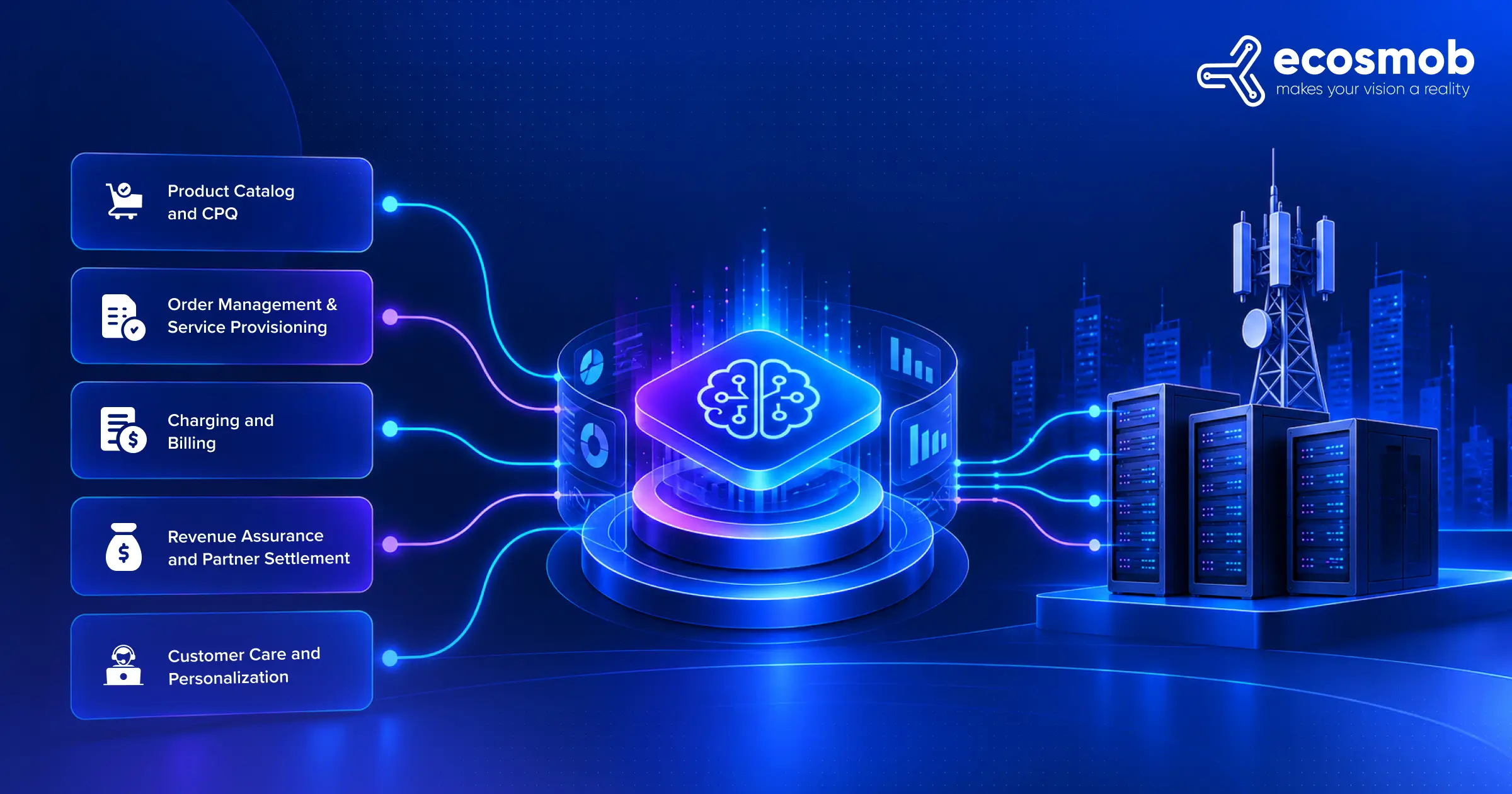
AI Capabilities for Telecom BSS Upgrades Can Modernize Your Systems by improving product recommendations, order processing, billing accuracy, revenue assurance, and customer support. The right capabilities help you reduce manual work, uncover hidden issues, and make better decisions without replacing your existing systems.
The key is to match each capability to a business problem. Here are five areas where AI can make a practical difference.
1. AI for Product Catalog and CPQ
Launching a new telecom plan often involves checking product rules, pricing, eligibility, and service dependencies. AI can help you analyze customer demand, recommend suitable offers, and assist your team with product configurations.
The payoff: You can explore new offers faster without having to make every decision manually.
2. AI for Order Management and Service Provisioning
An order can stall due to missing information, incompatible products, or unresolved dependencies. AI can flag incomplete orders, identify potential bottlenecks, and help your team prioritize exceptions.
The payoff: Fewer avoidable delays between placing an order and activating a service.
3. AI for Charging and Billing
Billing errors can damage customer trust and create costly investigations. AI can flag unusual charges, detect recurring billing patterns, and help explain discrepancies for further review.
I would start here if billing accuracy is a major concern. Let AI identify what looks wrong, but keep your billing rules responsible for calculating what customers owe.
4. AI for Revenue Assurance and Partner Settlement
Revenue leakage can hide in mismatched usage records, rating discrepancies, or partner settlement data. AI can help you identify unusual patterns and prioritize transactions that need reconciliation.
The payoff: Your revenue team can focus on suspicious discrepancies rather than manually reviewing every record.
5. AI for Customer Care and Personalization
When customer information is scattered across systems, resolving a simple query can take longer than it should. AI can summarize account history, suggest relevant responses, flag churn risks, and recommend suitable plans. Voice bot integration with CRM explains how connecting voicebots with CRM systems helps them access customer information and support more contextual interactions.
The payoff: Your support team spends less time searching for information and more time resolving customer issues.



Revenue slipping through mismatched usage records? Anomaly detection gets layered on top of your rating engine, never inside it.
Click to know more!
Mapping AI capabilities to your BSS
| BSS domain | AI capability | Initial autonomy |
| Catalog and CPQ | Offer recommendations | Recommend |
| Order management | Flag incomplete orders | Recommend |
| Billing | Detect unusual charges | Observe |
| Revenue assurance | Identify revenue discrepancies | Observe |
| Customer care | Suggest response & next actions | Recommend |
Start with observation and recommendations before allowing AI to execute changes. Once you validate its accuracy, you can introduce controlled automation with approval rules and audit trails.
That brings us to the next decision: which AI capabilities should you prioritize first?
AI Capabilities for Telecom BSS Upgrades Priorities
Your AI roadmap should start with capabilities that solve measurable business problems and fit your existing systems. Prioritize low-risk use cases first, then expand toward automated decisions as your data quality, integrations, and governance mature.
I would evaluate each capability against three questions: Does it solve a real problem? Is your data ready? Can you verify the results safely?
| Priority | AI capability | Why prioritize it? |
| 1 | Billing anomaly detection | Flags unusual charges without changing billing calculations |
| 2 | Customer care assistance | Helps your team resolve queries using existing customer records. |
| 3 | Order validation | Identifies missing information and potential fulfillment delays |
| 4 | Autonomous workflows | Automates approved actions once controls and integrations are proven. |
These AI capabilities for telecom BSS upgrades priorities should reflect your most pressing business challenges, data readiness, and ability to validate results safely.
For example,
>> If billing discrepancies consume hours, start with AI flagging suspicious transactions and measure accuracy before corrective action. If customer support is the bottleneck, an AI assistant may deliver value sooner. The broader opportunity is substantial: McKinsey estimates that generative AI could create $60–100 billion in annual value for the telecommunications industry.
>> If customer support is your biggest bottleneck, an AI assistant that retrieves account details and suggests responses may deliver value sooner.
The best starting point isn’t necessarily the most advanced AI capability. It’s the one you can implement, measure, and trust.
This is also where AI maturity matters. You can begin with observation, move to recommendations, and introduce execution only when your safeguards are ready.
Next, let’s look at the architecture that connects these capabilities to your existing BSS without requiring a complete rebuild.
How Does the AI Architecture for Modernizing Legacy Telecom BSS Work?
You can integrate AI into your existing telecom BSS without replacing the entire system. A practical architecture connects legacy platforms to an AI layer through APIs and events, supported by reliable data, controlled workflows, and clear approval rules.
The idea is simple: keep your core systems running while adding intelligence around them.
1. Existing OSS/BSS Platforms
CRM · Product catalog · Orders · Charging · Billing
2. Integration Layer
Open APIs · Event bus · Legacy adapters
3. Data and Semantic Layer
Data quality · Customer context · Business rules
4. AI and Agent Layer
Prediction · Recommendations · Workflow orchestration
5. Governed Action Layer
Policy engine · Human approval · Audit trail · Controlled actions
Each layer has a specific job.
- Integration layer: Connects your existing platforms to AI services. APIs handle requests, while events can notify AI workflows when relevant changes occur.
- Data and semantic layer: Brings together customer, product, order, and billing information. Consistent definitions help AI interpret that information correctly.
- AI and agent layer: Detects patterns, generates recommendations, and coordinates workflows based on your business requirements.
- Governed action layer: Checks permissions, enforces business rules, records decisions, and routes sensitive actions for approval.
Standards such as TM Forum Open APIs can help you connect systems through defined interfaces. For example, TMF620 supports product catalog management, TMF622 supports product ordering, and TMF678 supports customer bill management.
One important distinction: AI can flag a billing discrepancy, but your established billing engine should remain responsible for calculating charges. Any corrective action should pass through validated rules and authorization controls.
This architecture lets you introduce AI capabilities for telecom BSS upgrades incrementally. You can start with one use case, validate its results, and expand without making a complete rebuild your first step.
The architecture provides the foundation, but your implementation plan determines whether it delivers results.
How to Implement AI Capabilities in Telecom BSS Step by Step
Implementing AI capabilities for telecom in BSS works best as a phased process. Start with one measurable business problem, validate your data, and test AI outputs before introducing automation. This approach helps you improve existing systems without disrupting critical billing and service workflows.
1. Identify Your First Use Case
Start with a problem you can measure, such as billing discrepancies, delayed orders, or repetitive customer queries. For example, an AI voicebot for L1 support can help automate routine customer queries. Choose the pain point, not the trendiest AI tool. Define a baseline KPI before implementation.
2. Check Your Data Readiness
Review your customer records, product catalogs, order histories, and billing data. If information is incomplete or inconsistent, fix those gaps before relying on AI recommendations.
3. Integrate AI With Your Existing BSS
Connect the selected AI capability to your BSS through APIs, event streams, or suitable legacy adapters. You don’t need to replace your core platforms to start testing a targeted use case.
4. Test Before You Automate
Run a pilot using historical data and controlled live workflows. Compare AI outputs against verified results, and keep human approval in place for sensitive decisions, especially billing adjustments.
5. Measure Results and Expand
Track KPIs such as anomaly detection accuracy, order processing time, support resolution time, and false-positive rates. I would expand to the next use case only after the pilot meets your agreed targets.
Your first deployment should prove value, not promise perfection. Once the results are reliable, you can gradually move from observation to recommendations and then to controlled execution.
A phased rollout reduces risk, but it doesn’t eliminate it. You also need safeguards for the data, decisions, and workflows your AI touches.
What Are the Risks of AI-Powered Telecom BSS Modernization?
AI-powered telecom BSS modernization can introduce risks such as inaccurate predictions, poor data quality, security gaps, and billing errors. You can reduce these risks with data validation, access controls, human oversight, and clear rules for AI-driven actions.
1. Data Quality and Inaccurate Outputs
AI can only work with the information available to it. Inconsistent customer records or outdated product data can lead to unreliable recommendations.
Your safeguard: Validate data before deployment and monitor output accuracy as your systems change.
2. Billing Errors and Revenue Leakage
An incorrect AI recommendation could affect charges, customer trust, or revenue assurance if it triggers an unchecked action.
Your safeguard: Keep billing calculations within your established rating engine. Require validation and authorization before adjustments are made.
3. Security and Compliance Gaps
AI integrations may expose sensitive customer or usage data if permissions and data handling are poorly managed. A well-defined AI voice agent disclosure architecture can help establish transparency and accountability in how AI-driven interactions are handled.
Your safeguard: Apply role-based access, data minimization, audit trails, and relevant compliance controls.
4. Uncontrolled Automation
Giving AI too much authority too early can turn a small error into a larger operational problem.
Your safeguard: Start with observation, progress to recommendations, and allow execution only within tested limits.
The goal isn’t to eliminate every risk before you begin. It’s to make sure each AI capability has safeguards proportionate to its impact.
We’ve covered the key risks of AI-powered BSS modernization, the safeguards that help manage them, and how to prioritize the right capabilities.
Now, let’s bring it all together.


Letting AI act on billing without approval rules is how small errors become big ones.
Policy engines and audit trails come first here.
Optimize your BSS!The Bottom Line?
Delaying AI adoption could mean missing opportunities to reduce revenue leakage, improve customer experience, and streamline BSS operations. The key is knowing which AI capabilities for telecom BSS upgrades to prioritize before investing in tools that may not solve your biggest challenges.
At Ecosmob, we approach BSS modernization by aligning AI capabilities with your existing infrastructure, business goals, and integration needs. The right first step could make your next upgrade far more valuable.
Frequently Asked Questions
Yes, telecom companies use AI for customer support automation, fraud detection, predictive maintenance, personalized offers, and revenue assurance. In BSS modernization, AI can help detect billing anomalies, streamline order management, and improve customer interactions.
Key AI use cases in telecom BSS include billing anomaly detection, revenue assurance, intelligent order management, personalized product recommendations, and AI-assisted customer support. These capabilities help telecom operators reduce manual work, improve operational efficiency, and make better-informed decisions.
AI can modernize legacy telecom BSS systems by integrating with existing platforms through APIs, event streams, and data layers. This allows operators to introduce predictive analytics, recommendations, and workflow automation without replacing their entire BSS infrastructure.
Common challenges include poor data quality, legacy system integration, security and compliance requirements, inaccurate AI outputs, and billing risks. Operators can address these challenges through data validation, controlled integrations, human oversight, and clear governance policies.
Telecom companies should prioritize AI capabilities based on business impact, data readiness, implementation complexity, and risk. Starting with use cases such as billing anomaly detection or customer care assistance allows teams to measure results before expanding to more autonomous workflows.