
On his first day, Marcus was handed one task:
“Set up ingress for the new microservices cluster.”
Simple enough, he thought.
Two weeks, seven YAML files, and one very awkward all-hands meeting later, he realized nobody had told him there were dozens of ingress controllers, and picking the wrong one had consequences.
Most teams don’t struggle with Kubernetes anymore. They struggle with what happens around it.
Your services scale. Your deployments look clean.
But traffic? That’s where things quietly go sideways.
Requests start taking longer routes. TLS setups become fragile. A rollout that “should be safe” suddenly drops traffic for a few seconds.
That’s not a Kubernetes problem. That’s an ingress decision catching up with you.
If you’re looking for the best ingress controller for Kubernetes in production, you’re really solving for reliability, latency, and control.
Here’s the guide Marcus wished he had.
What is an ingress controller?
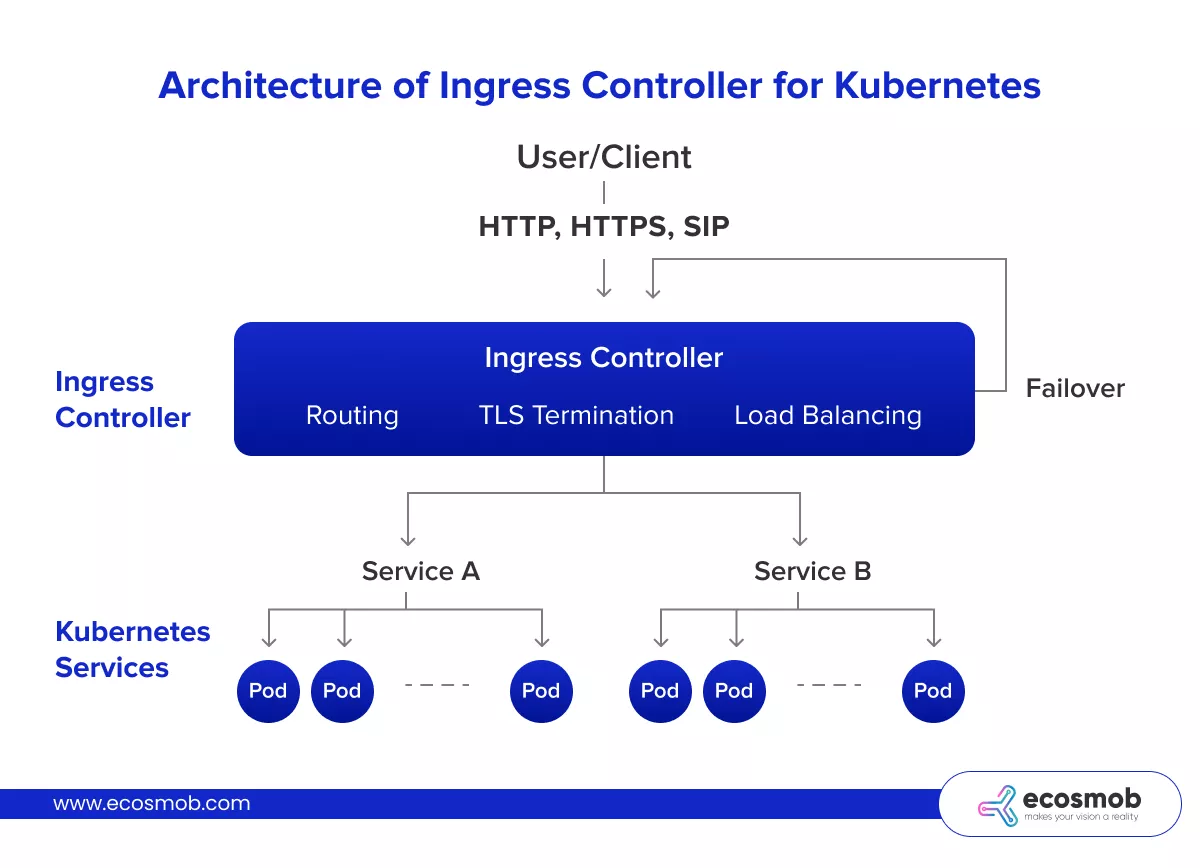
An ingress controller manages incoming traffic to your Kubernetes cluster. Every request hits it first. It decides:
- Where traffic goes
- How it’s secured (TLS termination)
- How it behaves under load
Earlier, it was just routing. Today, it acts as a control layer alongside API gateways and service meshes.
That’s why teams now treat it as a key part of choosing the best ingress solution for containerized microservices, not just a default setup.
Ingress controls how your system behaves under real-world traffic. Now, let’s define what actually makes one controller better than another.
Features of the Best Ingress Controller for Kubernetes in 2026
Here’s where most comparisons go wrong. They stack features like a checklist.
But in production, you don’t care about features; you care about behavior under pressure.
Let’s break down what actually matters when choosing the best ingress controller for Kubernetes in production.
Performance – At low traffic, everything looks fine. The real test is during spikes. The best ingress controller for Kubernetes in production keeps latency stable, doesn’t choke under concurrency, and uses resources efficiently when traffic suddenly surges.
Scalability – Your traffic won’t stay the same, and your ingress shouldn’t hold you back. A good controller scales naturally with your workloads without constant tuning or manual intervention.
Cloud-native support – If your ingress fights your cloud setup, it creates friction everywhere. The best setups integrate smoothly with AWS, GCP, or Azure, making load balancing, networking, and scaling feel native.
TLS termination – Security is essential, but managing it shouldn’t be painful. A strong ingress handles SSL, renewals, and encryption cleanly without forcing you into complex configurations.
Observability – When traffic behaves unexpectedly, you need answers fast. The best ingress controllers give you clear logs, metrics, and insights so debugging doesn’t turn into guesswork.
Zero-downtime deployments – Releases should be invisible to users. A reliable ingress ensures traffic shifts smoothly during updates, avoiding drops, errors, or disruptions.
Ease of use vs control – Some controllers are simple and quick to set up, others give deeper control but require more effort. The right choice depends on your team’s experience and how much flexibility you actually need.
The best choice balances simplicity with the control your system demands, and it always aligns with the right Ingress controller architecture for your system.
Let’s compare the top options side by side.
Kubernetes Ingress Controllers Comparison 2026
When you’re shortlisting options, you don’t need long explanations. You need clarity.
This comparison table is designed to give you a quick, decision-ready view of the best ingress controller for Kubernetes based on real-world usage. Instead of going deep into configurations, it highlights where each controller fits so you can quickly narrow down what works for your architecture.
| Controller | Type | Strength | Cloud Support | Best for |
| Ecosmob Ingress Controller | Managed / Custom | Performance + real-time traffic handling | Multi-cloud | VoIP, CPaaS, real-time apps |
| NGINX | Reverse Proxy | Stability & wide adoption | Moderate | General workloads |
| HAProxy | Reverse Proxy | High throughput & efficiency | Moderate | High traffic systems |
| Traefik | Modern Proxy | Easy setup & automation | Strong | Fast-moving teams |
| Istio Gateway | Service Mesh | Advanced traffic control | Strong | Fast-moving teams |
| Kong | API Gateway | Extensibility & plugins | Strong | API-driven platforms |
| AWS ALB | Cloud-native | Managed scaling | Native AWS | AWS environments |
| Gloo Edge | Envoy-based / API Gateway | Advanced traffic control & security | Multi-cloud | API-driven platforms |
| Ambassador | Envoy-based | Developer-friendly | Strong | Kubernetes-native teams |
| Contour | Envoy-based | High performance | Strong | Production-scale systems |
Some controllers focus on simplicity, others on control, and a few on high-performance use cases. For real-time workloads, Ecosmob’s ingress controller is built to handle scale, traffic spikes, and Kubernetes network security with ease.
Let’s break them down so you know where each fits.
Top 10 Best Ingress Controllers for Kubernetes in 2026
Now that you’ve seen the comparison, this is where things get practical.
Because choosing the best ingress controller for Kubernetes isn’t about knowing all options. It’s about knowing where each one actually fits in production.
Let’s break them down the way you’d evaluate them during a real decision.
1. Ecosmob SIP Ingress Controller

Most ingress controllers are designed for HTTP traffic. That works fine… until you deal with SIP, VoIP, or real-time communication.
That’s where Ecosmob’s ingress controller stands apart.
It’s the first cloud-native ingress controller built specifically for SIP traffic, not adapted for it.
Instead of routing based on URLs or paths, it understands how real-time communication actually works:
-
-
- Routes calls using SIP headers like DID, codec, and protocol
- Dynamically discovers pods and routes traffic using Kubernetes APIs
- Maintains session persistence so calls don’t drop during scaling
- Handles failover and load balancing automatically
- Secures signaling and media with TLS and SRTP
-
In simple terms, it solves a problem most ingress controllers don’t even address. Traditional tools were never built for SIP, which is why teams often end up stitching together proxies and workarounds.
Where it fits: VoIP providers, telecom platforms, CPaaS, WebRTC, and any real-time communication system.
2. NGINX Ingress Controller for Kubernetes
Most teams start with NGINX because it’s everywhere. It’s reliable, widely supported, and gets the job done for standard HTTP and HTTPS traffic.
That’s where NGINX fits best.
It acts as a solid reverse proxy that handles routing, TLS termination, and load balancing without much friction. But as systems grow, teams often need to fine-tune configurations to maintain performance.
In simple terms, NGINX gives you control and predictability, but expects you to manage complexity as you scale.
Where it fits: General-purpose applications, APIs, and teams looking for a stable starting point.
3. HAProxy Ingress Controller
Some systems don’t just need routing, they need raw performance. High traffic, constant load, and no room for latency spikes.
That’s where HAProxy stands out.
It’s built to handle massive volumes of traffic efficiently, keeping latency low even under pressure. Its load balancing capabilities are precise, and it uses system resources more efficiently than many alternatives.
In simple terms, HAProxy is designed for environments where performance isn’t optional, it’s expected.
Where it fits: High-scale production systems, fintech platforms, and performance-critical applications.
4. Traefik Ingress Controller
Not every team wants to spend time configuring ingress. Sometimes, you just want things to work and adapt as your system changes.
That’s where Traefik feels different.
It’s built with modern infrastructure in mind, automatically discovering services and updating routing without manual effort. It also simplifies SSL management and integrates smoothly with Kubernetes.
In simple terms, Traefik reduces the operational load so teams can focus more on building and less on configuring.
Where it fits: Startups, fast-moving teams, and environments where speed matters more than deep customization.
5. Contour by VMware

Some teams want Envoy’s performance, but without the complexity of a full service mesh like Istio.
That’s where Contour fits.
It uses Envoy under the hood to deliver high performance and reliability while keeping architecture cleaner and easier to manage.
In simple terms, it’s a streamlined way to get Envoy’s power without added layers.
Where it fits: Production environments needing performance with simpler operations.
6. Kong Ingress Controller
When APIs become the core of your system, ingress alone isn’t enough. You need more control at the API level.
That’s where Kong fits in.
It combines ingress with API gateway capabilities, allowing you to manage authentication, rate limiting, and traffic policies in one place. Its plugin ecosystem makes it highly extensible.
In simple terms, Kong turns your ingress layer into an API management layer.
Where it fits: API-first platforms, SaaS products, and systems with heavy API traffic.
7. Istio Ingress Gateway
As systems grow, routing becomes more than just sending traffic from A to B. You start needing fine control over how traffic behaves.
That’s where Istio Gateway comes in.
It works as part of a service mesh, giving you detailed control over routing rules, traffic splitting, security policies, and observability. But this level of control comes with added complexity.
In simple terms, Istio doesn’t just manage traffic, it lets you shape it, but only if you’re ready for the overhead.
Where it fits: Complex microservices architectures and enterprises needing advanced traffic control.
8. Gloo Edge

If your setup is growing beyond basic ingress, you start needing more control over how traffic behaves, not just where it goes.
That’s where Gloo Edge fits in.
It’s built on Envoy and brings API gateway capabilities into your ingress layer, giving you more control over routing, security, and traffic policies. It’s especially useful when you need features like authentication, rate limiting, and fine-grained traffic management without moving fully into a service mesh.
In simple terms, it turns ingress into a more programmable and flexible traffic control layer.
Where it fits: API-driven platforms, microservices architectures, and teams needing advanced traffic control without full mesh complexity.
9. Ambassador Edge Stack
Modern teams often want something more flexible than basic ingress, but not as heavy as a full service mesh.
That’s where Ambassador finds its place.
Built on Envoy, it offers advanced routing and traffic control while keeping configuration relatively approachable. It bridges the gap between simplicity and power.
In simple terms, Ambassador gives you modern capabilities without going all-in on complexity.
Where it fits: Kubernetes-native teams that need flexibility without full mesh overhead.
10. AWS ALB Ingress Controller
If you’re already on AWS, managing ingress separately can feel unnecessary. You want something that works with your cloud, not around it.
That’s where AWS ALB Ingress fits naturally.
It integrates directly with AWS load balancers, handling scaling, routing, and SSL without much manual effort. You trade some flexibility for ease and tight integration.
In simple terms, it lets AWS handle most of the heavy lifting for traffic management.
Where it fits: AWS-native applications and teams relying heavily on managed services.
And, what does this list really tell you?
Most ingress controllers are built for HTTP traffic.
Some are built for performance.
A few are built for control.
And then there are solutions like Ecosmob’s, built for entirely different traffic patterns like real-time communication.
That’s the real takeaway. The best ingress controller for Kubernetes in 2026 isn’t about features, it’s about fit especially when you’re deploying Ingress controller in Kubernetes for real-world production workloads.
Now let’s look at what actually happens under load.
Kubernetes Ingress Controller Performance Comparison and Real World Benchmark Insights
This is where most decisions become obvious.
On the surface, most ingress controllers look similar. But once traffic increases, latency spikes, or concurrency grows, their behavior starts to differ. That’s what really defines the best ingress controller for Kubernetes in production.
Here’s what consistent benchmark patterns and real-world usage show:
Ecosmob Ingress Controller for Real Time Communication Performance and Reliability
Traditional benchmarks focus on HTTP traffic, but real-time systems need more than low latency. They need session stability and zero disruption.
Ecosmob’s ingress controller is built specifically for SIP and real-time workloads, ensuring session persistence, accurate signaling, and stable performance even during traffic spikes.
Envoy-Based Kubernetes Ingress Controllers for High Concurrency and Low Latency
Envoy-based controllers handle high concurrency efficiently and maintain lower latency during spikes, making them well-suited for modern microservices architectures.
 HAProxy Ingress Controller for High Throughput and Efficient Resource Usage
HAProxy delivers consistent throughput with efficient resource usage, performing reliably in environments with sustained high traffic.
NGINX Ingress Controller Performance for Stable and Reliable Workloads
NGINX offers stable and predictable performance across most workloads, though it can become slightly heavier at very large scales.
Traefik Ingress Controller for Lightweight and Dynamic Kubernetes Environments
Traefik works well in dynamic setups and smaller workloads, offering speed and flexibility, but may need tuning as traffic grows.
Performance differences don’t show in demos; they show in production. So how do you choose without overcomplicating things?
How to Choose the Best Ingress Controller for Your Needs
Most teams don’t fail because they chose the wrong tool. They fail because they didn’t choose based on their actual workload.
So instead of guessing, start by identifying what your system really needs.pr
Let’s close this with clarity.
The Final Thought?
Most teams treat ingress like a small setup step. Something you configure once and move on from.
But over time, it quietly starts shaping everything, how your system performs, how it scales, and how it behaves under real traffic.
By 2026, the shift is clear: more automation, tighter cloud-native alignment, and much higher expectations around performance.
That’s why choosing the best ingress controller for Kubernetes isn’t about popularity. It’s about picking something your system won’t outgrow.
And if your workloads involve real-time communication like VoIP or CPaaS, that choice becomes even more critical. You need a solution built for that traffic, not adjusted to it.
Ecosmob brings that focus with a purpose-built ingress controller and deep expertise in real-time systems. If ingress is starting to feel like a bottleneck, it’s the right time to explore a solution designed for it.
Frequently Asked Questions
There’s no single answer. The best ingress controller for Kubernetes depends on your workload. NGINX works well for general use, HAProxy and Envoy-based controllers suit high-scale systems, and for real-time communication like VoIP or CPaaS, purpose-built solutions like Ecosmob’s ingress controller are a better fit.
Start with your traffic type and scale. If you handle standard HTTP traffic, go with NGINX or Traefik. For high-performance needs, consider HAProxy or Envoy-based controllers. If your workload involves real-time communication, you’ll need a specialized ingress designed for that.
An ingress controller manages external access to services in Kubernetes, mainly handling routing, TLS, and load balancing. An API gateway goes a step further by adding features like authentication, rate limiting, and API management.
For high-traffic environments, HAProxy and Envoy-based controllers (like Contour or Ambassador) are commonly preferred due to their ability to handle high concurrency and maintain low latency.
Cloud-native options like AWS ALB Ingress reduce operational overhead and integrate seamlessly with cloud services. However, they offer less flexibility compared to self-managed controllers, so the choice depends on your need for control vs convenience.