










QUICK SUMMARY
Transitioning conversational AI pipelines from traditional PBX cores to dedicated streaming switches is essential for maintaining natural human conversation cadences. This blog explains why Asterisk’s thread-per-channel and file-based execution models fail under continuous STT-LLM-TTS workloads. We detail the event-driven advantages of FreeSWITCH and map out a zero-downtime hybrid migration plan for enterprise networks.
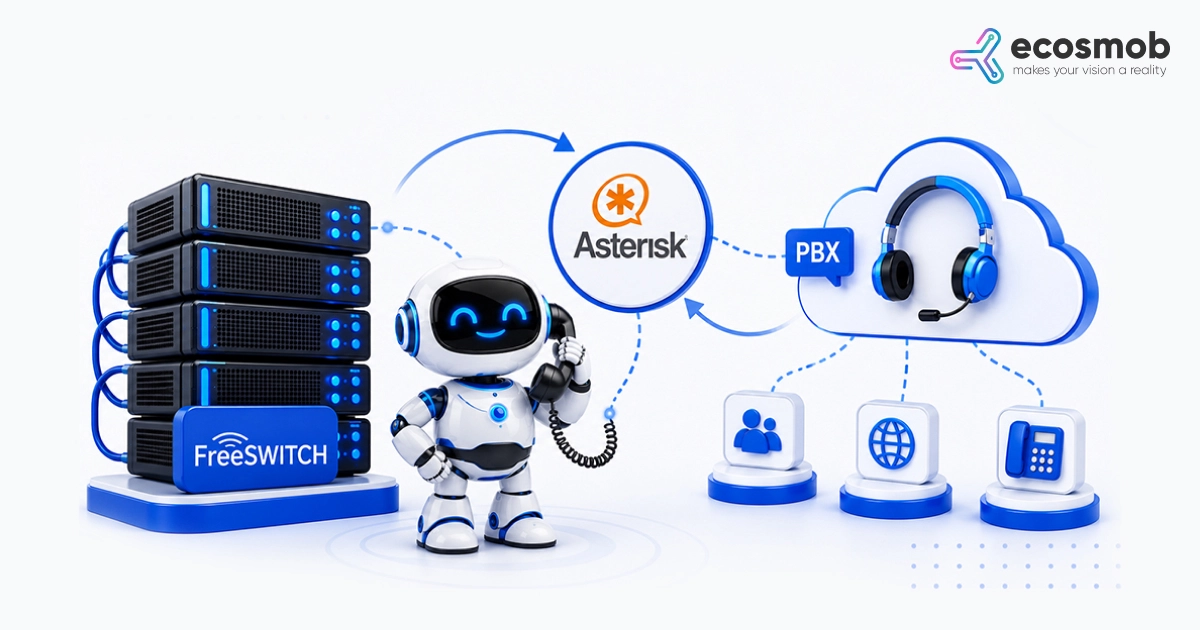
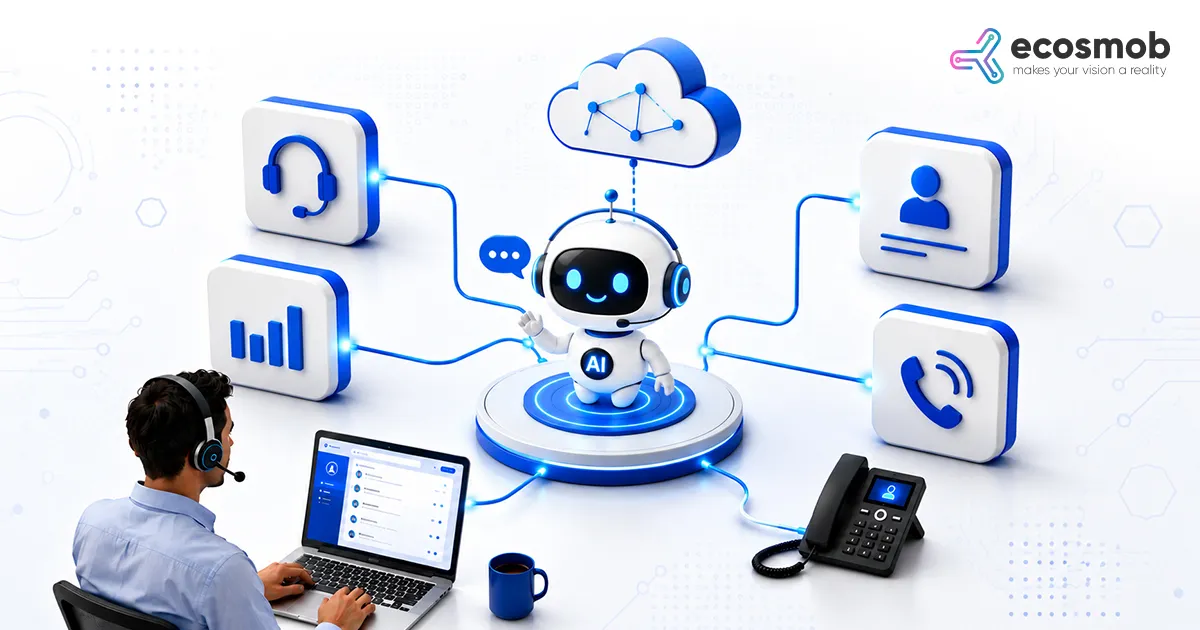
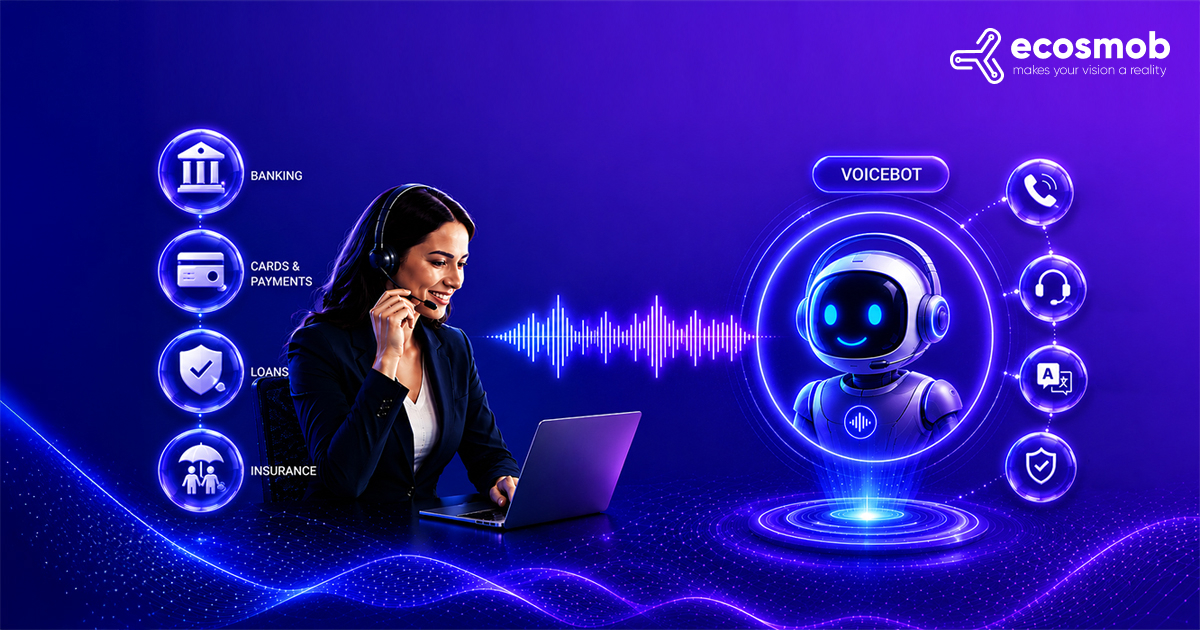
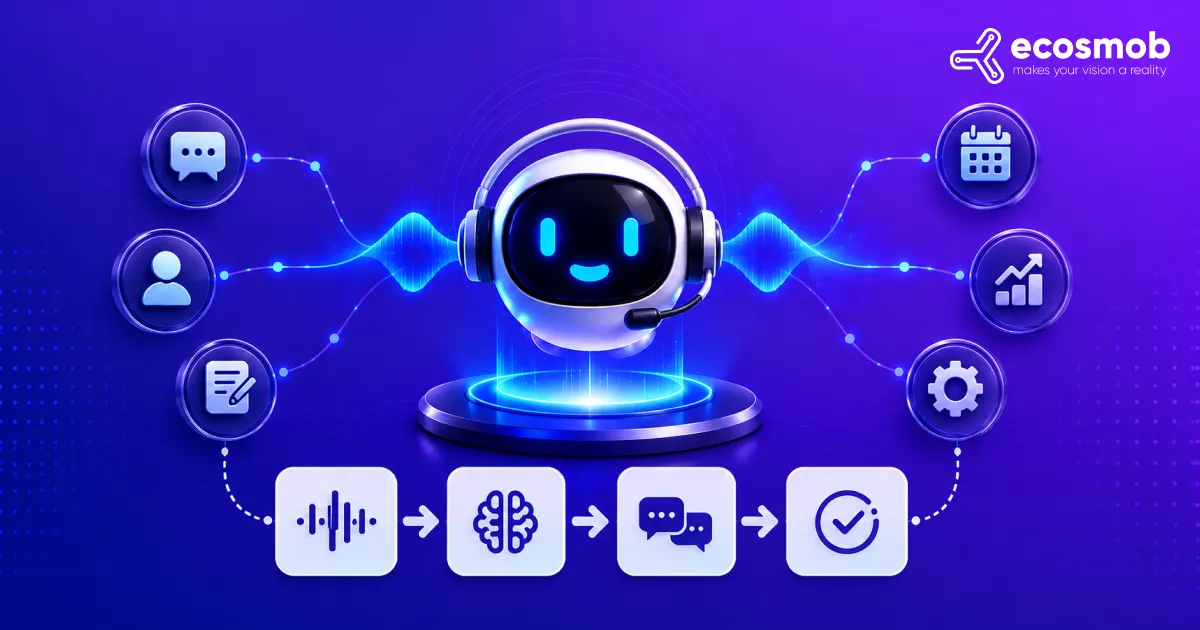
When you transition a voice infrastructure from legacy IVR menus to real-time conversational AI, your core engine requirements change completely. A traditional PBX engine designed for call bridging, extension management, and static audio playback hits a severe architectural wall when forced to handle continuous, bidirectional speech-to-text (STT), large language model (LLM), and text-to-speech (TTS) streaming loops.
Engineers attempting to run low-latency voice bots on Asterisk frequently encounter thread starvation, memory bloat, and jarring response delays exceeding 1.5 seconds. The issue isn’t your AI models or your cloud APIs. The issue is how the underlying telephony engine manages thread locking, channels, and media forking.
Migrating your conversational workloads to FreeSWITCH replaces legacy channel dependencies with a thread-isolated, event-driven architecture designed specifically for low-latency media streaming.
Why Does Asterisk Struggle With Real-Time AI Voice Agents Compared to FreeSWITCH?
Asterisk struggles with real-time AI voice agents because its traditional process-per-channel execution model and linked-list memory structures lock threads during asynchronous external processing. Whereas FreeSWITCH operates on a thread-isolated, shared-nothing architecture engineered for concurrent media streaming.
To understand why Asterisk degrades under real-time voice AI workloads, you must look at how the two engines handle memory and channel execution under load:
Asterisk Thread Locking & Channel Masquerading
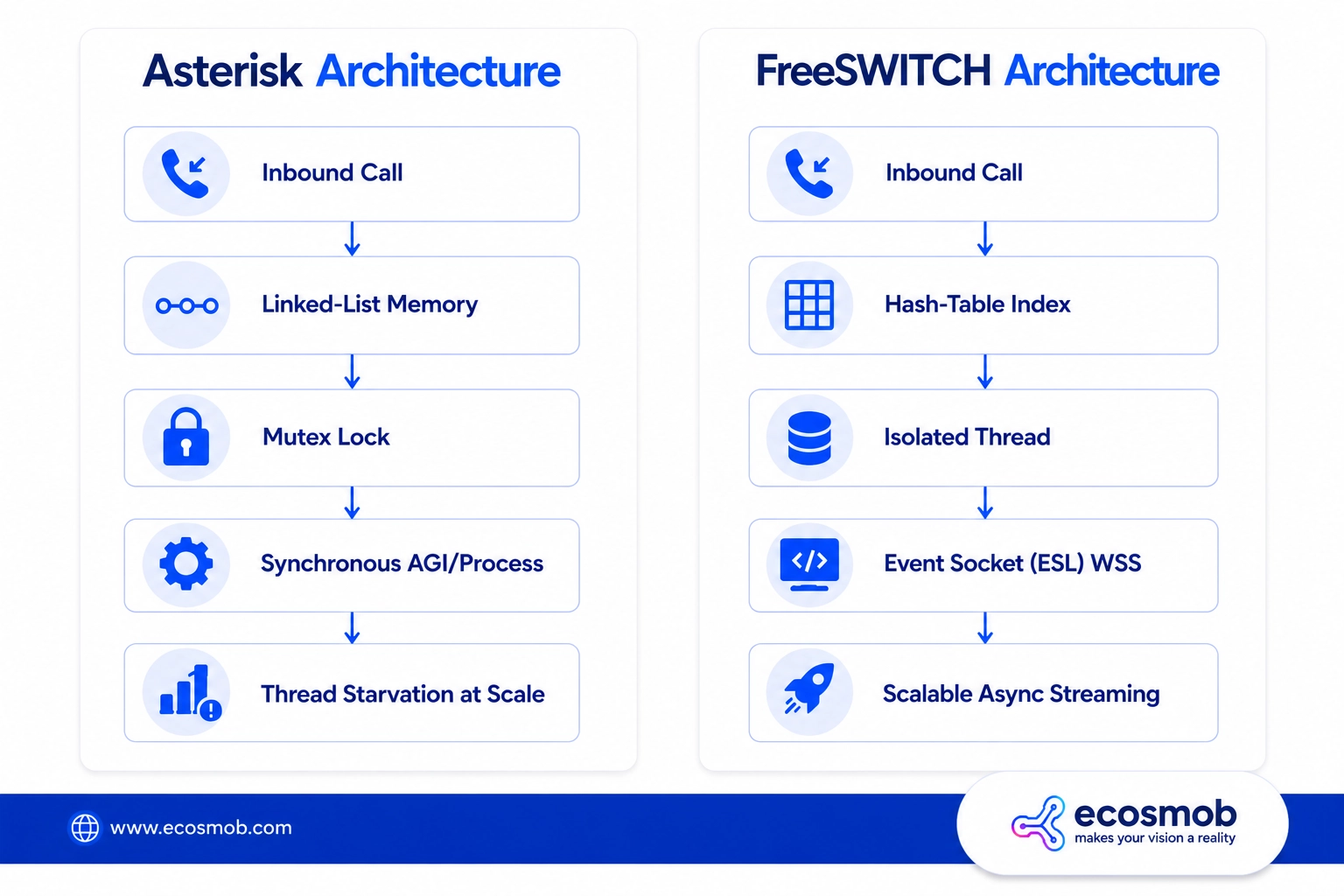
Asterisk historically relies on linked lists managed by mutexes to keep track of active channels. When an incoming call triggers an AGI script or requires complex media re-invites (such as shifting from a standard SIP trunk to an external AI WebSocket), Asterisk executes a process known as “channel masquerading”. During this operation, dynamic memory structures are torn down and re-linked.
If hundreds of concurrent calls hit external LLM inference loops simultaneously, thread contention over these linked lists causes CPU spikes, signaling lag, and eventual thread starvation.
FreeSWITCH Thread Isolation
FreeSWITCH was built specifically to eliminate this bottleneck. Every channel operates within its own dedicated thread and state machine, protected by read-write locks and indexed via hash tables rather than linked lists.
A delayed speech inference loop or a dropped WebSocket connection on Channel A cannot lock the thread or memory space of Channel B.
How Does FreeSWITCH Outperform Asterisk Under High AI Call Concurrency?
Under heavy AI call concurrency, FreeSWITCH outperforms Asterisk by maintaining lower CPU and memory overhead per call leg, preventing thread locking across simultaneous voice sessions.
When running traditional voice calls, Asterisk handles concurrency reasonably well. However, when every active call is continuously streaming 16kHz audio over WebSockets while running local Voice Activity Detection (VAD) and processing text-to-speech buffers, hardware demands multiply exponentially.
This is why Asterisk hits a capacity ceiling earlier compared to FreeSWITCH:
- Shared Resource Locks: Asterisk relies on central channel locks to update state transitions. When hundreds of channels simultaneously execute asynchronous API lookups or stream audio frames, thread contention over these locks creates CPU spikes.
- Process Overhead: Running AGI scripts or managing external sockets within blocking dialplan threads forces the operating system to manage heavy context switching.
- Typical Limit: On a standard 16 vCPU / 32GB RAM server running full-duplex AI voice streams, Asterisk typically begins experiencing audio jitter and frame drops past 250–350 concurrent AI sessions.
And here’s why FreeSWITCH can scale linearly:
- Thread-Isolated Architecture: FreeSWITCH assigns each channel its own isolated thread and state machine, indexed via fast hash-table lookups rather than linked lists.
- Asynchronous Media Handling: Modules like mod_audio_stream tap into raw media bugs directly at the network layer, streaming audio frames over WebSockets without locking the core call control thread.
- Typical Limit: On the exact same 16 vCPU / 32GB RAM hardware footprint, a tuned FreeSWITCH instance can sustain 1,200–1,500 full-duplex AI voice sessions before hitting hardware limits.
AI voice sessions choking your Asterisk PBX?
What Breaks During Asterisk to FreeSWITCH Migration for AI Voice?
Migrating an AI voice application from Asterisk to FreeSWITCH is not a simple 1:1 dialplan syntax translation. Because the media plane operates differently, four critical technical components will break if not re-architected correctly:
- Dialplan Syntax vs. Event-Driven Logic
Asterisk relies on sequential, line-by-line extension execution in extensions.conf. FreeSWITCH uses XML dialplans purely for initial channel authorization and destination routing. If you attempt to write complex AI application logic inside FreeSWITCH XML, you recreate the same blocking errors.
You must shift all application state logic out of the dialplan entirely, delegating call control to an external middleware service connected via the Event Socket Layer (ESL).
- PCM Streaming Transcoding & Codec Alignment
Asterisk frequently handles codec negotiation by running dynamic transcoding loops (e.g., converting G.711 μ-law to Opus or Signed Linear 16kHz) directly inside the channel thread.
In FreeSWITCH, running continuous mid-call transcoding consumes unnecessary CPU cycles.
Enforce native 16kHz Linear PCM (slin16 or L16) mapping across your incoming WebRTC or SIP trunks to feed uncompressed audio straight to your STT models without processing overhead.
- Barge-In and Voice Activity Detection (VAD) Handling
In Asterisk, handling a caller interruption requires monitoring channel variables or issuing an AudioSocket break. In FreeSWITCH, barge-in is handled natively through event hooks. When your local VAD engine detects caller speech energy mid-sentence, your external middleware issues an immediate uuid_break command over ESL.
This purges the playout buffer instantly on the hardware channel, muting the bot mid-word with zero audio tailing.
Ecosmob Expert Tip
When deploying mod_audio_stream on FreeSWITCH to fork audio out to your AI WebSocket servers, ensure your DevOps pipeline explicitly compiles from the community version v1.0.0. Pulling pre-compiled binaries matching v1.0.3 introduces a commercial license check that caps your media stream at 10 concurrent channels, causing silent call routing failures when your traffic scales.
How Do You Translate Dialplans, Channel Variables, and Logic from Asterisk to FreeSWITCH?
To translate Asterisk logic to FreeSWITCH without breaking call flows, you must map Asterisk dialplan extensions to FreeSWITCH XML contexts, and replace synchronous AGI scripts with asynchronous ESL event listeners.
When migrating your core logic, avoid trying to translate line-by-line dialplan commands. Instead, map your legacy telephony parameters directly to FreeSWITCH’s native variable namespace:
- Dialplan Context Mapping: Asterisk extensions.conf contexts (e.g., [from-pstn]) map directly to FreeSWITCH XML extension profiles inside /etc/freeswitch/dialplan/public.xml.
- Channel Variable Translation: Asterisk’s ${CALLERID(num)} becomes ${caller_id_number} in FreeSWITCH. Similarly, ${EXTEN} translates to ${destination_number}.
- AGI to ESL Logic Shift: Instead of launching an AGI script that executes EXEC Playback(prompt), your inbound FreeSWITCH XML dialplan simply answers the call and triggers an outbound socket: <action application=”socket” data=”127.0.0.1:8084 async”/>. Your external Node.js or Go application receives the channel connection over ESL and executes playout commands asynchronously.
The Zero-Downtime FreeSWITCH Migration Blueprint
You do not need to execute a high-risk “big bang” migration that replaces your entire operational PBX overnight. The safest zero-downtime FreeSWITCH migration path is deploying a Hybrid SIP Relay Pattern.
In this architecture, your existing, battle-tested Asterisk deployment remains in place to handle traditional business logic: PSTN trunking, internal extension routing, call queues, and billing integrations. Only conversational AI call legs are dynamically offloaded to FreeSWITCH.
Phase 1 (Edge Media Gateway Deployment)
Deploy a dedicated, containerized FreeSWITCH cluster within your private cloud (VPC) alongside your local or cloud STT/TTS engine nodes.
Phase 2 (Selective Dialplan Offload)
Configure a simple extension rule on Asterisk. When a caller enters an AI-driven workflow, Asterisk executes an internal SIP refer or bridge command, pushing the call leg over a dedicated low-latency local SIP trunk to FreeSWITCH.
Phase 3 (State Isolation & Media Forking)
FreeSWITCH accepts the incoming leg, terminates the media, extracts the raw LPCM stream via mod_audio_stream, and orchestrates the AI loop asynchronously over ESL.
Phase 4 (Full System Cutover)
Once your voice models and media paths are fully validated under production loads, you can gradually migrate your edge WebRTC and carrier ingress connections directly to FreeSWITCH (demoting or retiring the legacy PBX nodes at your own pace).
Need a zero-downtime hybrid SIP bridge for low-latency AI voice?
What Happens When an AI WebSocket Drops Mid-Call?
If a remote LLM API times out or your WebSocket connection to the speech engine drops mid-sentence, your FreeSWITCH ESL middleware must execute an immediate, non-blocking failover sequence to protect the customer experience.
When the ESL daemon detects a socket closure or processing timeout (e.g., no STT audio frame received within 1,200ms), it issues a uuid_transfer command to the active FreeSWITCH channel leg. FreeSWITCH instantly transfers the call back over the internal SIP trunk to an Asterisk queue context:
// Example ESL Fallback Handling in Node.js Middleware
eslConnection.on(‘esl::event::SOCKET_DATA::CLOSE’, function(event) {
const channelUuid = event.getHeader(‘Unique-ID’);
console.warn(`AI WebSocket lost on channel ${channelUuid}. Executing failover…`);
// Transfer the active call to a human agent queue
eslConnection.bgapi(
‘uuid_transfer’,
`${channelUuid} 8001 XML default`
);
});
This transfers the live call back to a human agent queue on Asterisk, seamlessly playing a localized apology prompt, ensuring the caller is never left in dead-air silence or disconnected due to an AI microservice crash.
How Does a FreeSWITCH Real-Time AI Voice Agent Simplify Regulatory Compliance for Regulated Industries?
Migrating your AI voice pipeline to FreeSWITCH simplifies HIPAA, PCI-DSS, and GDPR compliance by allowing you to isolate raw audio streams entirely within your private cloud or on-premises infrastructure.
For organizations in healthcare, banking, or government sectors, passing customer voice streams through third-party public cloud APIs creates significant legal and regulatory exposure.
Key Security & Compliance Advantages of FreeSWITCH for Voice AI
- Complete Media Plane Isolation: FreeSWITCH allows you to fork raw Real-time Transport Protocol (RTP) audio streams directly to local, containerized AI models (e.g., self-hosted Whisper for STT and Piper for TTS) residing within your private VPC.
- Zero External Data Transit: Customer audio packets, transcripts, and biometric voice data never leave your secure network perimeter (eliminating third-party vendor data-sharing liabilities).
- Encrypted WebSockets & Signaling: FreeSWITCH natively enforces Secure WebSockets (WSS) and SRTP encryption for all internal media forking pipelines, protecting audio streams from interception during internal microservice transit.
- Granular Audit Logging: Using the Event Socket Layer (ESL), security operations teams can track and log every media bug creation, audio playout event, and channel tear-down in real time for compliance reporting.
Migrating from Asterisk to FreeSWITCH for real-time AI voice is not about replacing a working PBX. It is about choosing the right tool for streaming data.
Asterisk excels at standard office extensions and traditional call routing. However, when your system must stream bidirectional audio at sub-600ms latency, FreeSWITCH’s thread isolation, event socket control, and unthrottled media forking provide the architectural foundation needed to scale. By adopting a hybrid SIP trunking pattern, you
- Eliminate response lag
- Protect your uptime
- Build a conversational platform ready for enterprise traffic
If your team is encountering latency walls, memory bugs, or concurrency caps on your current voice stack, you don’t have to navigate the migration alone. Connect with an Ecosmob open-source voice architect today to design your low-latency AI voice stack!
FAQs
Can I run a low-latency STT/LLM/TTS pipeline on Asterisk without migrating?
You can run an AI voice bot on Asterisk using AudioSocket to stream raw linear PCM audio over TCP. However, as your concurrent call volume grows, Asterisk’s thread-per-channel architecture and memory mutex locks create CPU bottlenecks and latency spikes, making it difficult to maintain sub-700ms response times at scale.
How does FreeSWITCH ESL plus mod_audio_stream cut AI voice latency versus Asterisk AGI?
mod_audio_stream taps the raw channel media bug and streams uncompressed audio chunks directly over WebSockets without disk I/O or dialplan delays. FreeSWITCH's Event Socket Layer (ESL) then executes outbound playout using asynchronous uuid_broadcast commands, saving 400ms to 600ms per conversational turn compared to synchronous, file-based AGI scripts.
Should I migrate my entire PBX system or route only AI voice traffic to FreeSWITCH?
You should adopt a hybrid migration path. Keep your existing Asterisk deployment to handle standard PBX functions, office extensions, and PSTN carrier trunks, while routing AI voice calls over an internal SIP trunk to a dedicated FreeSWITCH cluster (optimized specifically for low-latency AI media streaming).
How many concurrent AI voice sessions can FreeSWITCH handle versus Asterisk on the same hardware?
On identical bare-metal hardware, a properly tuned FreeSWITCH deployment can handle roughly 1,200 to 1,500 concurrent full-duplex AI voice sessions, compared to 250 to 350 sessions on Asterisk. FreeSWITCH’s thread isolation prevents channel memory contention under heavy concurrent streaming loads.
What is the migration risk for regulated industries using on-prem or VPC STT-TTS stacks?
Migrating voice AI from Asterisk to FreeSWITCH lowers compliance risks for HIPAA, PCI-DSS, and GDPR. Because FreeSWITCH grants complete control over raw RTP audio streams, you can run your entire voice bot pipeline (including self-hosted STT, LLM, and TTS models) within your private cloud or on-premises data center. This ensures customer voice data never crosses public third-party APIs.