
Netflix never set out to build everything. It built what made Netflix…NETFLIX.
That’s a distinction many telecom teams lose when Voice AI enters the conversation.
The debate quickly becomes build or buy. Engineers compare open source frameworks. Product teams shortlist vendors. Finance estimates implementation costs. Weeks later, everyone has an answer to the wrong question.
Before deciding whether to build or buy an AI voice bot solution, you need to know whether Voice AI is the AI initiative that will create the most value for your business.
This guide helps you make that decision first, then shows when building, buying, or combining both approaches makes the most sense.
Before you compare platforms, make sure you’re comparing the right priorities.
Key Factors to Consider Before Building or Buying Voice AI/ Questions to Ask Before Building or Buying Voice AI
Before comparing platforms or estimating development costs, whether you’re planning to build a voicebot for call centers or another Voice AI solution, answer these four questions first. They can save you from investing in the wrong AI initiative.
- What business outcome are you trying to achieve?
Start with the problem, not the technology. Your AI investment should support a measurable business goal, whether that’s reducing handling time, improving customer experience, or lowering support costs.
- Is Voice AI the right AI initiative?
Voice AI isn’t always the best first step. In some cases, AI Agent Assist, intelligent customized IVR solutions, or automated QA can deliver greater value with less implementation effort.
- Is your RTC environment ready?
Consider how the solution will fit into your existing SIP infrastructure, contact center platform, CRM, and compliance requirements. A smooth integration is just as important as the AI itself.
- What delivers the best long-term value?
Don’t compare build and buy based on upfront cost alone. Weigh customization, maintenance, scalability, internal expertise, and expected ROI before making a decision.
Answering these questions is often the first step toward a successful Voice AI strategy.
An RTC AI Discovery & Platform Selection engagement brings together business priorities, customer journeys, technical constraints, and AI opportunities into a practical roadmap before development begins.
The better your evaluation, the more confident your build-versus-buy decision becomes.
What Does it Take to Build a Voice AI Agent?
Building a Voice AI agent involves much more than connecting speech recognition to a language model. You’re creating a real-time system that can understand conversations, make decisions, respond naturally, and integrate with your communication ecosystem.
At its core, a Voice AI stack includes four key layers:
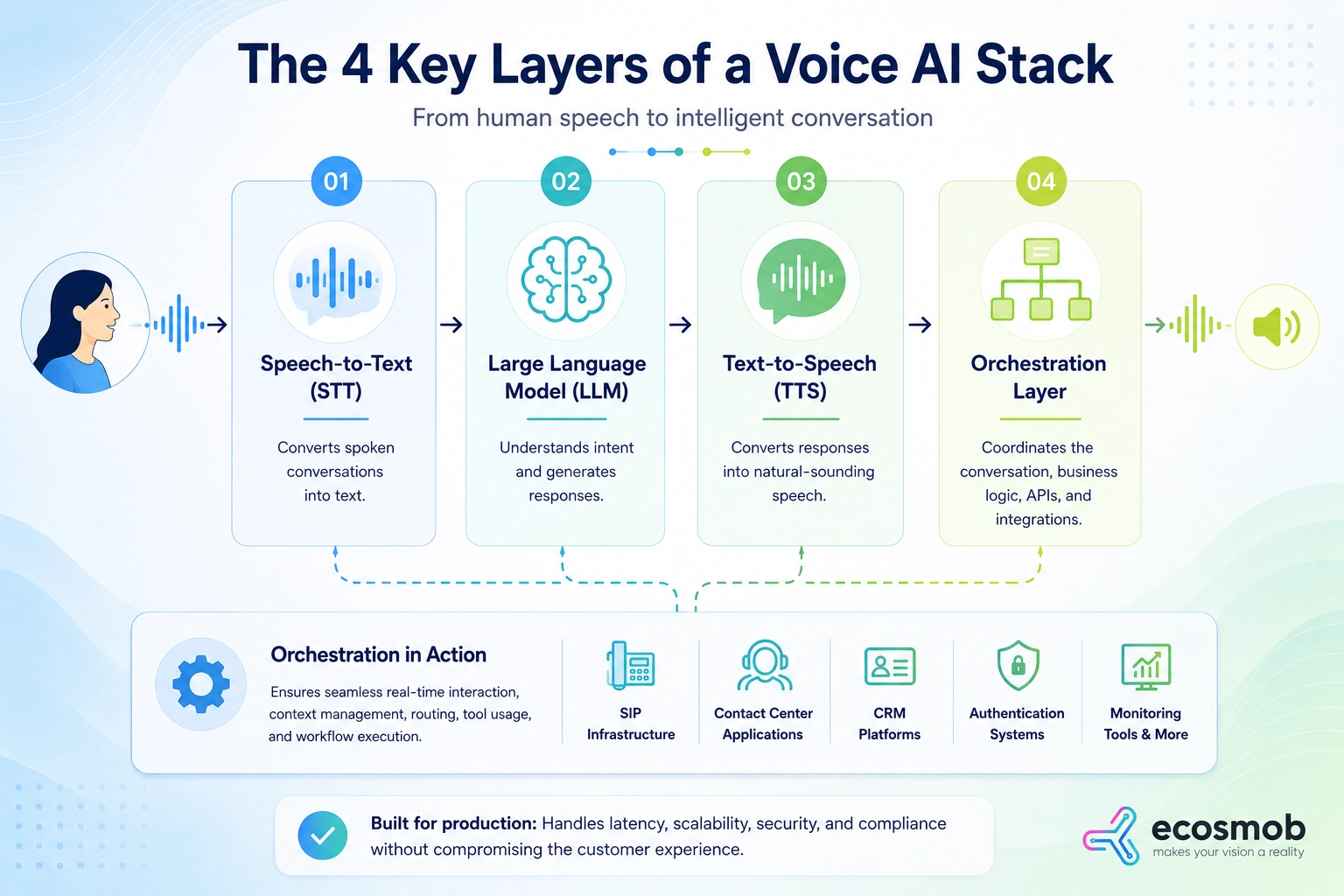
- Speech-to-Text (STT): Converts spoken conversations into text.
- Large Language Model (LLM): Understands intent and generates responses.
- Text-to-Speech (TTS): Converts responses into natural-sounding speech.
- Orchestration Layer: Coordinates the conversation, business logic, APIs, and integrations.
These building blocks are only part of the equation. To support production deployments, your Voice AI solution also needs AI voice bots SIP infrastructure integration with CRM platforms, contact center applications, authentication systems, and monitoring tools. It should also handle latency, scalability, security, and compliance without affecting the customer experience.
That’s why many organizations don’t build every component from scratch. They often combine open-source frameworks or commercial AI models with custom integrations and business logic that reflect their unique workflows.
The effort may be significant, but so can the payoff in the right scenarios. When Does Building a Custom Voice AI Solution Make Sense?
When Does Building a Custom Voice AI Solution Make Sense?
Building a custom Voice AI solution makes sense when AI becomes part of your competitive advantage, not just another business tool. If you want to develop AI voice assistant for business needs that go beyond commercial platforms, a custom solution can deliver greater long-term value.
You should consider building when:
- Business Objectives
If your customer journeys involve unique call flows, complex routing logic, or industry-specific processes, a custom solution gives you the flexibility to design AI around your business instead of adapting your business to the platform.
- Customization Requirements
For organizations with strict compliance, security, or data residency requirements, building allows greater control over how conversations are processed, stored, and managed.
- Infrastructure Readiness
If Voice AI becomes a core part of your customer experience or product offering, the upfront investment can pay off through greater customization, scalability, and innovation over time.
- Engineering Capability
Building doesn’t end at deployment. You’ll need engineering expertise to maintain integrations, improve AI performance, adapt to new business needs, and keep the platform reliable as it grows.
The strongest build decisions are rarely driven by technology alone. They begin with a clear understanding of where custom development creates measurable business value.
If building isn’t the right fit, buying may help you reach your goals faster and with less complexity.
When Should Telecom Teams Buy a Voice AI Platform?
Buying a Voice AI platform is often the better choice when your priority is solving a business problem quickly rather than building AI capabilities from scratch. If seamless Voice bot integration with CRM is part of your requirements, a commercial platform can help you get there faster while minimizing implementation effort.
- Faster Time to Market
If speed is a priority, buying lets you deploy Voice AI without spending months designing, developing, and testing every component. This allows your team to focus on adoption and business outcomes instead of platform engineering.
- Standard Business Requirements
Commercial Voice AI platforms work well when your customer journeys and workflows don’t require extensive customization. If your needs align with proven capabilities, building may add unnecessary cost and effort.
- Limited Engineering Resources
Building Voice AI requires continuous development, maintenance, and optimization. If your engineering team has other strategic priorities, a managed platform can reduce operational overhead while keeping your AI capabilities up to date.
- Lower Implementation Risk
Buying reduces the responsibility of managing AI infrastructure, platform updates, and performance improvements internally. This can make it easier to scale your Voice AI initiatives while maintaining predictable costs.
Choosing a commercial platform doesn’t mean compromising on innovation. If you’re evaluating the top AI voicebot platforms, this approach offers faster business value while leaving room for future customization.
Now, let’s compare both approaches side by side.
Build vs Buy Voice AI Comparison
There’s no universal winner in the build-versus-buy debate. The right choice depends on your business goals, technical priorities, and long-term AI strategy, especially if you’re evaluating custom AI voicebot solutions for intelligent customer conversations. Use the comparison below to determine which approach best fits your requirements.
| Factor | Build Voice AI | Buy Voice AI |
| Time to Market | Longer implementation with greater development effort | Faster deployment using a ready-made platform |
| Customization | High flexibility for unique workflows and business logic | Limited to platform capabilities and available configurations |
| Integration | Designed around your existing RTC environment and business systems | Depends on vendor-supported integrations |
| Control | Full ownership of data, infrastructure, and roadmap | Shared control with the platform provider |
| Maintenance | Requires ongoing engineering, updates, and optimization | Vendor manages platform updates and core maintenance |
| Scalability | Tailored to your infrastructure and growth plans | Scales within the platform’s capabilities |
| Initial Investment | Higher upfront development cost | Lower initial investment with subscription or licensing costs |
| Best Fit | Organizations seeking long-term differentiation and complete control | Organizations prioritizing speed, simplicity, and predictable deployment |
The right choice isn’t the one with more features. It’s the one that best supports your business priorities.
For many telecom teams, the answer isn’t choosing one over the other.
Why a Hybrid Build and Buy Approach is Becoming the Preferred Choice
For many telecom teams, the decision is no longer about choosing between building and buying. It’s about deciding where custom development creates business value and where proven platforms already do the job well.
McKinsey found that the organizations creating the greatest value from AI do more than adopt new AI tools. They rethink how software is built by redesigning workflows, roles, and development processes to maximize AI’s impact.
Instead of rebuilding mature AI capabilities, you can:
- Buy speech recognition, LLMs, or text-to-speech services that are already production-ready.
- Build the call flows, SIP integrations, CRM connectivity, and business logic that make your customer experience unique.
How Do Industry Leaders Think Differently?
Netflix invested in recommendation and personalization because they define its competitive advantage. Uber built proprietary dispatching and routing while relying on proven infrastructure to scale efficiently.
The same principle applies to Voice AI. Build the capabilities that differentiate your telecom business, and buy the mature technologies that accelerate deployment.
The lesson isn’t to copy Netflix or Uber. It’s to identify which capabilities make your business different and invest your engineering effort there.
It helps you identify what should be built, what can be bought, and where a hybrid approach delivers the strongest ROI before development begins.
The smartest Voice AI strategy isn’t about building everything. It’s about building what matters.
The Bottom Line?
The build-versus-buy decision isn’t about choosing the smartest technology. It’s about making the smartest business investment. The right choice is the one that fits your customers, your communication ecosystem, and your long-term goals.
Whether you’re exploring your first Voice AI initiative or scaling an existing one, Ecosmob helps telecom teams build communication solutions that are ready for real-world business challenges.
Frequently Asked Questions
The right choice depends on your business objectives, customization needs, technical resources, and long-term strategy. If Voice AI is a competitive differentiator, building may provide greater flexibility and control. If speed, lower implementation effort, and predictable deployment are priorities, buying a commercial platform is often the better option.
Building Voice AI typically requires a higher upfront investment in development, infrastructure, integrations, and ongoing maintenance. Buying usually lowers initial costs through subscription or licensing models, although long-term expenses depend on vendor pricing, usage, and customization requirements.
Many open-source Voice AI frameworks and models can be used commercially, provided their licenses permit commercial use. Before deployment, review the licensing terms, security requirements, maintenance commitments, and compliance obligations of every component included in your Voice AI stack.
Yes, but only when it is designed and optimized for production. Carrier-grade deployments require scalable infrastructure, low-latency media processing, high availability, monitoring, and robust SIP integration. Open-source components alone are not enough without the right architecture and operational engineering.
A hybrid approach is often the preferred choice when you need both speed and flexibility. You can adopt proven AI services for foundational capabilities while building custom integrations, workflows, and business logic that differentiate your telecom platform.