
I’ve noticed that teams often spend months choosing AI technologies and only weeks thinking about adoption.
Yet adoption is usually where the biggest risks sit.
In real-time communications, success depends on more than model accuracy. Infrastructure readiness, latency, compliance, and operational ownership all influence whether AI solutions deliver value at scale.
This guide outlines an AI adoption framework designed to address those challenges from the start.
The first step is understanding what this framework actually covers and why it matters to your platform.
What Is an AI Adoption Framework for Real-Time Communications?
An AI adoption framework for real-time communications is a staged model that helps you move AI from evaluation to production across voice, video, and messaging platforms. It provides a structured path to identify opportunities, assess readiness, deploy AI, and scale it successfully.
At its core, the framework helps you answer the questions that often determine whether an AI initiative succeeds beyond the pilot stage.
For example:
- Which use cases should you prioritize first?
- Is your infrastructure ready for AI workloads?
- How will you measure success?
- What happens when the AI cannot resolve a request?
- Are your compliance requirements covered?
These questions become more important in real-time communications because AI operates inside live customer interactions. Your infrastructure, latency requirements, compliance obligations, and operational processes can all influence the outcome.
That’s why organizations increasingly treat AI adoption as an ongoing journey. As AI trends in 2026 continue to evolve, a structured framework helps you make informed decisions from initial planning through long-term optimization.
Once you understand the framework, it’s easier to see why your AI journey needs one.
Common Challenges in AI Adoption for Real-Time Communications
Real-time communications introduce challenges that many enterprise AI frameworks never address. Understanding these challenges can help you prepare for them before AI reaches production.
- Infrastructure Readiness
Your AI solution must work with existing communication systems, APIs, and business applications. Infrastructure gaps often surface only when AI begins handling live traffic.
- Latency Management
Every interaction happens in real time. Delays in speech recognition, response generation, or audio delivery can affect the customer experience.
- Compliance Requirements
AI deployments must address call recording, consent, privacy, and compliance. Introducing our custom SIP recording real-time streaming gateway helps support these requirements.
- Integration Complexity
AI rarely operates on its own. Your team needs a plan to monitor performance and manage escalations in isolation. It must connect with CRMs, ticketing platforms, communication systems, and internal workflows to deliver meaningful results.
- Operational Ownership
Launching AI is ongoing, and improving outcomes over time.
- Measuring Success
Without clear metrics, it becomes difficult to determine whether AI is improving customer experience, operational efficiency, or business performance.
With these challenges in mind, let’s look at the stages that help you navigate them.
The Seven Stages of an AI Adoption Framework for Real-Time Communications
A successful AI initiative rarely moves from idea to production in a single step. Most organizations progress through a series of stages, each designed to reduce risk and improve outcomes.
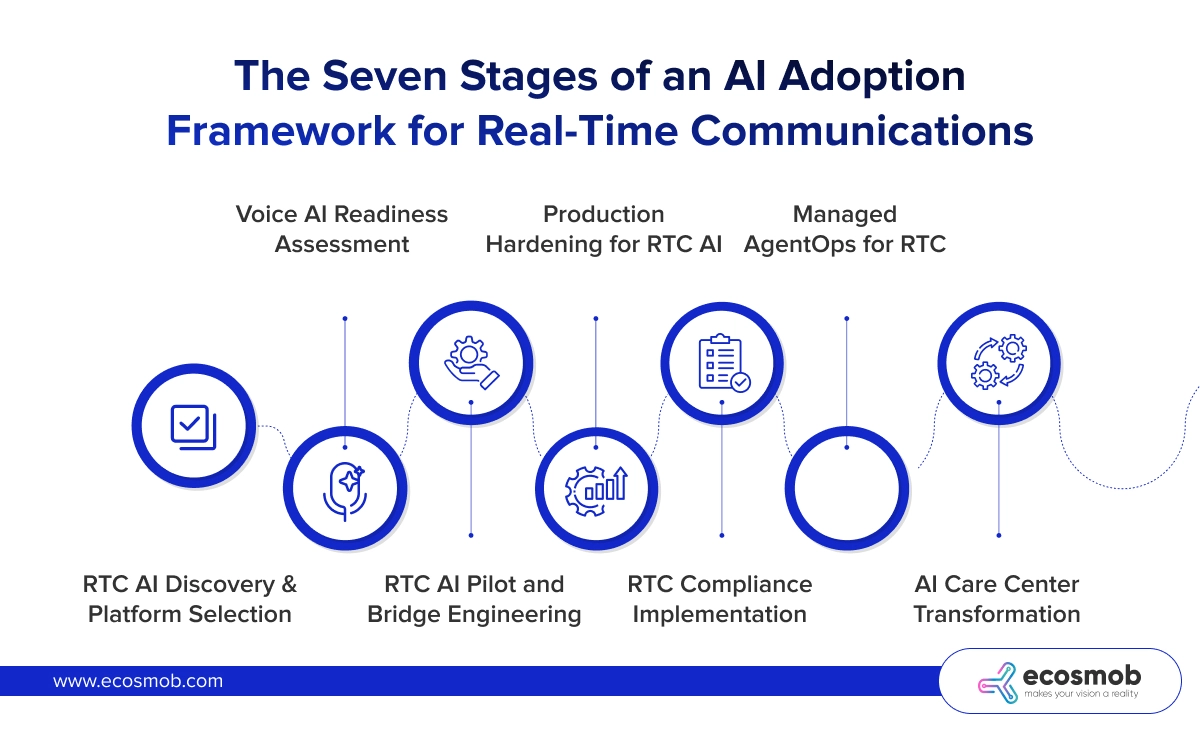
1. RTC AI Discovery and Platform Selection
This stage helps you identify where AI can create the greatest business value.
Before selecting models or vendors, it’s important to understand your customer journeys, operational challenges, and communication workflows. The goal is to identify use cases that align with business objectives rather than following market trends.
By the end of this stage, you have a clearer view of which AI initiatives deserve investment and how they fit into your broader roadmap.
2. Voice AI Readiness Assessment
Once you’ve identified the right opportunities, the next step is determining whether your environment can support them.
This assessment evaluates the readiness of your communication infrastructure, integrations, APIs, data sources, and operational processes. It helps uncover issues that could affect AI performance long before deployment begins.
Addressing these gaps early can reduce implementation risk and improve the chances of a successful rollout.
3. RTC AI Pilot and Bridge Engineering
This is where AI begins interacting with your real business systems.
The focus is on connecting AI with communication platforms, enterprise applications, knowledge sources, and customer data. Instead of operating as an isolated demonstration, AI becomes part of an actual workflow.
A successful pilot allows you to validate business value while minimizing the risk of a large-scale deployment.
4. Production Hardening for RTC AI
A pilot proving value does not automatically mean it is ready for production.
This stage focuses on reliability, scalability, performance, and operational resilience. Testing helps ensure the solution can handle real-world traffic, unexpected failures, and changing workloads without compromising the customer experience.
The objective is to prepare your AI solution for enterprise-scale operations.
5. RTC Compliance Implementation
As AI becomes part of customer interactions, compliance moves from a consideration to a requirement.
This stage focuses on regulatory obligations, privacy requirements, governance controls, consent management, and data-handling practices. Building these controls into the solution from the beginning can help avoid costly delays later.
For many organizations, compliance is a key factor in determining production readiness.
6. Managed AgentOps for RTC
Deploying AI is only the start of the journey.
Customer expectations, knowledge, and business processes continue to evolve, so ongoing monitoring and optimization help keep your AI solution accurate and effective.
This also makes practices such as AI voice agent disclosure architecture an important part of maintaining consistent, compliant AI interactions over time.
7. AI Care Center Transformation
The final stage extends beyond individual AI deployments.
Instead of improving isolated processes, organizations begin redesigning the broader customer experience around AI. Voice automation, agent assistance, quality management, analytics, and knowledge systems work together as a connected ecosystem.
The result is a more intelligent, scalable, and customer-focused care operation.
Every successful AI deployment starts long before the first customer interaction. So what changes when you get the process right?
Benefits of Following an AI Adoption Framework for Real-Time Communications
A structured framework helps you make AI decisions with greater clarity and less uncertainty.
Instead of investing in multiple initiatives at once, you can focus on the opportunities most likely to deliver business value.
You also gain better visibility into infrastructure, integration, and compliance requirements before implementation begins. This can help reduce costly surprises later in the project.
As your AI initiatives mature, the framework creates a more predictable path from pilot to production. Each stage builds on the previous one, making it easier to validate progress and manage risk.
Some of the most common benefits include:
- Better alignment between business and technology goals
- Reduced implementation and deployment risk
- Faster path from evaluation to production
- Improved ROI from AI investments
- Greater operational and compliance readiness
- More sustainable long-term AI adoption
Ultimately, the framework helps you treat AI as a business capability rather than a standalone technology project.
A framework doesn’t guarantee success, but it can help you avoid costly mistakes. The next step is turning that framework into action.
How to Implement an AI Adoption Framework Successfully
You can implement an AI adoption framework successfully by defining clear business objectives, prioritizing high-value use cases, assessing readiness, and validating results through a pilot before deploying AI-based RTC solutions at scale. A phased approach helps reduce risk and improve adoption outcomes.
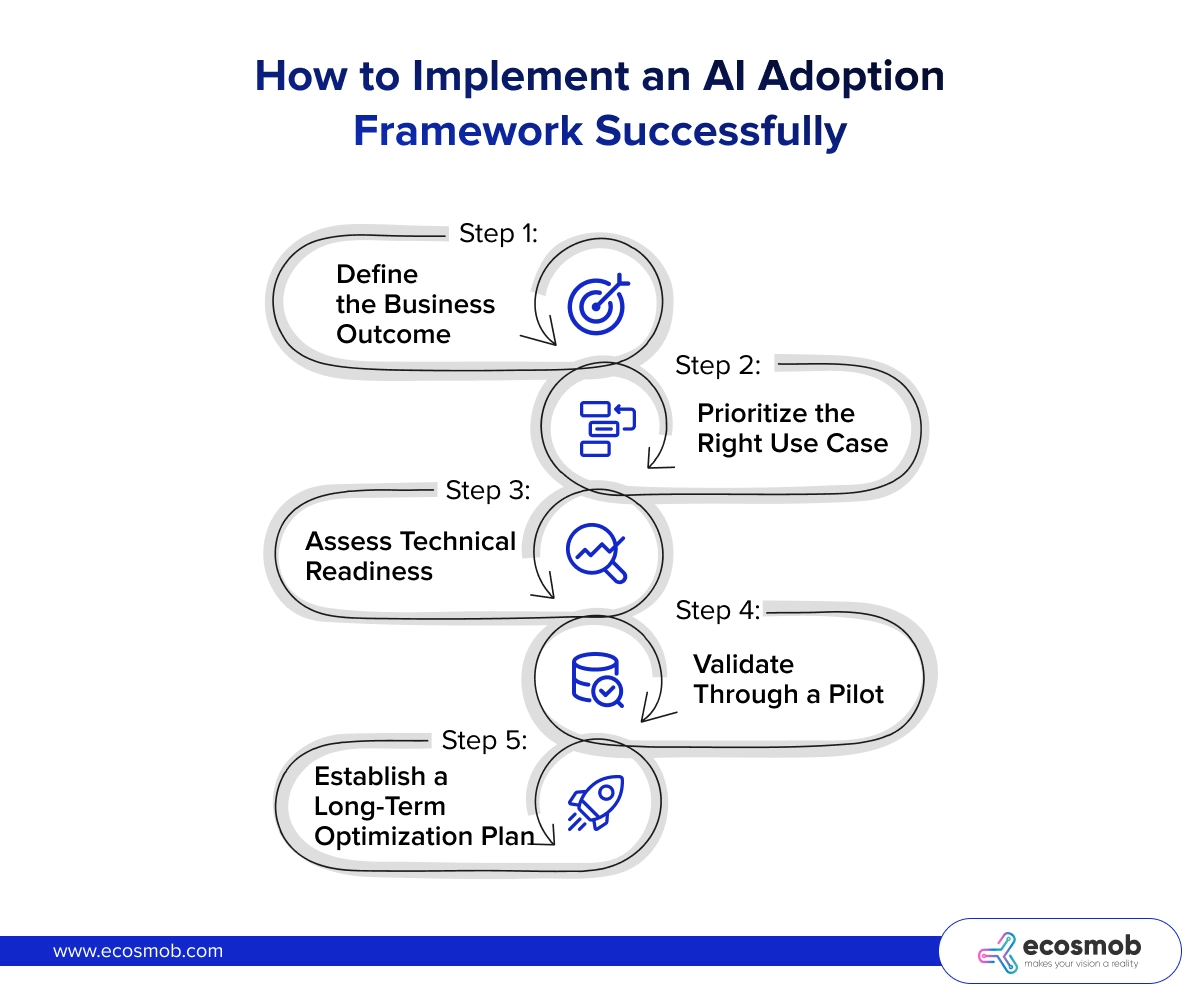
Step 1: Define the Business Outcome
Start by identifying the problem you want AI to solve. A clear objective helps you align technology decisions with measurable business results.
Step 2: Prioritize the Right Use Case
Focus on use cases that offer meaningful business impact and realistic implementation effort. Starting small often creates a stronger foundation for future initiatives.
Step 3: Assess Technical Readiness
Review your infrastructure, integrations, data sources, and operational processes. Addressing readiness gaps early can help prevent delays during implementation.
Step 4: Validate Through a Pilot
Test AI in a controlled environment before expanding deployment. This allows you to measure performance, gather feedback, and refine the solution.
Step 5: Establish a Long-Term Optimization Plan
AI adoption continues after deployment. Monitoring performance and improving outcomes over time helps ensure long-term business value.
The strongest AI initiatives are built one validated step at a time. Even with a clear implementation plan, one decision can shape the path ahead.
Should You Build or Buy AI for Real-Time Communications?
The choice between building and buying AI depends on your business goals, compliance requirements, and long-term strategy. For build vs buy, voice AI telecom teams need to consider that a hybrid approach can combine third-party AI capabilities with custom RTC integrations.
A managed platform can help you deploy faster, while a custom-built solution offers greater control over integrations, data, and customer experience.
In real-time communications, factors such as latency, scalability, compliance, and operational ownership often play a major role in the decision.
| Approach | Best for | Key Consideration |
| Buy | Faster deployment | Less control and customization |
| Build | Maximum flexibility | Higher implementation effort |
| Hybrid | Balanced approach | Requires integration expertise |
For many organizations, the goal is not to choose one approach over the other. The goal is to find the right balance between speed, control, and long-term business value.
There is rarely a one-size-fits-all answer. What matters most is the outcome your AI strategy helps you achieve.
The Bottom Line…
AI adoption in real-time communications is rarely a single technology decision. It involves a series of business, operational, and technical decisions that influence long-term success.
A structured framework helps you approach those decisions with greater clarity. Instead of focusing only on AI models and platforms, you can evaluate readiness, reduce risk, and create a more predictable path to production.
At Ecosmob, we approach AI adoption as a complete RTC transformation journey. From identifying high-value opportunities and assessing infrastructure readiness to integration, production hardening, compliance, and ongoing optimization, every stage is designed to help you build AI capabilities that deliver measurable business outcomes.
The organizations seeing the strongest results are not simply adopting AI faster. They are adopting it with a clear roadmap, the right technical foundation, and a long-term growth strategy.
AI delivers its greatest value when your adoption strategy is as deliberate as the technology itself.
Frequently Asked Questions
An AI adoption framework is a structured approach for moving AI from planning to production. For real-time communications, it also considers latency, SIP infrastructure, integrations, compliance, and the demands of live customer interactions.
The stages include AI discovery, readiness assessment, pilot engineering, production hardening, compliance, managed AgentOps, and care center transformation. Together, these stages form an AI adoption framework for enterprises moving from strategy to long-term AI operations.
Assess your SIP capacity, codecs, network performance, latency, SBC configuration, media quality, APIs, and integrations. You should also review security and compliance requirements before connecting Voice AI to your live communication environment.
Build when you need greater control over data, integrations, deployment, or customization. Buy when speed matters more. A hybrid approach can combine third-party AI capabilities with custom RTC integrations for a flexible framework for AI adoption.
Requirements vary by your industry, location, and use case. AI call handling may involve consent, recording, privacy, data retention, residency, and telecom requirements, which enterprise AI adoption frameworks should account for before production deployment.