

Telecom software development is a process that entails the creation of custom software solutions for telecom companies that includes Operations Support Systems (OSS), Business Support Systems (BSS), VoIP communication solutions, AI-based analytics solutions, and other telecom applications for consumers. Telecom software solutions allow telecom companies to deliver efficient operations, billing systems, customer management systems, and intelligent communication solutions for customers in real-time.
Over the past decade, the telecommunications industry has shifted from being a connectivity provider to becoming a digital service ecosystem. Modern telecom software development solutions no longer manage just voice and SMS; they operate complex, high-volume digital infrastructures powered by advanced telecom software development.
Telecommunications Software Development It now powers every critical operation, from subscriber management and real-time billing to network orchestration and customer experience platforms. It has become the foundation of modern telecom businesses.
As 5G, IoT, AI-driven automation, and cloud-native technologies continue to evolve, telecom companies must continuously modernize their software development strategies to stay competitive.
Whether you are launching a new software development for telecom solution or upgrading an existing telecommunication solution, having a scalable, secure, and future-ready software foundation is no longer optional; it is mission-critical.
This guide walks you through everything you need to know about telecom software development services, the challenges telecom operators face, the latest technology trends, and how to build a custom telecom software solution that aligns with long-term growth.
What are the Significant Challenges In The Telecom Software Development?
Today, the telecom sector is entering a new era of operational pressure and digital acceleration. Telecom operators now manage massive subscriber bases, real-time service delivery, distributed workforces, and increasingly complex telecom software ecosystems.
Here are the top challenges telecom businesses face today:
- Quick and Personalized Customer Service
Telecom providers handle millions of service requests daily across multiple channels. Delivering real-time support while maintaining subscriber satisfaction requires robust CRM systems, AI-driven chatbots, and intelligent telecom software solutions that automate workflows without compromising the experience. - Complex Operational Processes (OSS/BSS Pressure)
Managing Operations Support Systems & Business Support Systems has become increasingly complex. Billing accuracy, mediation systems, real-time charging, fraud detection, and revenue assurance require scalable telecommunications software solutions capable of handling high-volume data processing. - Remote and Distributed Workforces
Traditional on-premise telecom infrastructure struggles to support remote operations efficiently. Cloud-based telecom business solutions are becoming essential to ensure business continuity, collaboration, and service stability. - Network Security & Fraud Prevention: With 5G and IoT expanding the attack surface, operators face sophisticated threats. This includes Artificially Inflated Traffic (AIT), where bots drain margins by generating fake SMS/voice traffic, as well as subscription fraud and complex Signaling Attacks (SS7/Diameter/HTTP2).
Overcoming these hurdles is more than a fix; it’s a strategic pivot. By refining these critical touchpoints, you transform operational bottlenecks into a launchpad for a network that thrives under the relentless demands of a 24/7 digital economy.
Top Telecom Trends Of 2026

The telecom industry is no longer driven by connectivity alone. Intelligent automation, cloud-native infrastructure, software-defined networks, and data-driven decision-making are reshaping it.
For telecom operators investing in telecom software development solutions, understanding these technology shifts is essential to remain competitive, scalable, and secure.
Here are the key technology trends redefining telecommunications software solutions today:
- 5G Advanced & Edge Computing: We’re moving past basic 5G. The focus now is ‘Edge’ processing, handling data closer to the user to kill latency.
- AI-Driven Network Automation: This goes beyond chatbots. We’re discussing ‘self-healing’ networks that use predictive analytics to prevent outages before they occur.
- Agentic Conversational AI: Beyond simple bots, 2026 is the year of AI agents that autonomously resolve billing disputes and technical troubleshooting via natural dialogue.
- Travel eSIMs & Managed Connectivity: The new gold rush is in seamless eSIM integration for global travelers.
- Wi-Fi 7 & Direct-to-Cell: These are the big ones for 2026. They bridge the gap between satellite and cellular to ensure 100% coverage everywhere.
- Quantum-Safe Security: As quantum computing threatens traditional encryption, telcos are migrating to Post-Quantum Cryptography (PQC) to protect their infrastructure against future breaches.
Staying ahead of these trends ensures your network is an innovator, not just a spectator. Embracing these shifts today is the only way to secure your market position for tomorrow.
What Does It Take to Develop Carrier-Grade Custom Telecom Software?
Developing custom telecom software requires architecting distributed, real-time systems capable of handling signaling, media processing, and subscriber operations at scale. Unlike conventional enterprise applications, telecom platforms must operate under strict constraints on latency, reliability, and concurrency.
Key technical requirements include:
- Protocol Implementation & Interoperability
Support for telecom signaling and transport protocols such as SIP, RTP, Diameter, SS7, SMPP, and HTTP-based APIs, ensuring compatibility with both legacy network elements and modern IP-based infrastructure. - High Availability & Fault Tolerance
Active-active or active-passive clustering, session replication, automated failover mechanisms, and load balancing to maintain uninterrupted service delivery. - Scalable System Architecture
Horizontal scaling for concurrent sessions, distributed microservices, containerized deployments, and orchestration using platforms like Kubernetes. - Low-Latency Media & Signaling Handling
Efficient packet processing, media proxy optimization, and real-time event handling to maintain call quality and signaling stability. - Secure Integration Layers
API gateways, authentication frameworks, encryption protocols (TLS, SRTP), and secure communication between OSS and BSS systems. - Monitoring & Observability
Real-time logging, metrics aggregation, performance monitoring, and automated alerting for proactive fault detection.
Carrier-grade telecom software must be engineered for deterministic performance, high concurrency, and continuous uptime, making architectural resilience and protocol efficiency fundamental design priorities rather than optional enhancements.
The Types Of Communication Software Available In The Market
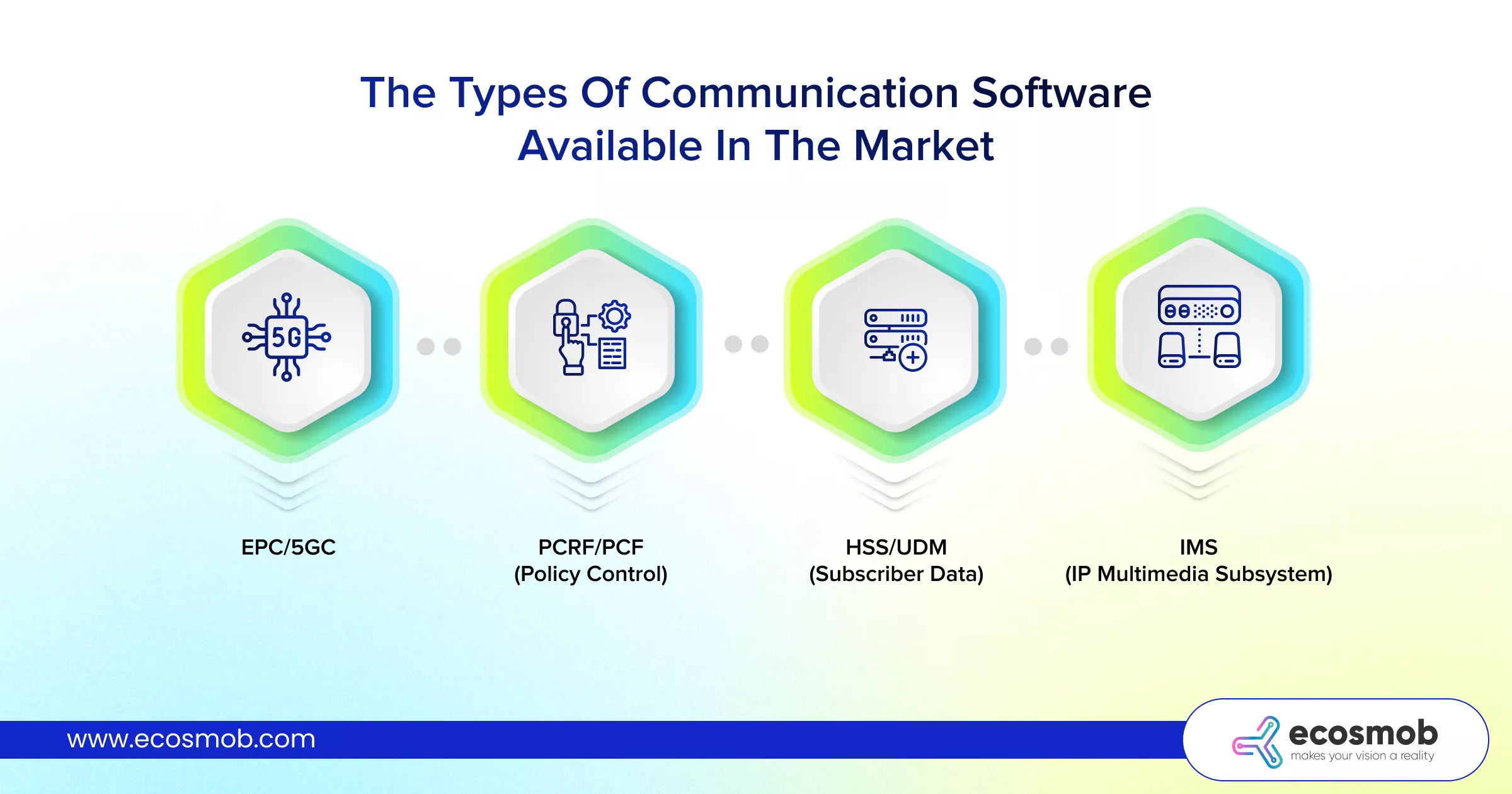
Using telecom software development, you can establish synchronous or asynchronous connections. While the market is flooded with options, most telecommunication solutions fall into these three buckets:
- EPC/5GC: The “brain” of the operation. The Evolved Packet Core (EPC) handles 4G traffic, while the 5G Core (5GC) introduces a service-based architecture (SBA) that allows for network slicing and ultra-low latency.
- PCRF/PCF (Policy Control): The network’s “traffic cops.” The Policy and Charging Rules Function (PCRF) and the Policy Control Function (PCF) manage data usage rules and Quality of Service (QoS) in real time, ensuring that critical IoT or premium users receive prioritized bandwidth.
- HSS/UDM (Subscriber Data): The “master directory.” The Home Subscriber Server (HSS) and Unified Data Management (UDM) store all subscriber identities, service permissions, and authentication keys. They are the single source of truth for network access.
- IMS (IP Multimedia Subsystem): The “voice engine.” The IMS is the architectural framework that enables IP-based communication services like VoLTE (Voice over LTE), VoNR (Voice over New Radio), and Rich Communication Services (RCS). It is what allows a data-only network to function as a phone service.
Choosing the right communication bucket determines how effectively your brand connects with its audience. The right software mix transforms standard interactions into high-value customer relationships.
What are the Benefits Of Having Telecom Software?
As the industry evolves, upgrading IT infrastructure is a survival tactic. Here’s how the services actually impact the bottom line:
- Efficient Communication: Real-time data exchange removes regional boundaries, making your company more profitable through instant decision-making.
- Flexibility & Virtualization: Using Network Function Virtualization (NFV), employees and systems can connect from anywhere, reducing the need for expensive on-site hardware.
- Boosting Customer Relations: By improving your Quality of Service (quality of service), you handle millions of requests without friction, eliminating the need for constant face-to-face support.
- Cost-Efficiency: You save on electricity and office overhead, but more importantly, you cut down on ‘billing leaks’ through automated BSS (Business Support Systems).
These benefits represent more than just internal efficiency; they directly boost your ROI. Investing in your software stack is the most direct route to sustainable, long-term profitability.
Essential Features in Telecom Software Development
When building your list of benefits and features, prioritize these to stay competitive:
- Better UI & UX: Customization enables you to tailor the interface to specific subscriber needs, a key differentiator in the market.
- Security & Compliance: Ensure the software complies with GDPR and applicable local regulations to protect sensitive subscriber data.
- Interoperability: Your software should enable your business to integrate with other platforms via standard Telecom APIs.
- Scalability & Quick Loading: Customers will abandon an app if it’s slow. High-speed performance is no longer a ‘nice-to-have’; it’s a requirement.
These features are the building blocks of a “sticky” user experience that keeps subscribers loyal. If your software isn’t easy, secure, and fast, your customers will find a competitor that is.
What are Some of the Options for Telecom Application Development?
When it comes to building your telecommunications software solutions, you generally have three strategic paths. Choosing the right one depends on your long-term roadmap and current technical debt.
- In-House Development: Best for core IP where you need absolute control. However, in 2026, the high cost of specialized talent (such as 5G or AI engineers) makes this the most expensive option.
- Off-the-Shelf (SaaS) Integration: A quick fix for standard functions like basic CRM. The downside? You’re locked into a vendor’s roadmap and have zero competitive advantage.
- Hybrid Custom Development: This is the “sweet spot.” You maintain a core strategic team but partner with a telecom software development company to handle the heavy lifting, such as SDN (Software-Defined Networking) or Cloud-Native migrations.
Your development model should reflect your business’s appetite for risk and its need for speed. Finding the right balance ensures you don’t overspend while still owning your most valuable assets.
What Should be the Migration Strategy?
In the telecom world, downtime isn’t just an inconvenience; it’s a revenue leak and a brand killer. A 99.9% uptime requirement means you only have 8.7 hours of total downtime per year. To protect this, our migration strategy moves away from risky “Big Bang” cutovers toward a multi-layered, fail-safe approach.
Here is the detailed strategy-
1. The Infrastructure Layer: Blue-Green Deployment
Instead of updating your live environment, we build a parallel infrastructure.
- The “Blue” (Legacy): Your current production environment remains live and untouched.
- The “Green” (New): We deploy the new custom solution here. We run comprehensive stress tests and security audits in this isolated “Green” bubble.
- The Switch: Using a Global Load Balancer, we flip the traffic from Blue to Green. If even a single metric spikes incorrectly, we flip it back instantly.
2. The Data Layer: Real-Time Synchronization & CDC
The hardest part of zero-downtime is keeping data consistent. We use Change Data Capture (CDC) to ensure that every bill paid or SMS sent in the “old” system is mirrored in the “new” system in milliseconds.
- Dual-Write Strategy: During the transition, the application writes data to both the old and new databases simultaneously.
- Data Validation: We use automated checksums to verify that $100\%$ of the records in the new database match the legacy source before the final cutover.
3. The User Layer: Canary Releases & Feature Flags
We don’t move all 10 million subscribers at once.
- The “Canary” Group: We route a tiny fraction of traffic (e.g., 1%) to the new system. We monitor their latency and error rates for 24 hours.
- Incremental Expansion: Once the “Canary” proves stable, we scale to 10%, then 50%, then 100%.
- Feature Toggles: If a specific new feature (like a 5G data booster) causes issues, we can “toggle” it off for everyone without rolling back the entire software update.
4. The Safety Net: Automated Rollback Triggers
We define Service Level Indicators (SLIs). If the new system exceeds a specific error threshold (e.g., >0.1% failed calls), the system triggers an Automated Rollback. No human intervention is needed to protect the network.
A migration without a safety net is a gamble your network shouldn’t take. By utilizing Blue-Green and Canary releases, you ensure your transition is a headline of success, not a report on downtime.
Telecom Application Development: When to Outsource?
Outsourcing is no longer just a “cost-saving” move; in the modern landscape, it is a speed-to-market move. You should consider the services under the following conditions:
- When You Need “Niche” Tech Fast: If your project requires 6G impact analysis, MVNO-in-a-box setups, or Artificially Inflated Traffic (AIT) prevention, finding that specific talent locally can take a year. An outsourced partner gives you that expertise on Day 1.
- When scaling for 5G Advanced: Transitioning to 5G Standalone (SA) architecture is technically complex. Outsourcing to a team that has already handled NFV (Network Function Virtualization) deployments reduces your risk of network downtime.
- When Your Backlog is Stifling Innovation: If your internal team is stuck maintaining legacy systems, you’ll never launch new features. Outsourcing the new “Green Tech” or “Self-Service” modules allows you to innovate without pausing operations.
Outsourcing is the ultimate lever for teams that need to outpace the competition without bloating their overhead. It gives you the power to innovate at the speed of the global market.
In a Nutshell
By 2026, the industry will have moved beyond basic connectivity. The focus has shifted to AI-native networks, 5G Standalone (SA), and Edge Computing. Operators are no longer just “pipes”, they are the engines of a high-speed, automated digital economy.
Sticking with rigid, legacy systems is no longer an option. To capture the next wave of innovation, from Direct-to-Cell satellite services to Zero-Energy IoT, you need an infrastructure that is modular, secure, and built to scale.
Don’t just keep up; lead the market. Contact our telecom experts today to modernize your IT infrastructure with custom solutions designed for the future.
Frequently Asked Questions
Telecom software development involves creating custom software solutions to streamline communication processes, improve network management, and enhance customer engagement.
The development time depends on the project’s complexity but usually ranges from a few months to a year, including requirement analysis, design, development, and testing.
Yes, custom telecom software can seamlessly integrate with CRMs, billing systems, OSS/BSS platforms, and other business tools to streamline workflows.
OSS (Operations Support Systems) manages network operations like monitoring and fault management, while BSS (Business Support Systems) handles customer-facing activities like billing and CRM.
Choose custom-built solutions for scalability and tailored features, while ready-made solutions are better for quick deployment and lower initial costs.